Short version: The best short hair for a chubby or round face has height at the crown, sides kept close to the head, and a hem or fringe that ends on a diagonal or below the widest part of the face. That points to crown-lifted pixies, chin-to-collarbone bobs with an angle or a deep side part, and layered cuts that keep volume on top. Curly and coily hair gets the same result by shaping the top taller and the sides tighter, and any of these can be worn on any face; they are conventions, not rules.
Short Hair for a Chubby or Round Face: What Actually Changes the Read
A short cut changes how a round face reads through five things: height at the crown, where the hem or the sides end, asymmetry, the angle of the fringe and where the volume sits. None of them changes the face. They change the lines the hair draws around it. A round face is about as wide as it is long, with the widest point at the cheeks and a soft jaw, and this page sorts short haircuts for women by how well each frames that shape.
Readers describe this shape as round, full or chubby, and the advice is the same for all three because it concerns proportion, not size. Short hair is easier to judge than long hair here, since the cut ends where the face begins and the line it draws is plain to see.
| Lever | What it does | Landmark to ask for | Where it goes wrong |
|---|---|---|---|
| Height at the crown | Adds a vertical line, so the outline reads taller than wide | Top 1-1.5 in longer than the sides; 3-4 in on a pixie | Flat roots cancel it |
| Hem and side length | Draws a horizontal line wherever it ends | Hem 1 in or more below the chin, or sides above the cheekbone | A hem at the cheekbone or jaw adds a line at the widest area |
| Asymmetry | Breaks the mirror image with a diagonal | Part starting above the outer end of the brow; one side 1-2 in longer | Strong angles need trims every 4-6 weeks |
| Fringe angle | A diagonal or wispy fringe adds length; a straight-across fringe adds a horizontal | Side-swept to the cheekbone, or wispy to the brow | Heavy blunt bangs ending at the brow |
| Volume placement | Keeps the width on top instead of at the cheeks | Sides close above the ears; weight removed from the interior | Thick straight hair puffs at the sides |
The counter-intuitive part is that shorter is not the same as wider. A bob that ends at the jaw sits level with the widest part of a round face, while a pixie with height on top has no horizontal line at all, so a very short cut can read narrower than a longer one without lift. For the generic six-shape comparison, see the face-shape table in the main guide; this page goes deeper on one shape.
Salon note: Many stylists look at the face straight on with the hair pulled back before deciding where a hem or side length should end, then check the same line again with the hair down. The widest point is often at the cheeks, but it varies, and the cut should be placed against your face, not a diagram.
Pixies and Bixies with Height on Top
A pixie gives a round face its clearest vertical line, because the top can stand 3-4 inches above sides that stay close to the head. The sides and nape matter as much as the top: a tapered nape (see the nape options) keeps the outline narrow below the ears, and ears left partly out keep hair from adding width at the cheeks.
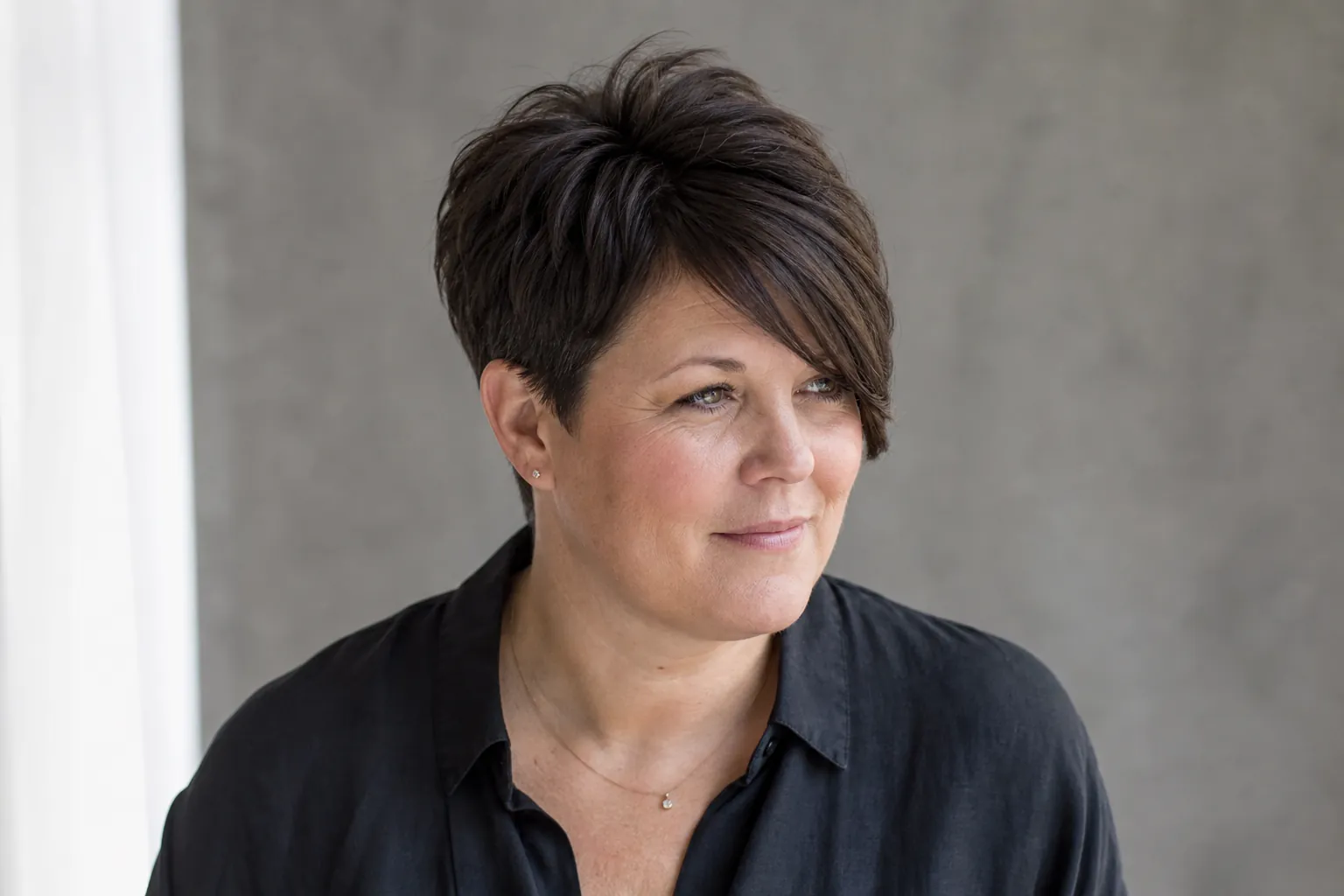
1. Crown-Lifted Pixie with a Long Diagonal Fringe

- Length
- 3-4 in on top, fringe to the cheekbone, sides tapered
- Texture
- Straight to slightly wavy
- Density
- Fine to medium
- Face shapes
- Round, full, square
- Daily effort
- 5-7 minutes
- Trim every
- 4-5 weeks
The reference cut for this face shape. The height comes from a top left longer than the sides, and the diagonal fringe crosses the forehead instead of stopping at the brow. Blow-dry the crown upward first and the fringe second.
Ask for: "About 3.5 inches on top, point cut for lift at the crown. Long fringe angled from the part down to the cheekbone. Scissor-taper the sides and nape, ears half out."
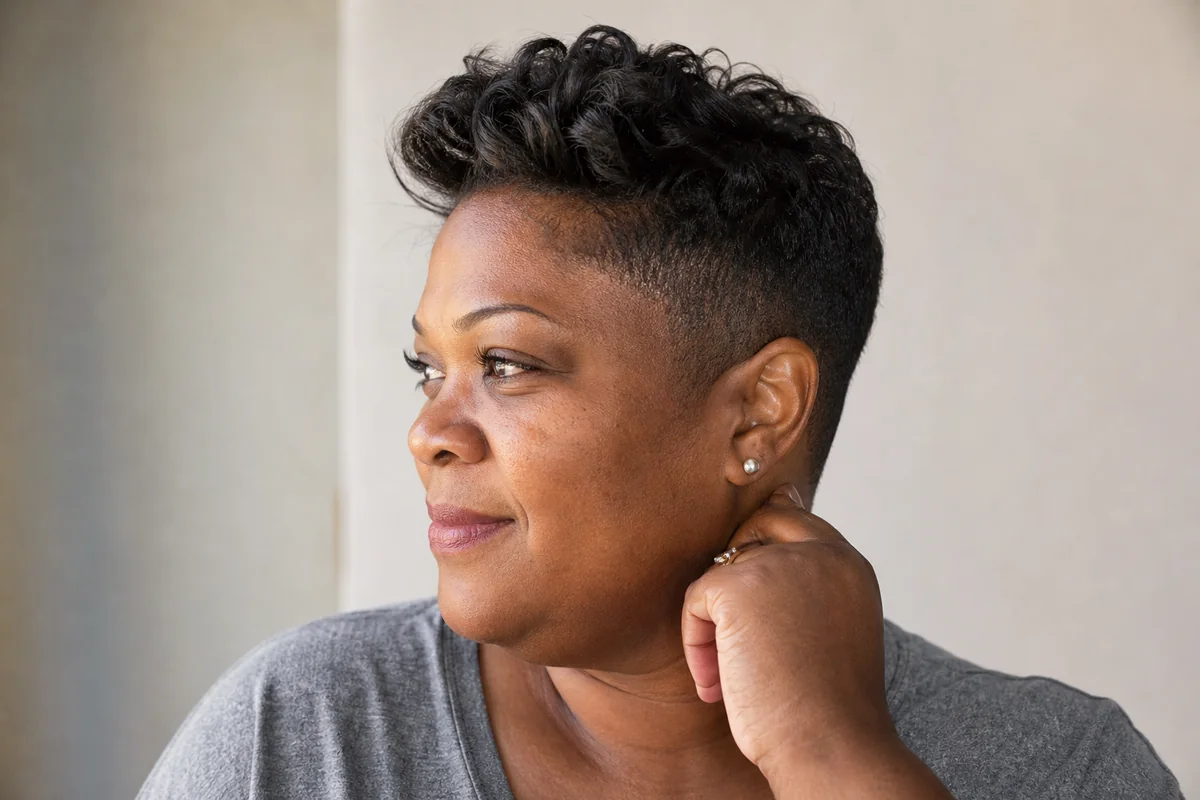
2. Undercut Pixie with a Tall Top and Close Sides
- Length
- 3-3.5 in on top, #2-#3 guard at the sides
- Texture
- Straight to wavy
- Density
- Medium to thick
- Face shapes
- Round, full, oval
- Daily effort
- 5 minutes
- Trim every
- 3-4 weeks for the sides
Thick hair cut short tends to puff outward over the ears, which adds width exactly where a round face has it. Clippering the sides removes that bulk and leaves the top to supply the height. The trade is upkeep, since a number 2 side looks overdue in about three weeks.
Ask for: "A #2 on the sides and nape, blended up to about 3 inches on top. Keep the top textured, not thinned out, and leave the length at the crown."
3. Asymmetric Pixie with One Side Cut Longer

- Length
- 3 in on top, long side to the earlobe, short side above the ear
- Texture
- Straight to wavy
- Density
- Fine to medium
- Face shapes
- Round, full, heart
- Daily effort
- 5-8 minutes
- Trim every
- 4-5 weeks
With one side long and one short, the eye follows the diagonal between them instead of the symmetry of the face. The long side should end at or above the earlobe, because a longer side can fall to the jaw and add a hem on that side. Fine hair keeps the shape best.
Ask for: "Longer on the left, to the earlobe, and short above the right ear. Deep side part, about 3 inches on top, tapered nape."
4. Long Pixie with a Deep Side Part and Tapered Nape

- Length
- 4-5 in on top, sides to the top of the ear, tapered nape
- Texture
- Straight
- Density
- Fine to medium
- Face shapes
- Round, full, long
- Daily effort
- 6-8 minutes
- Trim every
- 5-6 weeks
A long pixie keeps the lift of a short one and adds enough length to sweep across the forehead. The deep part is the main tool: start it above the outer end of the brow and root-lift the hair on the high side. On gray hair that feels coarse, a pea of cream keeps the sweep from springing back.
Ask for: "Four to five inches on top with a deep side part. Sides just covering the top of the ear, nape tapered with scissors, no thinning shears."
Bobs and Lobs That End Below the Jaw
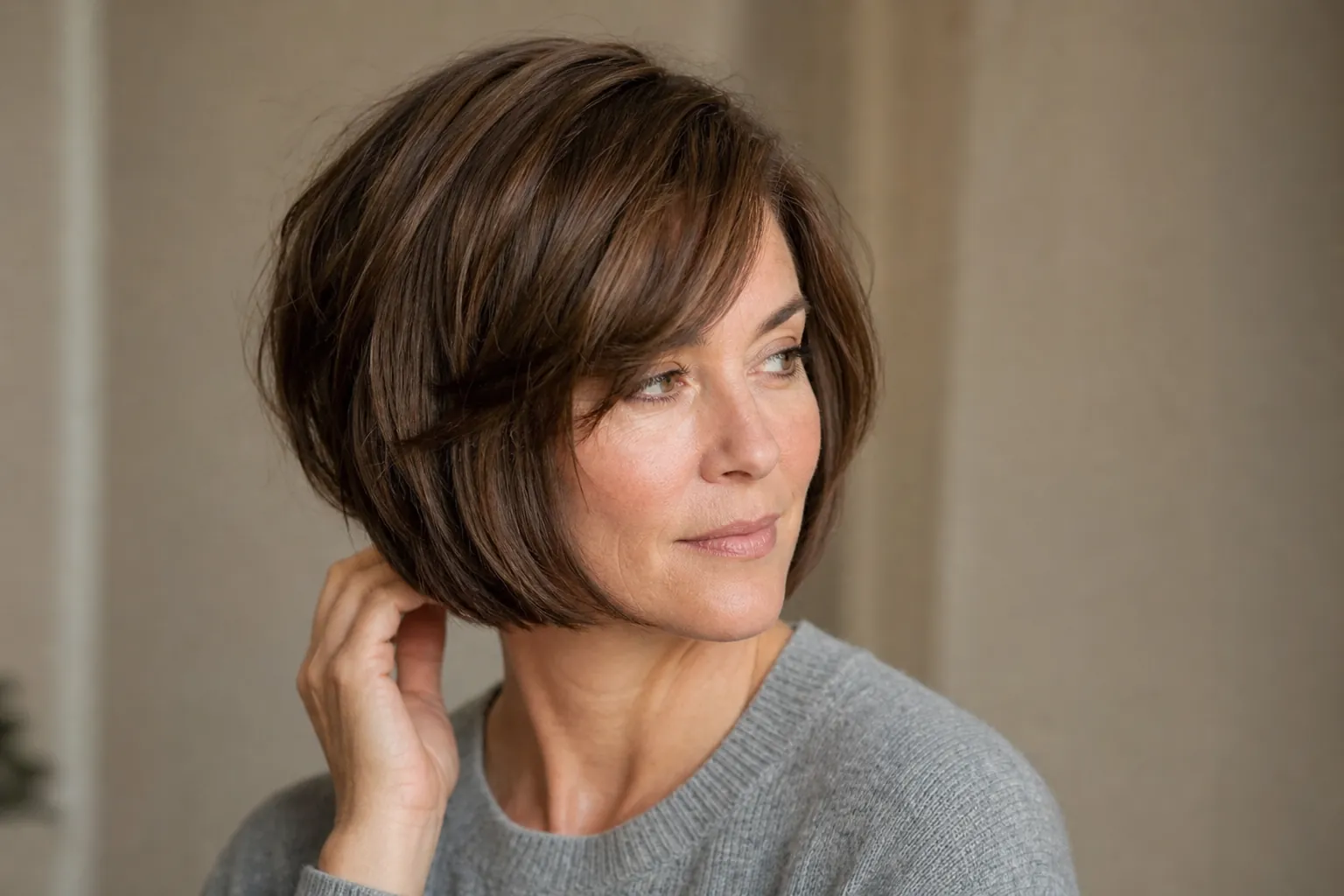
A bob works on a round face when its hem sits a clear inch below the chin or when the cut carries an angle, because the hem is the horizontal line that sets the width. A hem that lands on the cheekbone or the jaw repeats the widest area, and one that lands lower moves that line out of the way. The back can be lifted with graduation, which is explained in the bob guide to angle and stacking.
5. Chin-Length Bob with Crown Lift and a Deep Side Part

- Length
- Hem 1 in below the chin, crown lifted
- Texture
- Straight
- Density
- Fine to medium
- Face shapes
- Round, full, square
- Daily effort
- 10 minutes
- Trim every
- 6-7 weeks
The one-inch drop below the chin is the whole point: a bob that ends at the chin draws its line across the lower face, and one that ends just under it does not. A center part would split the face into two equal halves, so the deep part and the lifted crown do the rest.
Ask for: "A bob ending an inch below my chin, blunt hem, ends turned slightly under. Deep side part and a little extra length at the crown."
6. A-Line Bob Longer in Front, with a Short Stacked Back
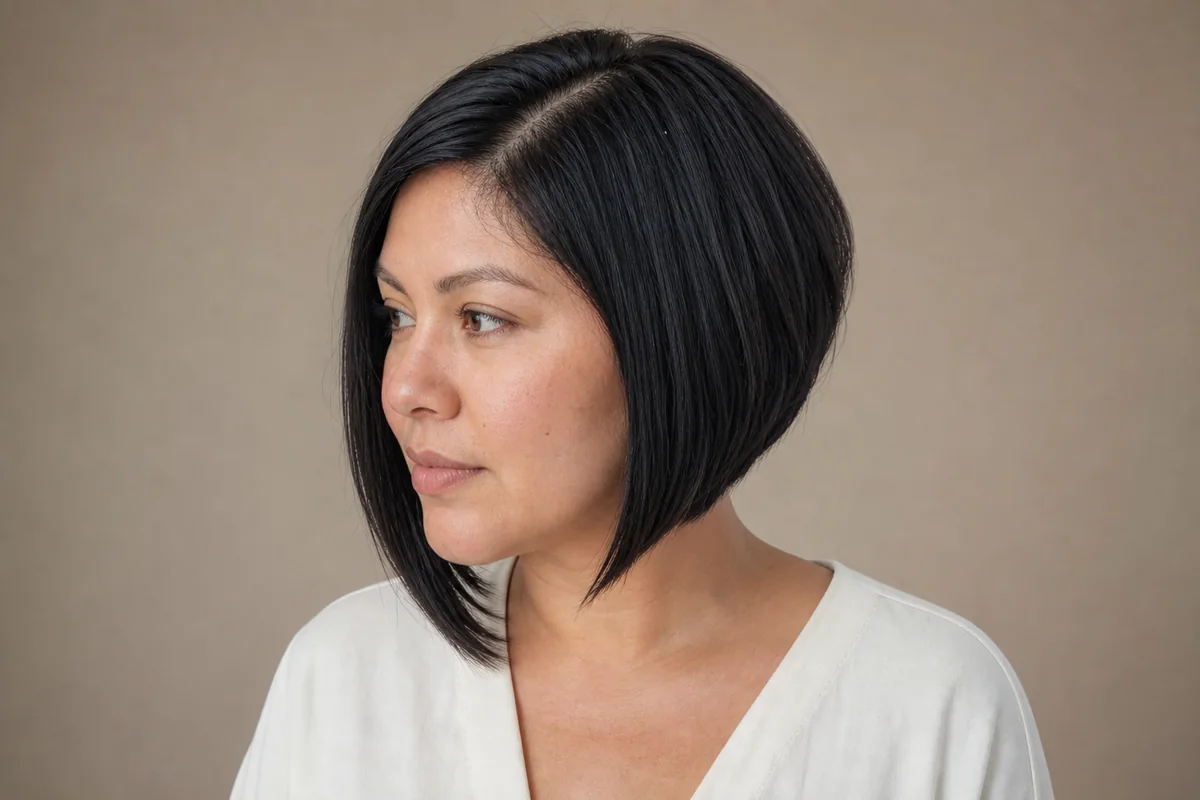
- Length
- Front 2 in below the chin, back at the nape
- Texture
- Straight to wavy
- Density
- Medium to thick
- Face shapes
- Round, full, oval
- Daily effort
- 10-12 minutes
- Trim every
- 5-6 weeks
The angle makes the longest hair frame the face in a diagonal that runs toward the chin, and the stacked back adds height behind the crown. Steep angles grow out unevenly, so choose a gentle one if trims will be six weeks apart. Thick hair needs interior weight removed so the back does not shelf.
Ask for: "A-line bob, front about two inches below the chin, back graduated to the nape with a gentle stack. Remove weight from the inside, keep the hem blunt."
7. Asymmetric Bob, One Side at the Chin and the Other at the Jaw

- Length
- Long side at the chin, short side 1 in higher at the jaw
- Texture
- Straight
- Density
- Medium
- Face shapes
- Round, full, heart
- Daily effort
- 10-15 minutes
- Trim every
- 5-6 weeks
The difference between the sides is small, about an inch, and that is enough. Lines that do not match across the face stop it reading as one wide band. A larger gap needs a steady hand at home, since the longer side tends to flip when it is not dried under.
Ask for: "A bob that is one inch longer on the part side. Chin on the long side, jaw on the short side, blunt edge, no layers underneath."
8. Collarbone Lob with Long Face-Framing Layers

- Length
- Collarbone, layers starting at the chin
- Texture
- Straight to wavy
- Density
- Medium to thick
- Face shapes
- Round, full, square
- Daily effort
- 8-12 minutes
- Trim every
- 8-10 weeks
Past the jaw, the lob hands the hem to the collarbone, well below the widest point. What matters at this length is where the layers begin: starting at the chin, they run in long vertical lines down both sides of the face. Starting at the cheekbone, they add width at the cheeks. More on this length is in the long bob guide.
Ask for: "A lob ending at the collarbone, layers starting at the chin and no shorter, a deep side part. Please check the ends do not flip at my shoulders."
9. Graduated Bob with a Lifted Crown on Fine Hair

- Length
- Back 2-3 in above the front, front just below the chin
- Texture
- Straight
- Density
- Fine
- Face shapes
- Round, full, long
- Daily effort
- 10 minutes
- Trim every
- 6 weeks
Fine hair rarely has enough density to hold a lift, so the lift is built into the cut. Stacking at the back packs shorter layers under the hem, and the crown is left a little longer to carry the height. The front stays solid and below the chin so the face is framed by a line, not by wisps.
Ask for: "A graduated bob with a short stacked back and a solid, blunt front. Crown left a little longer, front just below the chin, no thinning shears."
Shags and Layered Cuts That Keep the Volume on Top
Layers help a round face when they start at the crown and stay off the cheeks, because that moves the volume upward. Layers that begin at the cheekbone and flare out add width exactly where the face has it. The shag and layered cut pages cover the technique, and these looks apply it: a short shag keeps its layers high, and short layered cuts can be built to place or avoid weight.
10. Short Shag with Crown Layers and a Side-Swept Fringe

- Length
- Crown layers 3-4 in, ends at the jaw, fringe to the cheekbone
- Texture
- Wavy to loosely curly
- Density
- Medium
- Face shapes
- Round, full, oval
- Daily effort
- 5-8 minutes
- Trim every
- 6-8 weeks
Crown layers lift the top into a rounded dome and leave the sides lean. The shape holds only while the layers sit high, which is why the sides should be kept long enough to lie smooth against the cheeks. Air-drying with a texture spray gives the broken-up top.
Ask for: "Layers starting at the crown, no shorter than the cheekbone anywhere else. Ends at the jaw, long side-swept fringe to the cheekbone, texture on top."
11. Choppy Layered Cut with Interior Weight Removed on Thick Hair
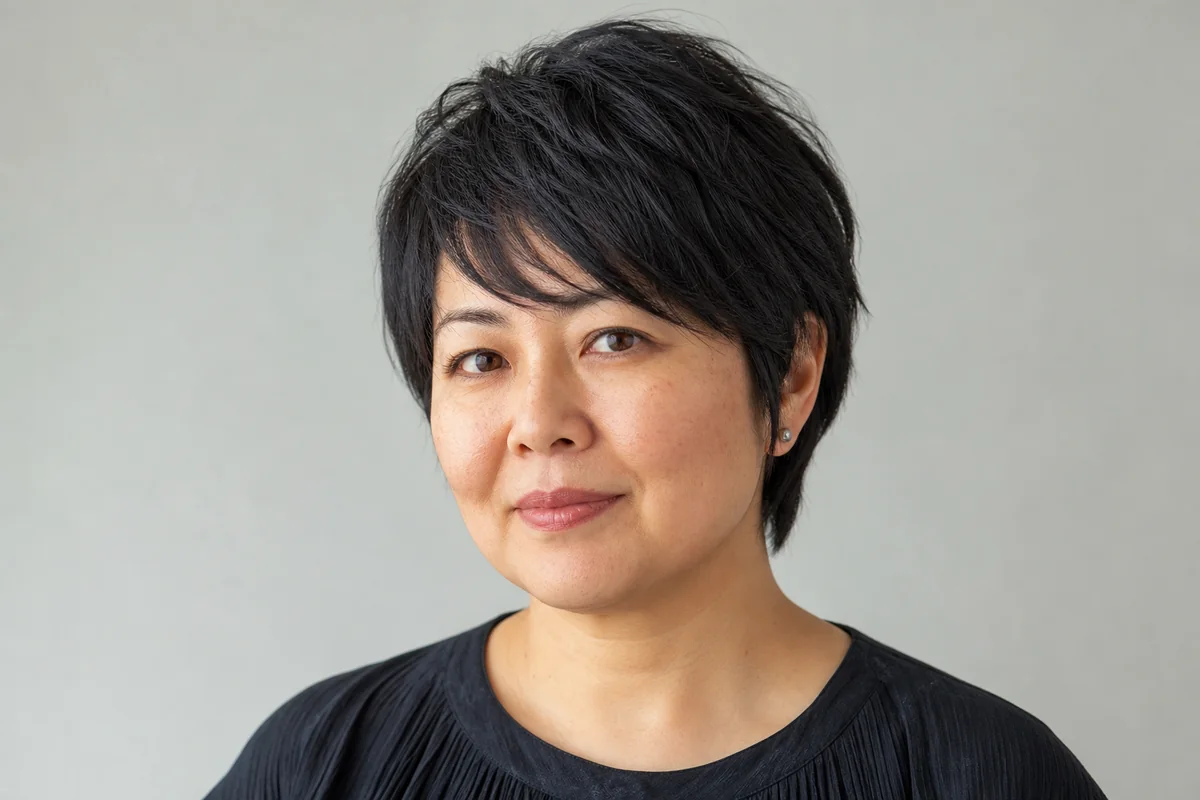
- Length
- 3 in on top, sides close above the ears, back to the nape
- Texture
- Straight
- Density
- Thick
- Face shapes
- Round, full, square
- Daily effort
- 5-8 minutes
- Trim every
- 4-6 weeks
On thick straight hair the usual problem is bulk at the sides, so the stylist takes weight from the inside and keeps the outer layer intact. That leaves the sides smooth and the top free to carry the shape. Without that step, the same cut mushrooms at the cheeks within three weeks.
Ask for: "Remove weight from the interior, point cut the top, keep the sides close above the ears. Fringe swept to the side, nape short and soft."
12. Bixie with a Long Side Fringe and Ear-Length Sides
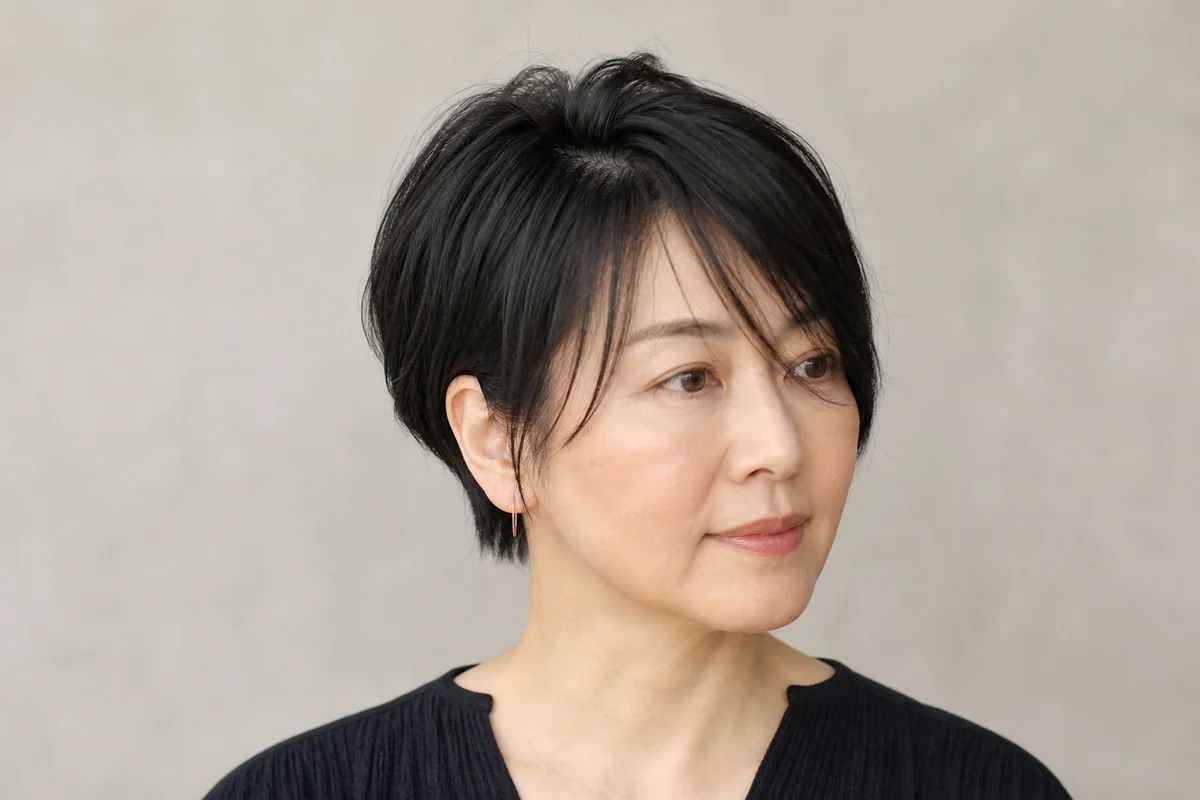
- Length
- 3 in on top, sides to the earlobe, fringe to the cheekbone
- Texture
- Straight to wavy
- Density
- Medium
- Face shapes
- Round, full, heart
- Daily effort
- 6-8 minutes
- Trim every
- 5-7 weeks
The middle length between a pixie and a bob suits those who want some coverage at the ears without a hem at the jaw. The sides end at the earlobe and tuck back, so no line crosses the cheeks. The bixie guide covers the boundaries with a long pixie.
Ask for: "A bixie: sides to the earlobe, tucked behind the ear, short nape, about 3 inches on top with lift at the crown, and a long side fringe to the cheekbone."
Curly and Coily Short Cuts for Round Faces
On curly and coily hair the width comes from volume, so the cut shapes the top taller and the sides tighter instead of relying on a hem. Curls shrink, so these cuts are made longer than they will look and checked dry, as the short curly hair guide explains. A round crown with tapered sides gives the vertical line that straight hair gets from root lift.
13. Curly Pixie with Tapered Sides and a Rounded-Up Top
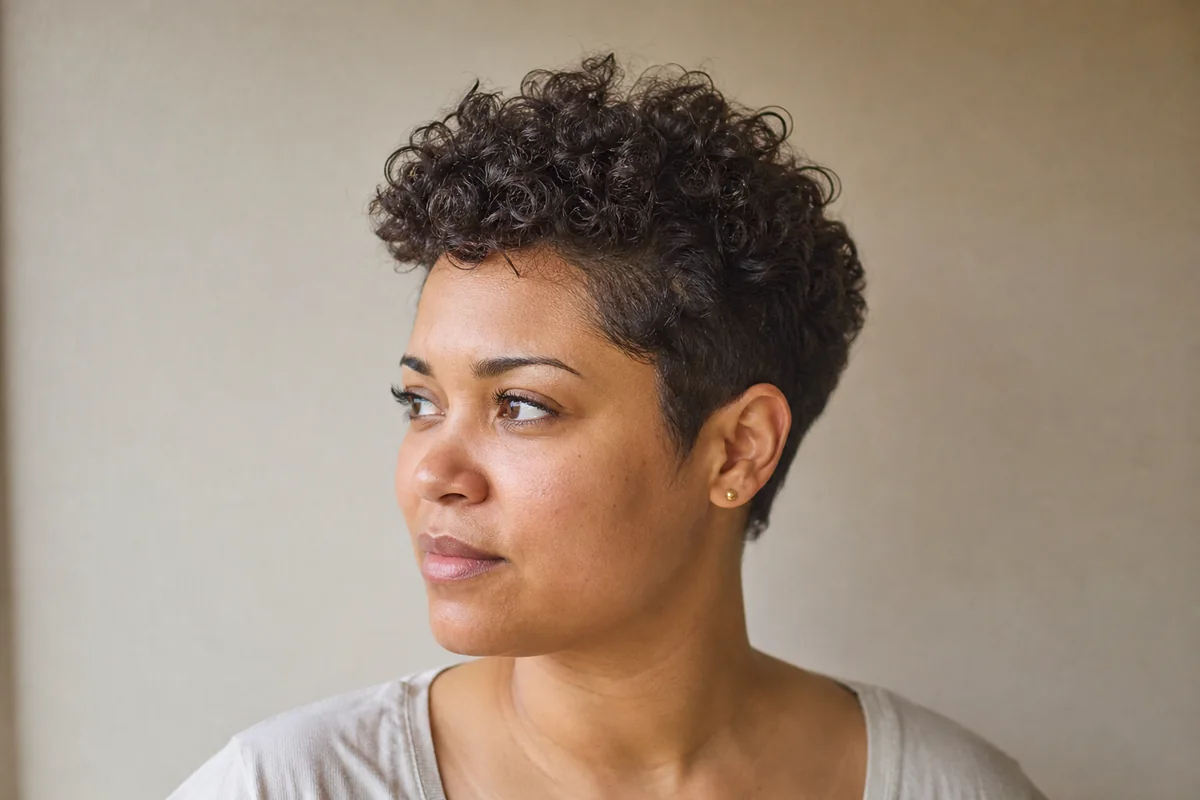
- Length
- 3 in on top (stretched), sides tapered, short nape
- Texture
- Curly, 3B-3C
- Density
- Medium
- Face shapes
- Round, full, oval
- Daily effort
- 5 minutes
- Trim every
- 4-5 weeks
Curls spring upward once the hair is short enough, so a curly top builds its own height. The sides are the part to control: tapering them close to the head stops the curl pattern from widening the outline at the ears. Style on soaking-wet hair and dry with a diffuser.
Ask for: "Cut dry, curl by curl, about three inches on top stretched. Taper the sides and nape with scissors, keep the top rounded, no thinning shears."
14. Curly Bob That Ends Below the Jaw, Shaped Dry
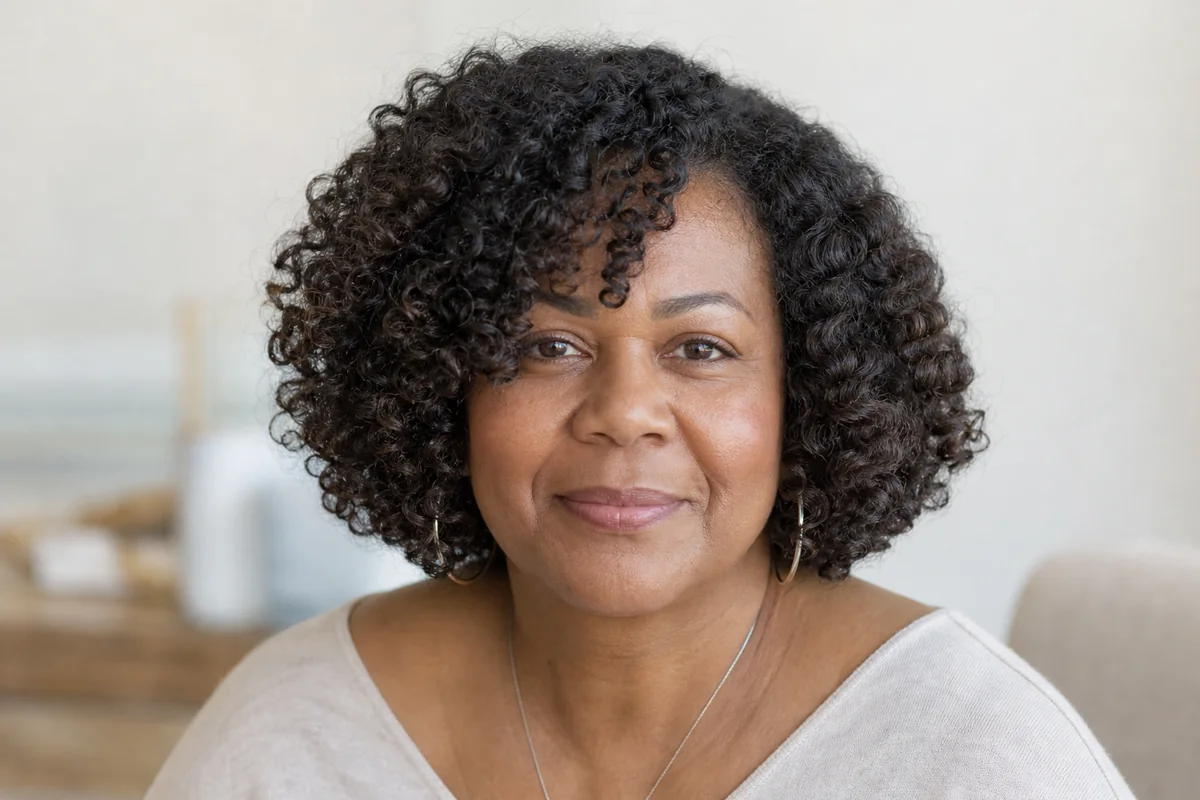
- Length
- Chin when dry, 1-2 in more when stretched; crown layers
- Texture
- Curly to coily, 3C-4A
- Density
- Medium to thick
- Face shapes
- Round, full, square
- Daily effort
- 8-12 minutes
- Trim every
- 6-8 weeks
On curls the width of the hem matters more than its length, and a heavy, wide hem is what widens a round face. Layers that start at the crown move the volume upward and keep the bottom from forming a triangle. Cut dry so the stylist sees where the curls will actually sit.
Ask for: "A curly bob that lands at the chin when dry, cut dry. Layers from the crown, shaped to a rounded outline, with the hem not wider than the cheeks."
15. Tapered Coily Crop with a Rounded-Up Top
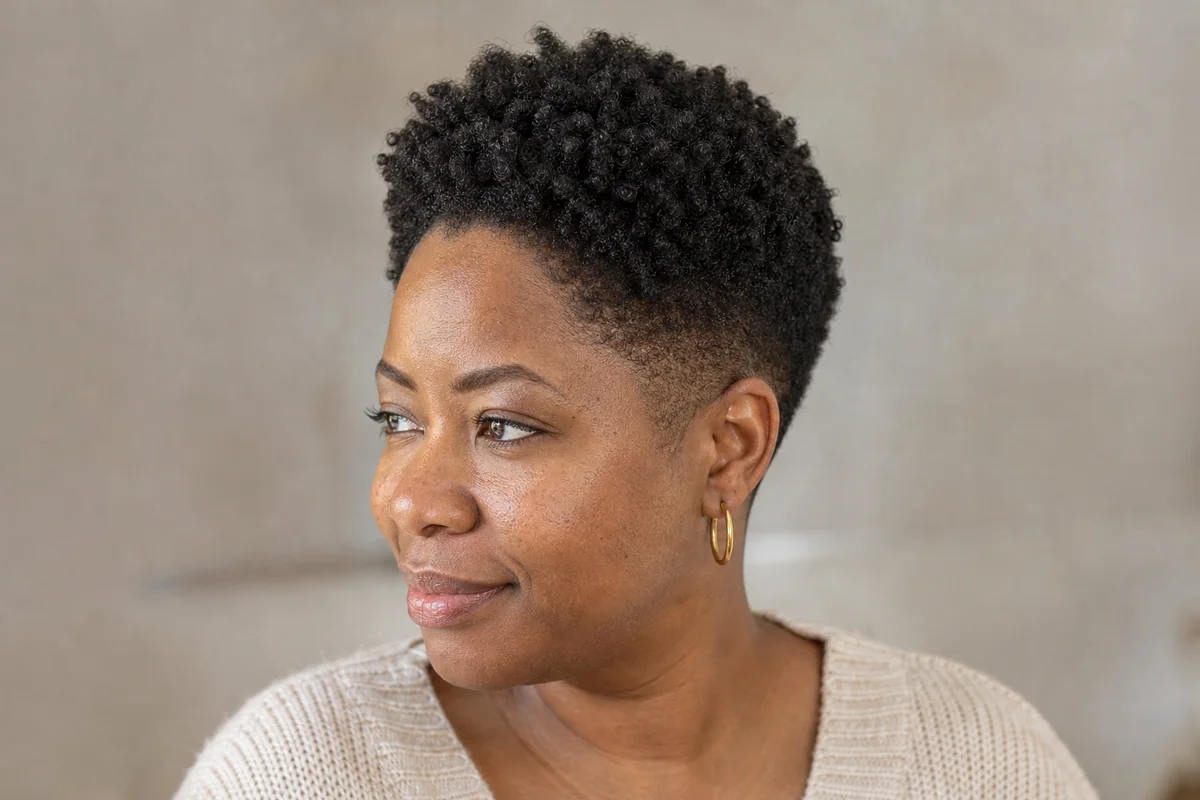
- Length
- 1.5-2 in on top, #2-#3 guard at the sides and nape
- Texture
- Coily, 4A-4C
- Density
- Medium to thick
- Face shapes
- Round, full, oval
- Daily effort
- Under 5 minutes
- Trim every
- 2-4 weeks
The taper does the narrowing work here: sides clipped close and blended up into a top a little longer, so the shape rises from the temples to the crown. A barber or stylist experienced with coily hair will shape the top slightly higher at the crown than at the front.
Ask for: "A tapered crop with a #2 on the sides and nape, blended into about two inches on top. Shape the top a little higher at the crown, and keep the hairline lined softly."
16. Coily Cut with a Cut-In Side Part and a Longer Side
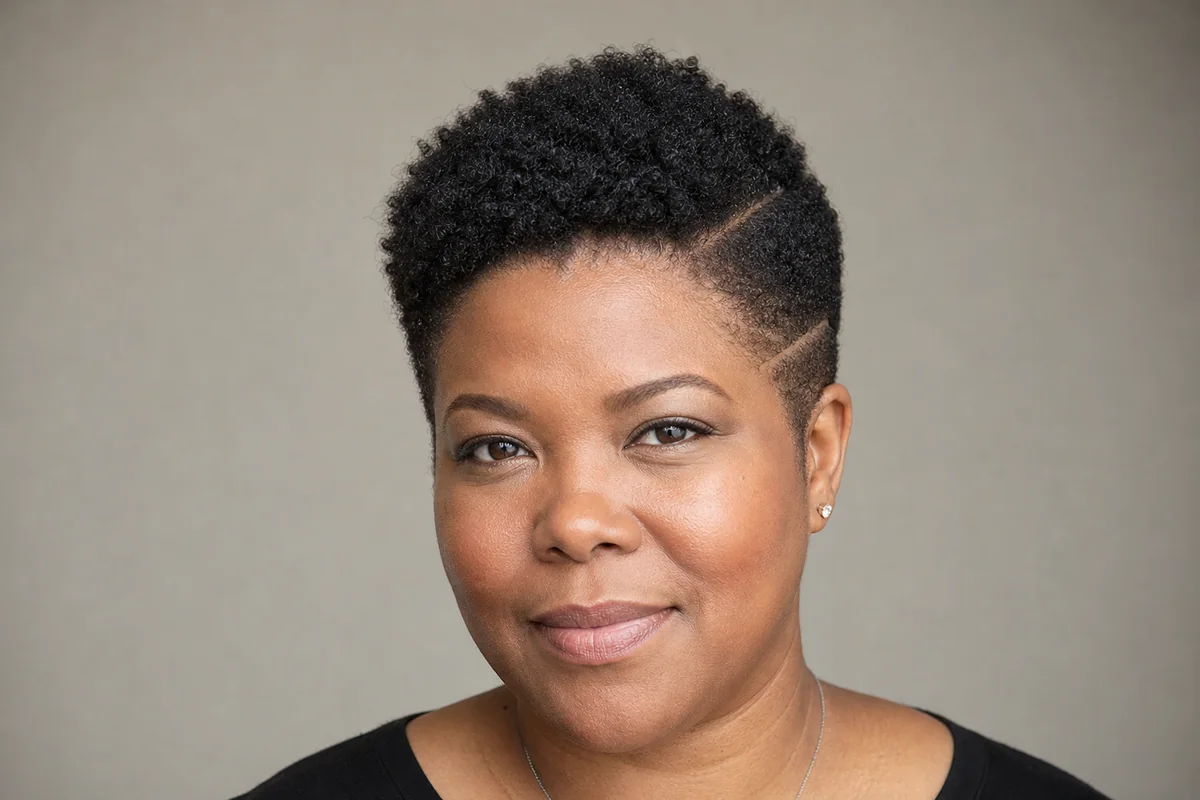
- Length
- 2-2.5 in on top, long side 1 in longer than the tapered side
- Texture
- Coily, 4A-4C
- Density
- Medium
- Face shapes
- Round, full, heart
- Daily effort
- 5 minutes
- Trim every
- 3-4 weeks
A cut-in part puts the diagonal into the hair itself, since coils do not fall into a part the way straight hair does. The longer side adds asymmetry, and the clean line takes a trim every three to four weeks to stay sharp. Plan on a water-based leave-in and a light butter to keep the coils soft.
Ask for: "A shaped crop with a cut-in side part. Leave one side an inch longer, taper the other with a #2, and keep the crown rounded and slightly higher."
Choosing a Short Cut for a Round Face by What You Want to Change
Start with the one thing about the current cut that bothers you, then pick the lever that answers it. A round face does not call for all five at once; a cut with two well-chosen levers reads clearly, and a cut with five tends to look overworked.
| If you want | Choose this feature | Looks to start with |
|---|---|---|
| A taller outline | 3-4 in on top, sides close, root lift | 1, 2, 13 |
| A hem that is not at the cheeks | Hem 1 in or more below the chin, or collarbone | 5, 8, 14 |
| A line that is not symmetrical | Deep side part, one side 1-2 in longer | 3, 7, 16 |
| A fringe that does not sit straight across | Long side-swept or wispy fringe | 1, 10, 12 |
| Less width at the sides of thick hair | Interior weight removed, clippered or tapered sides | 2, 6, 11 |
| More body on fine hair | Stacked back, blunt front, crown left longer | 4, 9 |
| Round curls without a wide hem | Crown layers, tapered sides, cut dry | 13, 14, 15 |
A fringe is the easiest lever to change, and short hair with bangs covers which type fits which forehead and cowlick. A fringe that falls in two soft curtains is its own subject; see curtain bangs on short hair.
How Texture and Density Change Each Lever
Texture and density decide how much of each lever the hair can supply on its own. Fine hair needs the lift built into the cut, thick hair needs weight taken out of the sides, and curls and coils need the shape set dry. For low-density hair, the choices in short hairstyles for thin hair overlap with several looks above.
| Hair | What helps most | What to avoid | Looks |
|---|---|---|---|
| Straight, fine | Blunt hem, stacked back, crown left 1 in longer | Thinning shears, layers that begin at the cheeks | 1, 4, 5, 9 |
| Straight, thick | Interior weight removal, tapered or clippered sides | Full, one-length sides that puff out | 2, 6, 11 |
| Wavy | Crown layers, a hem that does not flip, air-dry texture | Layers short enough to frizz into a wide triangle | 8, 10, 12 |
| Curly, 3A-3C | Dry cut, tapered sides, rounded top | Wet cut one-length hem | 13, 14 |
| Coily, 4A-4C | Taper that rises to the crown, shaped part | Hem wider than the cheeks | 15, 16 |
What to Ask Your Stylist For
Describe the cut by landmarks and inches, and name the line you want, since "something for a round face" can produce a cheekbone hem. Bring a photo of the cut on a face close to yours in shape, and a photo of your own hair dry.
- Give the top length in inches (3-4 on a pixie) and say the crown should stay longer than the sides.
- Give the hem as a landmark: "an inch below the chin" or "at the collarbone", not "chin length".
- Say where the layers should begin: at the crown or the chin, not the cheekbone.
- Choose the part and fringe direction at the chair, with the hair dry.
- For curls and coils, ask for a dry cut and a shape checked from the front, not only the side.
Salon note: Many stylists cut the fringe last, once the part and the crown are set, because a fringe cut early shifts when the rest of the hair is trimmed. Ask to see it dry before the cut ends, and ask for the length to be left a little long.
Styling Short Hair for Height at the Crown
Dry the roots at the crown upward first, then shape the sides flat and the fringe last; the cut supplies the shape, and the dryer supplies the lift that makes it show. The same sequence works on every look above, with curls styled wet and diffused instead. For the wider method, see the face-shape section of the main guide. For the daily routine, see how to style short hair.
- Prep damp hair. Work a golf-ball amount of volumizing mousse or 4-8 sprays of root spray into the roots at the crown only.
- Lift the crown. Dry upward and slightly back with a round brush of 1-1.5 inches or fingers, keeping the dryer 6 inches away and moving.
- Smooth the sides. Direct the dryer down along the sides and over the ears so they stay flat.
- Set the fringe. Dry it diagonally, away from the part, with a pea of cream or a few sprays of texture spray.
- Finish at the top. A pea of paste or clay on the tips of the crown holds the height.
Curly and coily short hair is styled on soaking-wet hair with leave-in and gel raked through, then diffused or air-dried; once dry, a pick or fingers lift the crown. Keep hot tools near 300-350°F on fine, gray or lightened hair.
Maintenance and Grow-Out for Round-Face Cuts
The cuts that depend most on a clean line need the most trims: tapered and clippered sides, asymmetry and fringes go soft first, while a lob or a layered cut tolerates 8-10 weeks. Growing a cut out is easier when the crown and the sides grow together, and low-maintenance short haircuts compares the options by daily minutes and weeks between visits.
| Cut | Trim every | Daily minutes | How it grows out |
|---|---|---|---|
| Undercut or clippered pixie | 3-4 weeks | 5 | Sides fill in over the ears by week 5; keep the top |
| Long pixie, asymmetric pixie | 4-6 weeks | 5-8 | Becomes a bixie in 4-6 months with the nape tapered |
| Chin bob, A-line, asymmetric bob | 5-7 weeks | 10-15 | Keeps its line until week 7; angle goes first |
| Collarbone lob, shag, layered | 6-10 weeks | 5-12 | Layers soften; remove bulk at each trim |
| Curly bob or crop | 4-8 weeks | 5-12 | Hem widens first; reshape the outline |
| Tapered coily crop | 2-4 weeks | Under 5 | Taper softens by week 3 |
When These Conventions Do Not Apply
The advice above describes what stylists usually do, not what a round face needs, and plenty of round faces wear a cheekbone bob or a cropped pixie well. Treat each of these as a default you can set aside.
Myth: a round face must avoid short hair
Reality: Short hair shows the whole face, and many round faces wear it well. The question is where the cut ends and where the volume sits, not whether the hair is short.
Myth: a haircut can change your face shape
Reality: A cut changes the frame, not the face. Height, a diagonal or a lower hem change the proportions of the outline; the face stays the same and so does the person wearing it.
Myth: every round face needs a side part
Reality: A deep part adds asymmetry, but a center part suits a lifted crown with a sleek hem, and a fringe can replace the part entirely. Choose the part that lies down naturally, since hair forced the other way flops back.
- Thick straight hair that you want very short with no taper. It puffs at the sides and adds width; choose the undercut pixie or an interior-weighted cut with close sides, or a longer cut with the weight removed.
- Fine, flat hair with no time for root styling. The crown height disappears by midday; choose a cut built with stacking or a shorter top that stands on its own, such as look 4 or look 9.
- A cowlick at the crown. Height cannot be forced there; leave 3 inches or more so it lies down, or cut it very short, then build the lift beside it. A stylist should check it dry before cutting.
- Glasses with wide, heavy frames. Sides that cover the ears are pushed outward by the arms and add width; keep the sides close, ears partly out, and see short haircuts for women over 60 for glasses-friendly cuts.
The best short haircuts for round faces put height at the crown, keep the sides close, and end the hem or fringe on a diagonal or below the widest point. Choose the one lever that matters most to you, bring a photo and a landmark such as "an inch below the chin", and book the first trim for 4-6 weeks out.