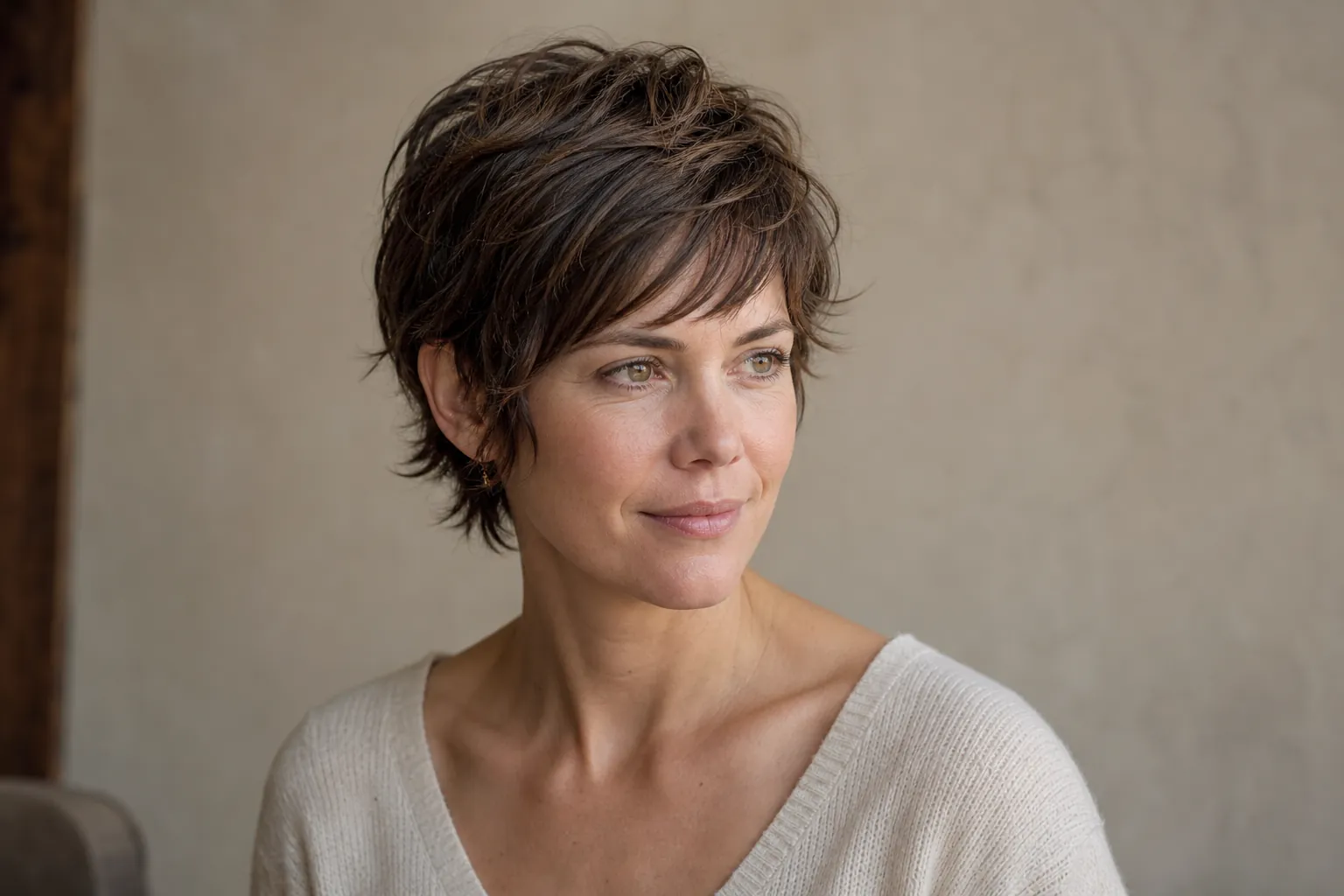
Short version: The short haircuts for women over 60 that work best are a tapered pixie with 2.5-3 inches on top, a blunt chin-length bob, and a soft graduated bob or short shag, because each keeps weight and length where hair has become finer, sparser or wirier. Choose by what your hair is doing now: strand texture, density and the crown matter more than a number. Expect a trim every 4-6 weeks for a pixie, 6-8 for a bob, and 5-10 minutes of styling.
What Changes in Gray and Thinner Hair
Around 60, hair usually changes in three ways that affect a cut: strands turn gray or white, the head carries fewer and finer strands, and texture shifts. None of this is universal, and none of it makes a short cut wrong. It does change which short cut is easiest to live with, and it explains why advice for fine hair in one's twenties does not carry over. The wider range of lengths is in our guide to short haircuts for women; this page sorts the options by what has changed. The decade before has its own page, short hairstyles for women over 50.
The science is specific and limited. In lab tests, non-pigmented (gray or white) fibers showed more waviness and a larger diameter than pigmented ones, and gray-rich hair held more volume as a mass, which is one reason gray strands can look unruly. White fibers also had less lipid in the cuticle and a lower capacity to take up water than brown fibers in a separate fiber study, which may help explain why gray hair often feels drier.
Density moves in the other direction. In a study of Caucasian women, a combined measure of density and shaft diameter fell with age, and thinning became more noticeable from the mid-40s to the late 50s. A review of menopause and hair found that menopausal status influenced growth rate, the share of hairs in the growth phase and shaft diameter, mostly at the frontal scalp, while density fell with age whether or not a woman had reached menopause.
| What you may notice | What it means for the cut | Looks that address it |
|---|---|---|
| Wiry or wavier gray strands that stand away from the head | Leave 2.5-3 in on top and soften the ends by point cutting so the weight lies down | 1, 4, 8 |
| Fewer strands overall (lower density) | A solid, blunt edge or a short cut that concentrates the hair; no thinned ends | 2, 5, 7 |
| Thin crown or a widening part | Extra length at the crown, a side part, no clippered crown | 5, 9, 16 |
| Flat back of the head | Graduation at the back to build shape | 8, 10 |
| Curls that have loosened, tightened or changed pattern | Cut dry, curl by curl, longer than the target | 15, 16 |
| Glasses that push hair out at the ears | Sides tapered or cut to end at the arms; fringe above the frame | 3, 6 |
Pixies and Crops for Silver, Fine and Thinning Hair
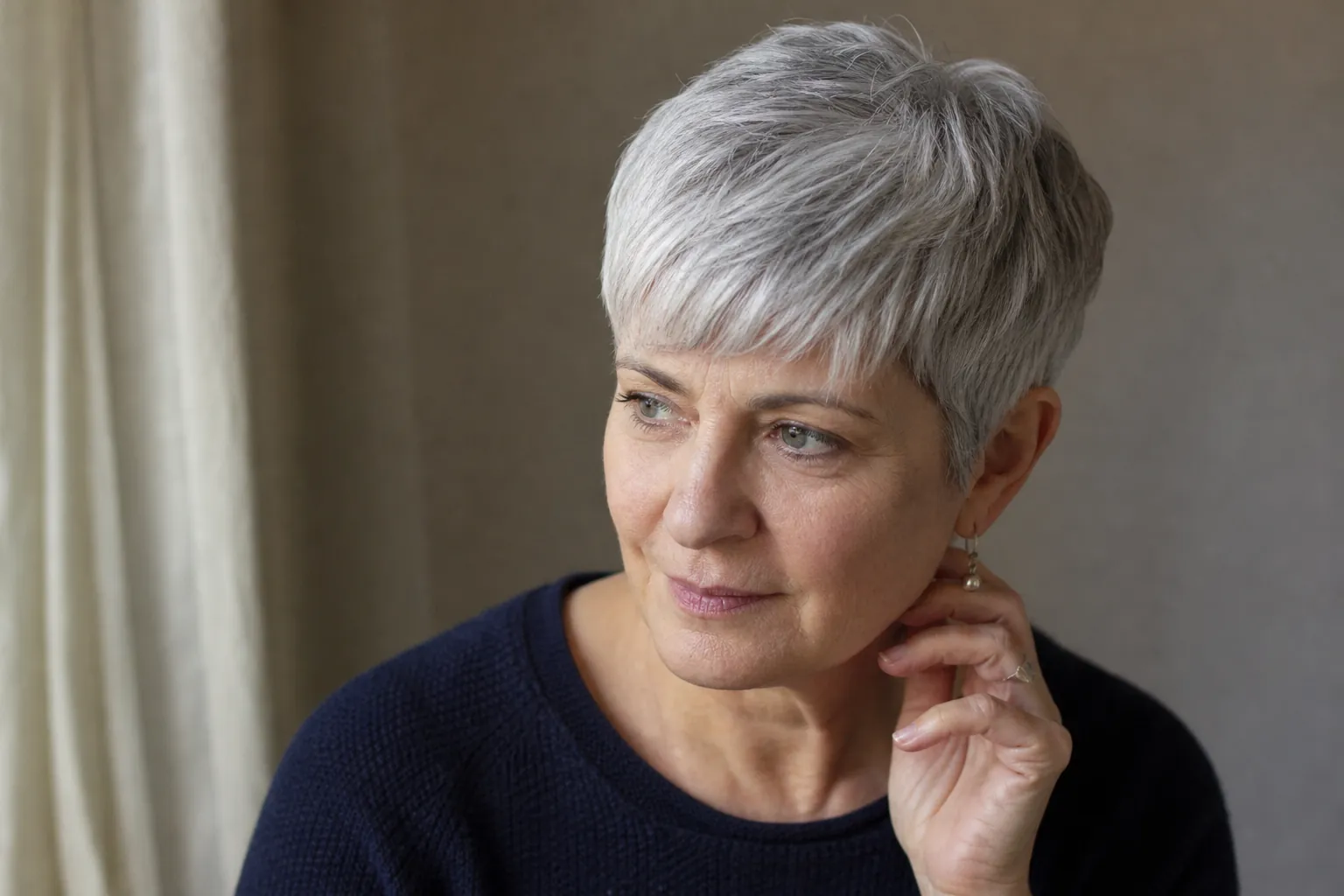
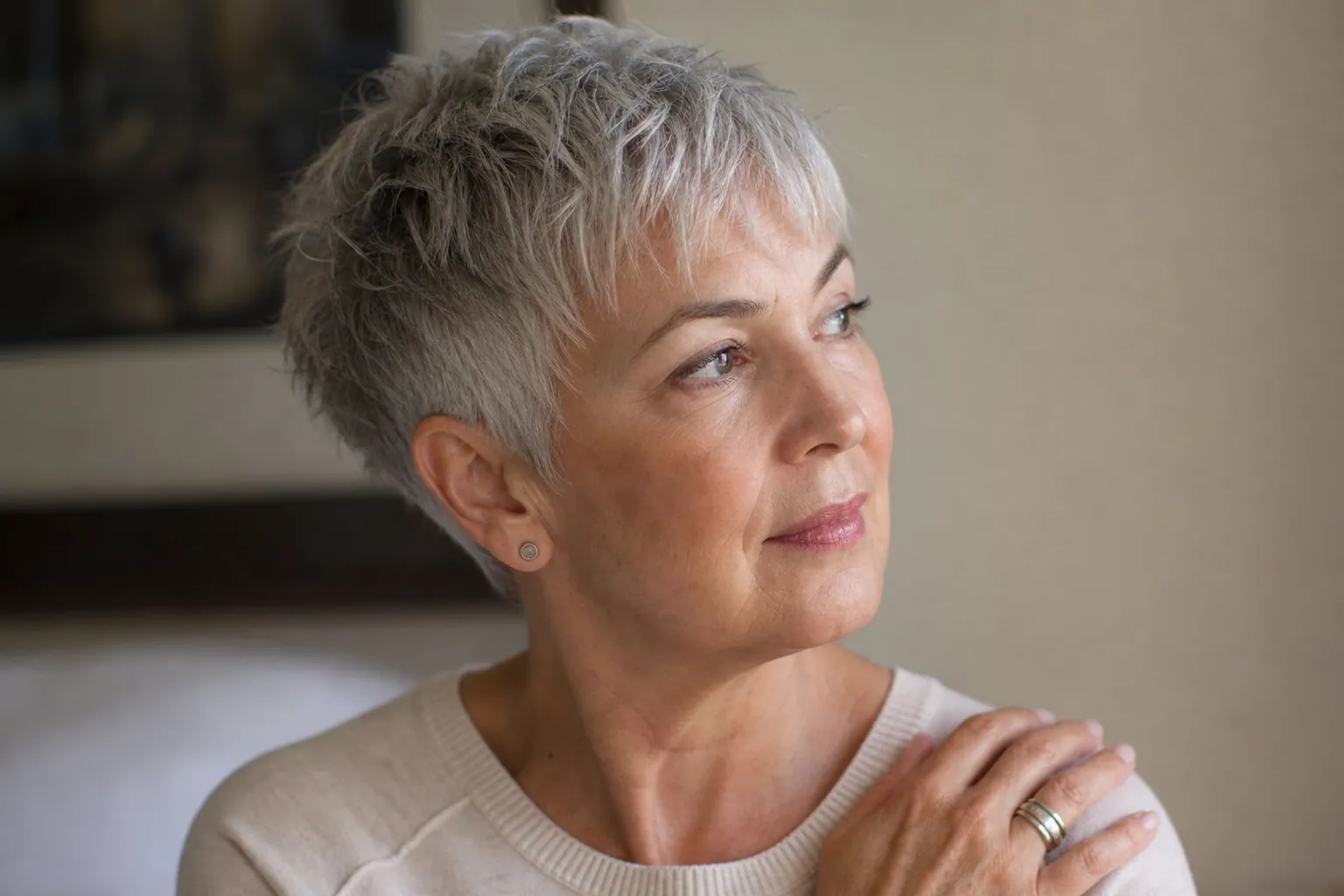
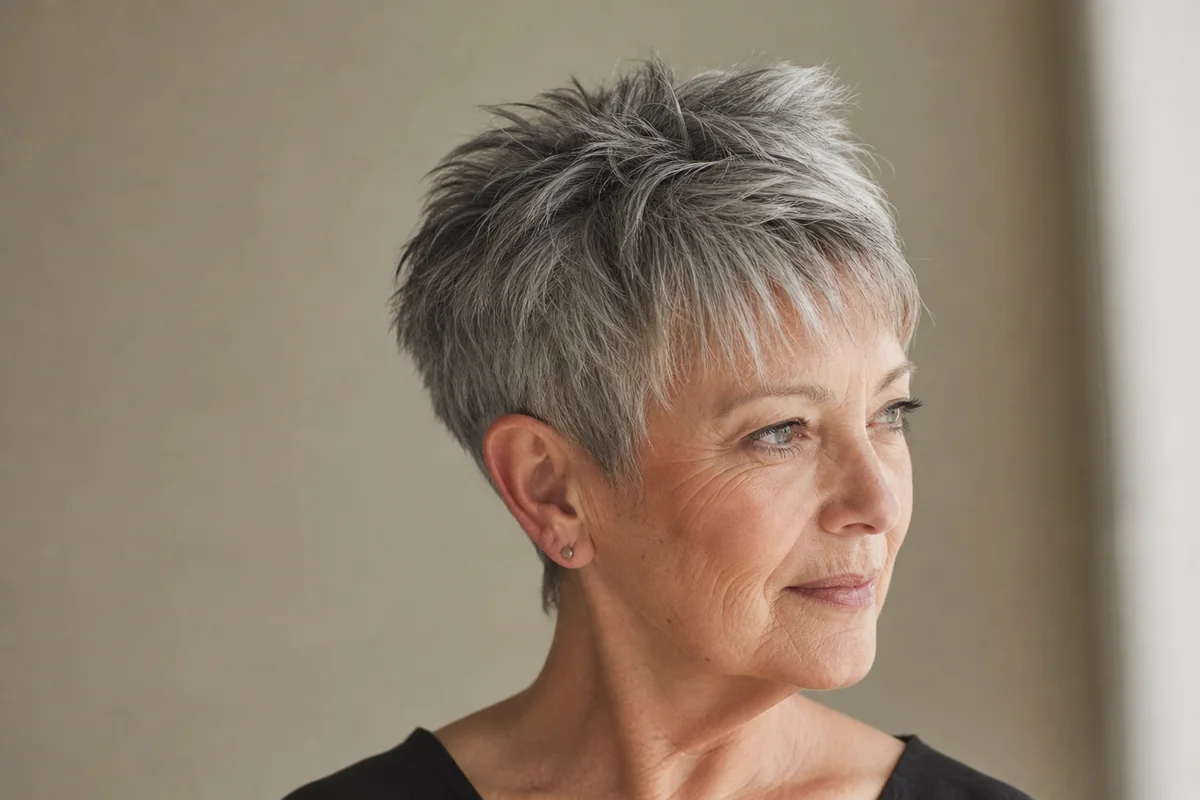
A pixie works after 60 when the top is long enough to lie down and the sides are short enough to stay neat: about 2.5-3 inches on top, with sides and nape tapered by scissors or clippers. Shorter than 2 inches, wiry gray hair stands straight up, and very fine hair can show scalp. The nape does most of the maintenance work, as the nape options in our pixie guide explain.
1. Tapered Silver Pixie with a Longer Top
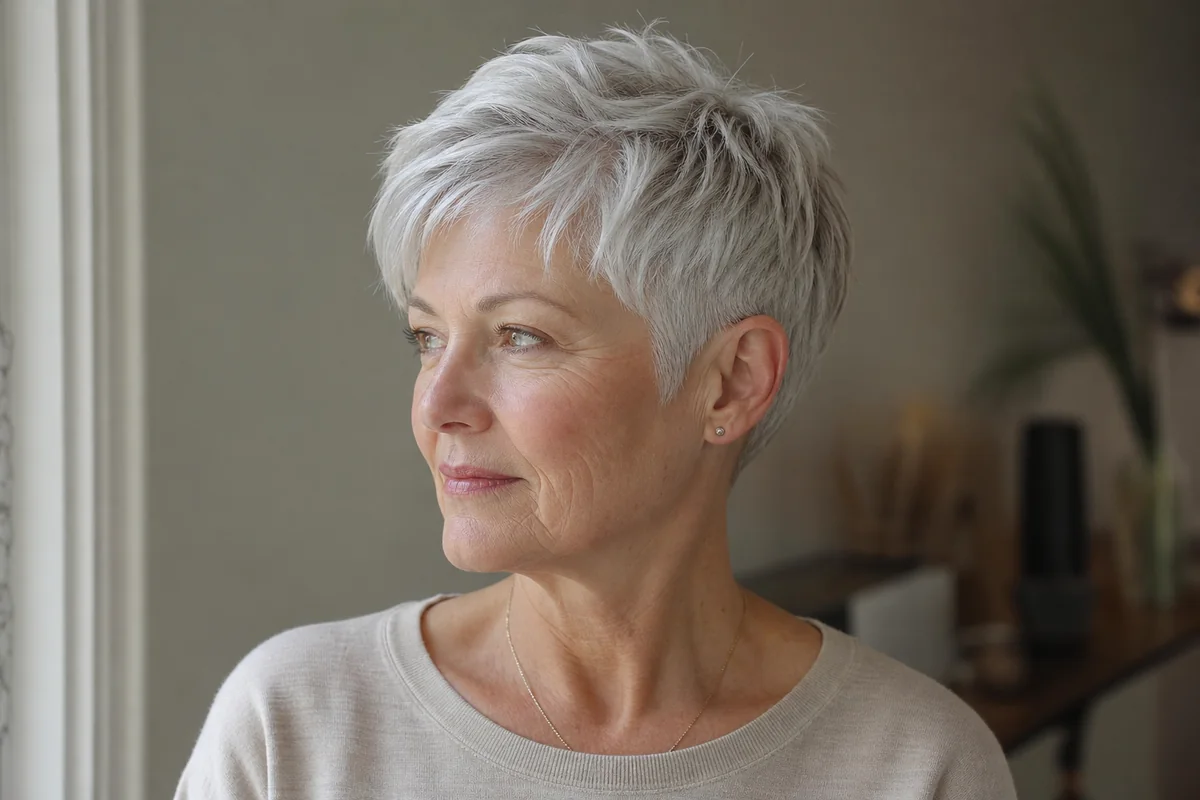
- Length
- 2.5-3 in on top, tapered sides and nape
- Texture
- Straight to wavy, including wiry gray
- Density
- Fine to medium
- Face shapes
- Oval, heart, long, diamond
- Daily effort
- 5 minutes
- Trim every
- 4-6 weeks
Gray that has turned wiry bristles when it is cut very short, so this version keeps enough length for the weight of the hair to settle. Point cutting breaks the ends into a soft edge without thinning the interior, and a fingertip of paste or cream is enough to direct it.
Ask for: "About 3 inches on top, point cut, not thinned. Scissor-taper the sides and nape, and leave the ears half covered."
2. Soft Pixie with a Side-Swept Fringe on Fine Hair
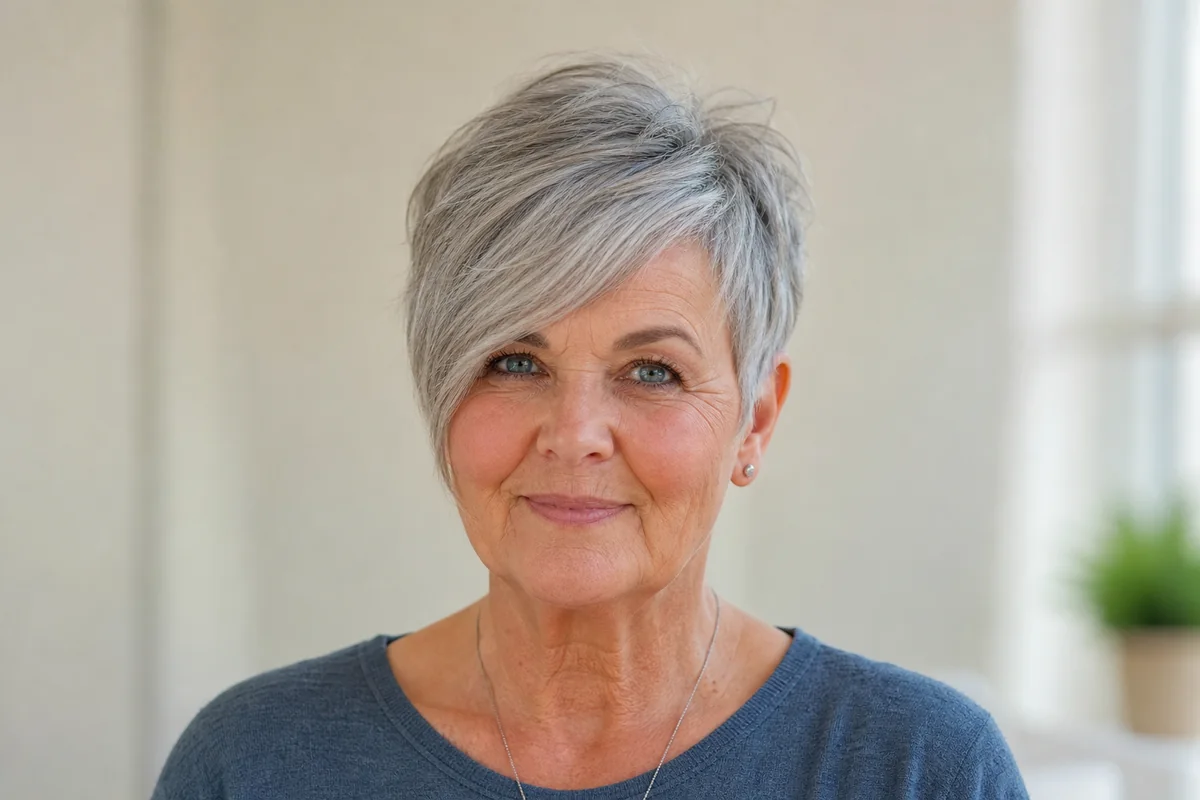
- Length
- 2.5 in on top, fringe to cheekbone
- Texture
- Straight
- Density
- Fine, low to medium
- Face shapes
- Round, square, oval
- Daily effort
- 5 minutes
- Trim every
- 4-5 weeks
On a round or square face, a fringe swept on a diagonal breaks up the width at the cheeks, while keeping the sides close to the head leaves nothing to widen it. The fringe also puts the densest-looking hair at the front, where fine hair tends to look thinnest.
Ask for: "A long side fringe ending at the cheekbone, cut blunt through the ends rather than razored. Keep the sides short and tapered."
3. Short Crop with a Clippered Nape
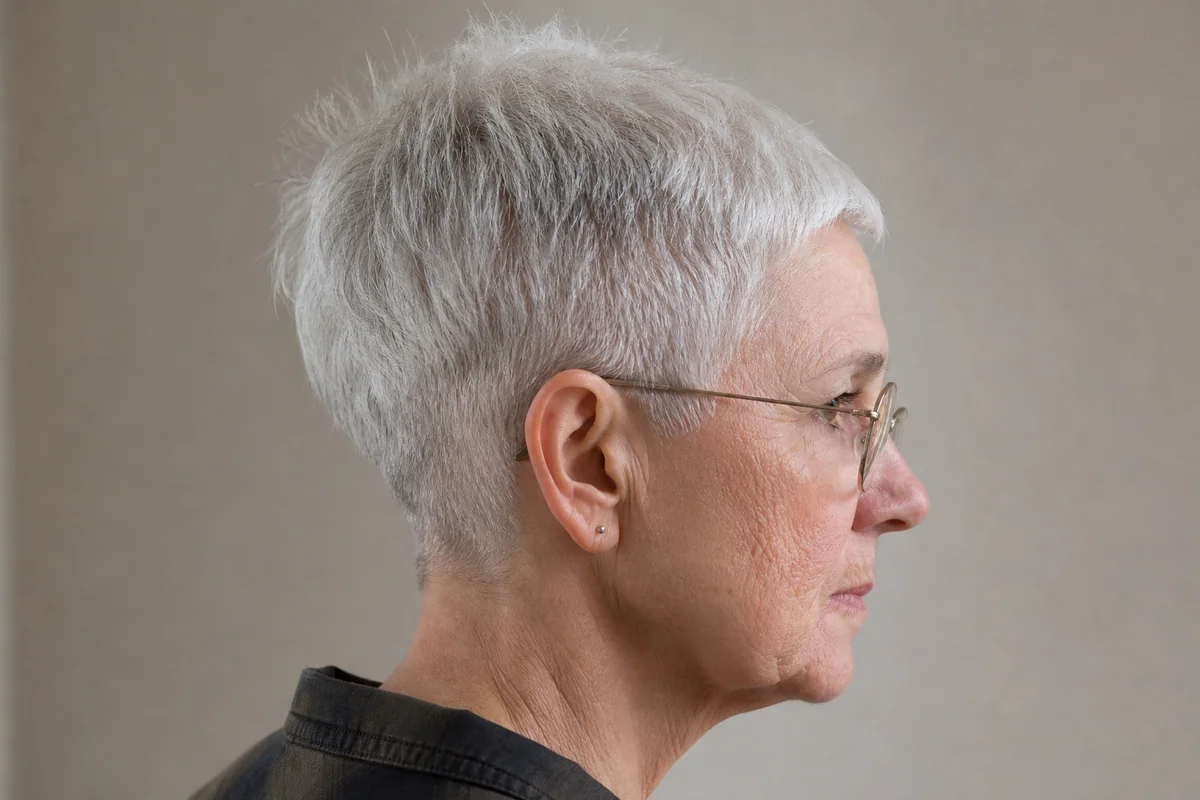
- Length
- 1-1.5 in on top, #2 guard at the nape
- Texture
- Straight
- Density
- Medium to thick
- Face shapes
- Oval, long, heart
- Daily effort
- 2-3 minutes
- Trim every
- 3-4 weeks, cleanups at 2-3
This is the quickest routine on the page and the one that asks most of the calendar. It also exposes the scalp, so it suits medium to thick hair; on sparse hair the closeness can read as thinner than the same hair at 2.5 inches. A clean ear outline also sits neatly around the arms of glasses.
Ask for: "An inch on top, point cut. Clipper the nape with a #2 blended up, and clean the outline around both ears."
4. Textured Pixie for Thick, Coarse Gray Hair
- Length
- 3 in on top, short tapered sides
- Texture
- Straight to wavy, coarse
- Density
- Medium to thick
- Face shapes
- Oval, heart, square
- Daily effort
- 5-8 minutes
- Trim every
- 4-5 weeks
Thick, stiff gray hair is where a pixie turns into a helmet unless weight is removed from the inside. Slide cutting or point cutting through the interior lets the top move; the razored version is in the shaggy pixie gallery, and it suits coarse hair better than soft, fine strands.
Ask for: "Remove weight from the inside with point or slide cutting, leave 3 inches on top, and taper the sides so nothing flares over the ears."
5. Pixie with Extra Length at the Crown

- Length
- 3-3.5 in at the crown, sides shorter
- Texture
- Straight to wavy
- Density
- Low, with a thin crown or part
- Face shapes
- Oval, round, long
- Daily effort
- 5-7 minutes
- Trim every
- 5-6 weeks
The crown is the one area where the cut should stay longer than the rest. Length there can be lifted and directed across a thin spot, while a close crown lets the scalp show; the sides carry the shortness instead. A side part covers a widening center line better than a center part does.
Ask for: "Leave the crown 3 to 3.5 inches, shorter at the sides and nape, and set a side part. No thinning shears anywhere."
Bixies and Bobs: A Solid Hem for Fine Hair, Softness for Coarse Gray
Bobs reward fine hair with a solid edge and coarse gray hair with softness, which is the reverse of what most layered cuts do. Blunt ends make sparse hair look thicker; soft, point-cut ends stop stiff gray hair from jutting. The full technique, including how steep an angle to ask for, is in our bob gallery.
6. Feathered Bixie That Sits Clear of Glasses
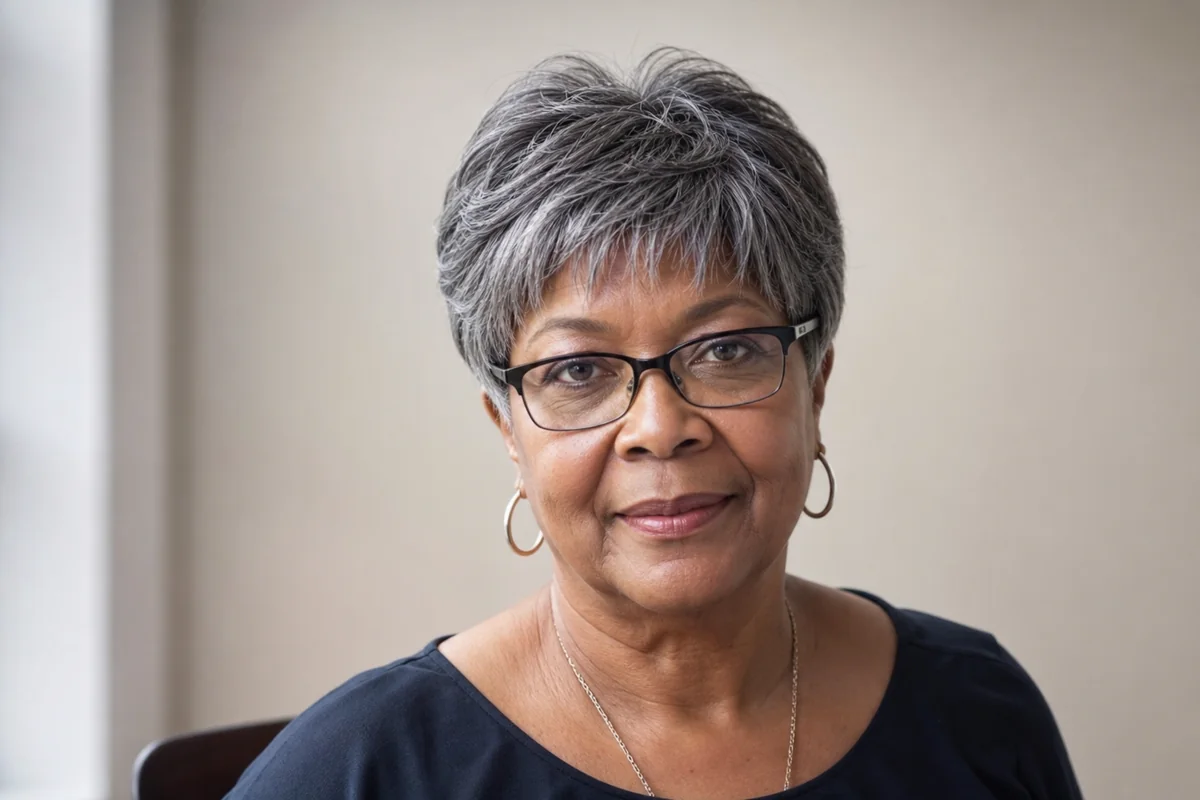
- Length
- Sides at the ear, fringe above frames, short back
- Texture
- Straight to wavy
- Density
- Fine to medium
- Face shapes
- Oval, round, heart
- Daily effort
- 5-8 minutes
- Trim every
- 5-7 weeks
Frames create two collisions: arms push the sides out, and bangs brush the lenses. Cutting the sides to end at the arm line, instead of over it, and stopping the fringe just above the top of the frame solves both. The longer-sided bixie is explained in our bixie guide.
Ask for: "I will bring my glasses. Sides cut to end at the arms, fringe above the top edge of the frame, back kept short and tapered."
7. Blunt Chin-Length Bob for Fine Hair
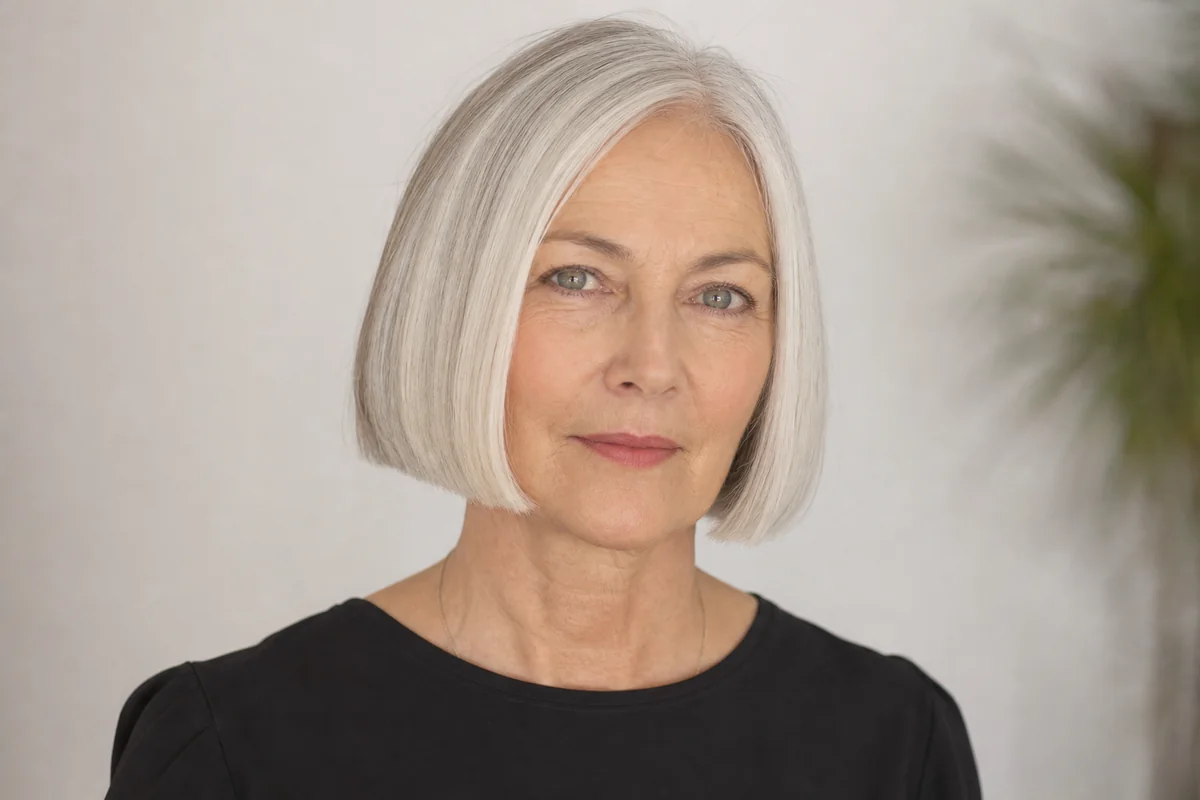
- Length
- Chin, one length
- Texture
- Straight
- Density
- Fine, low to medium
- Face shapes
- Oval, heart, long
- Daily effort
- 8-12 minutes
- Trim every
- 6-8 weeks
A single-length hem makes fine hair look denser, because every strand ends at the same line instead of tapering away. Layers beneath remove the little weight there is, so this cut gets any layering only on top, near the crown.
Ask for: "A blunt chin-length bob, cut dry-checked at the hem, with no layers underneath and a few short ones at the crown if it needs lift."
8. Soft Graduated Bob with a Short Nape
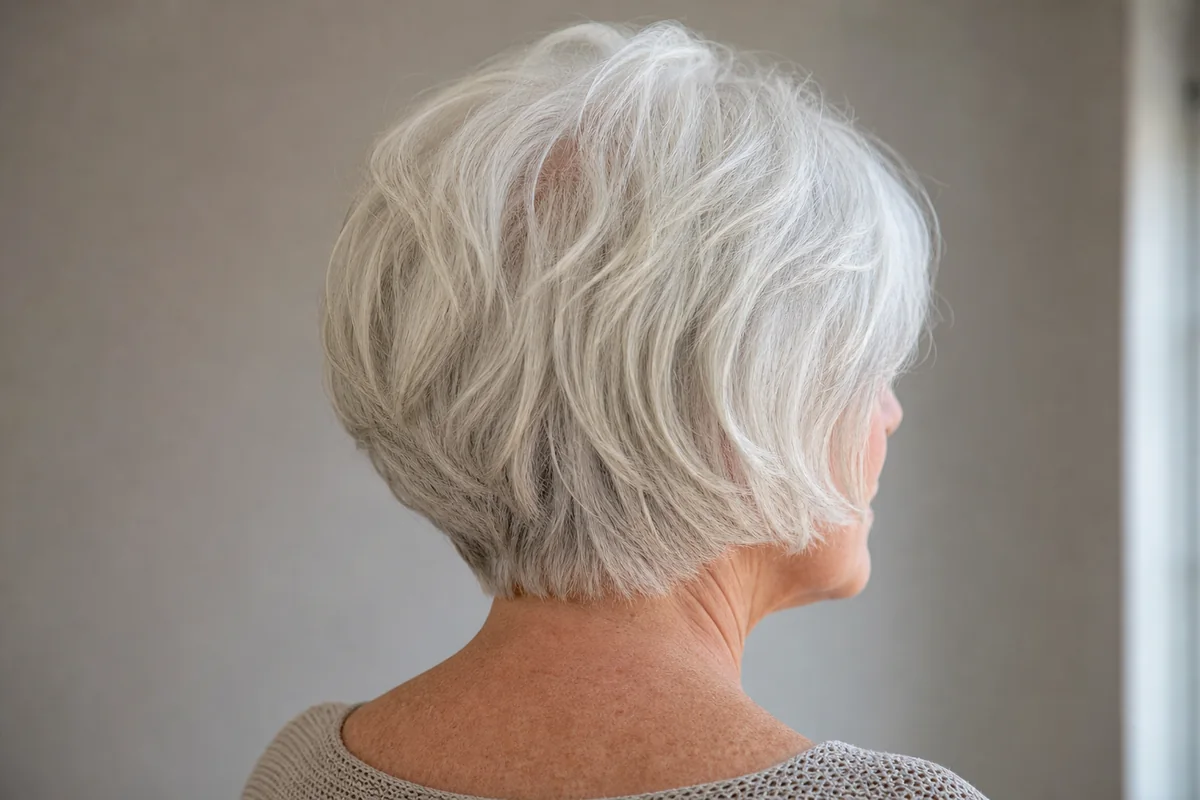
- Length
- Jaw at the front, 1-2 in shorter at the back
- Texture
- Straight to wavy, coarse
- Density
- Medium
- Face shapes
- Oval, heart, round
- Daily effort
- 8-10 minutes
- Trim every
- 6-8 weeks
Graduation stacks short layers at the back so the shape builds on a head that has gone flat there. On coarse gray, keep it to a low angle, about 45 degrees or less, since a steep stack will jut; the angle explanation in the bob guide covers the trade.
Ask for: "A low graduation at the back, nape about an inch shorter than the front, point-cut ends and a soft jaw-length hem."
9. Angled Bob with a Deep Side Part
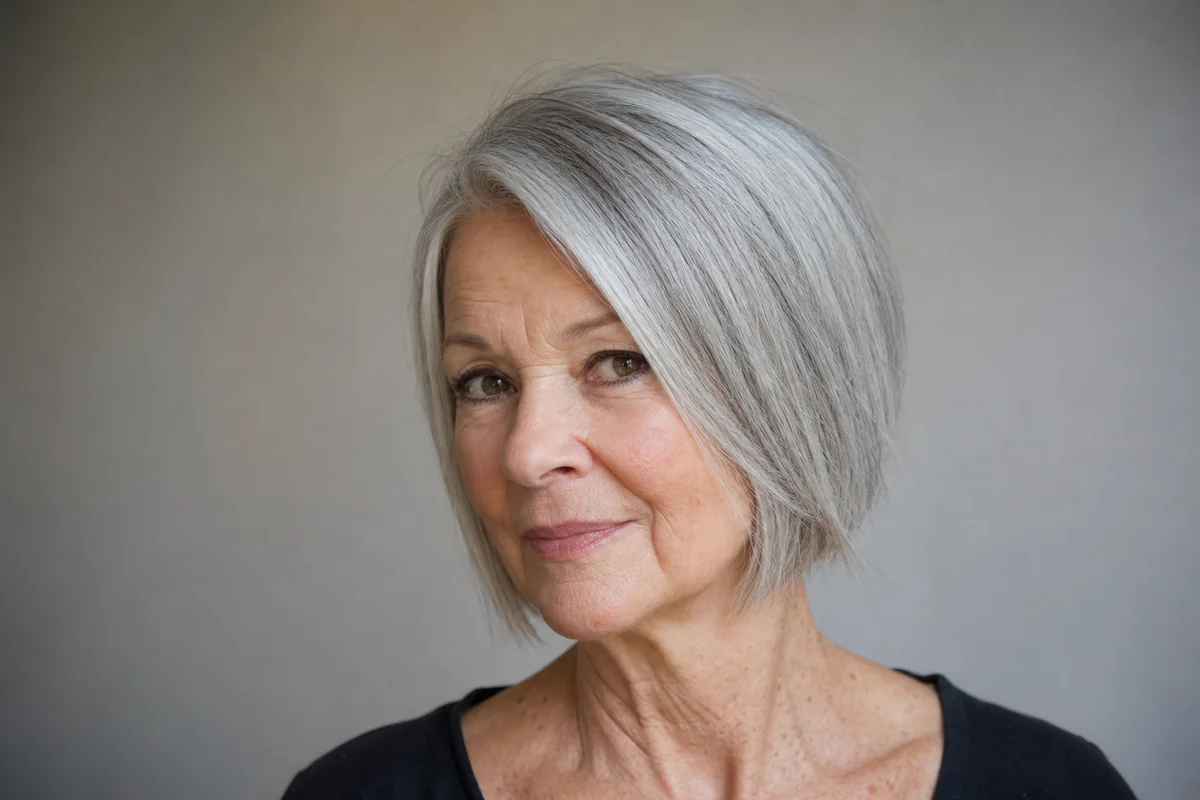
- Length
- Chin at the front, about 1 in shorter at the back
- Texture
- Straight to slightly wavy
- Density
- Fine, with a widening part
- Face shapes
- Oval, long, square
- Daily effort
- 10 minutes
- Trim every
- 6-7 weeks
A part set at the arch of the eyebrow, rather than the center, moves hair across a widening line and gives it somewhere to lie. The gentle angle at the front adds movement without the steep stack that needs frequent trims.
Ask for: "A bob about an inch longer in front than in back, a deep side part cut in dry, and enough length on top to sweep across."
10. Ear-Length Rounded Bob with a Tapered Nape
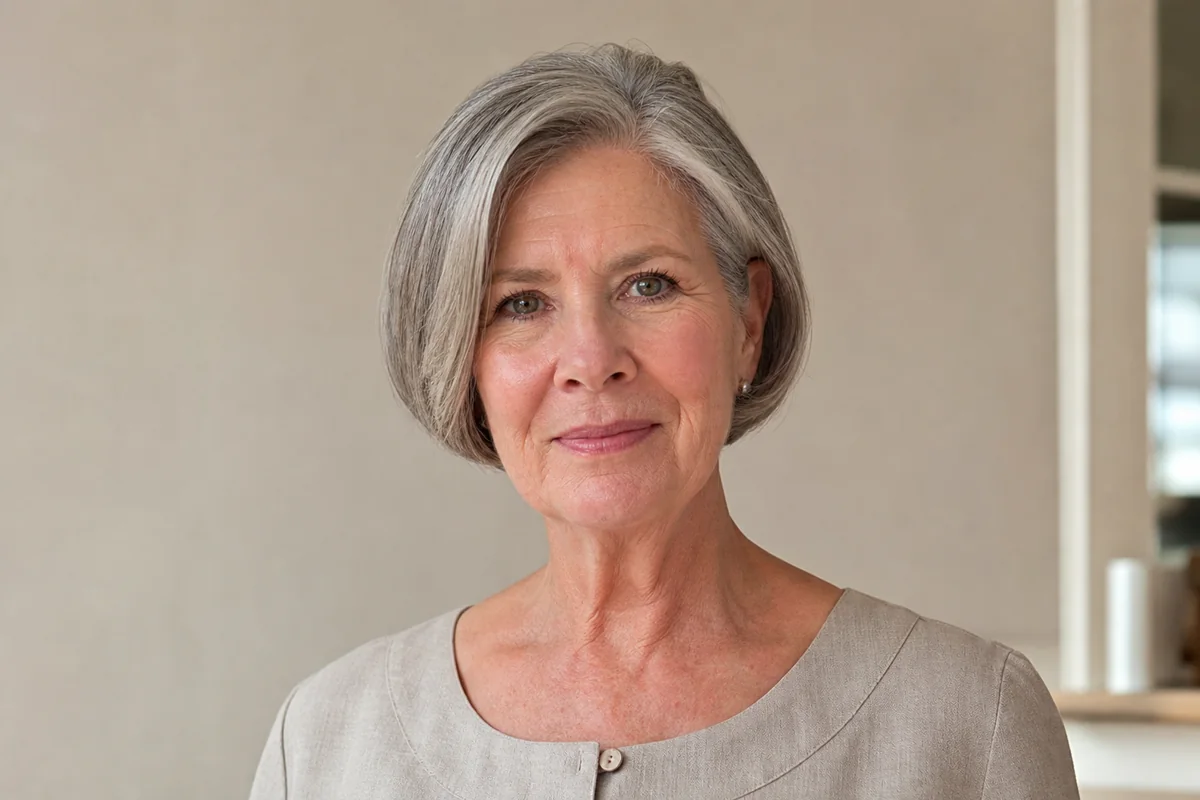
- Length
- Just below the earlobe, tapered nape
- Texture
- Straight
- Density
- Fine to medium
- Face shapes
- Oval, long, heart
- Daily effort
- 5-8 minutes
- Trim every
- 5-7 weeks
The rounded outline needs little styling: dry it with fingers and a round brush at the crown only, and the shape does the rest. A hem at or just below the earlobe also tucks easily behind the ear, which makes it practical for glasses wearers.
Ask for: "A rounded bob ending just below the earlobe, tapered nape, a little graduation at the back, and a hem that lies in toward the jaw."
11. Wavy Bob with a Curved Hem

- Length
- Chin when dry, cut about 1 in longer wet
- Texture
- Wavy (2A-2C)
- Density
- Medium
- Face shapes
- Oval, round, square
- Daily effort
- 5 minutes, air-dried
- Trim every
- 6-8 weeks
Waves lift and bounce up as they dry, so a bob cut straight across at the chin wet can finish at the jaw. A curved hem, a little longer at the front, keeps the ends from flipping out and leaves room for gray that has gone wavier than it used to be.
Ask for: "A wavy bob with a curved hem, cut about an inch longer than I want while wet, then checked dry."
Soft Shags and Layered Cuts for Thick or Wavy Hair
A short shag adds movement where thick or wavy gray hair would otherwise sit heavy, and it does so with layers at the crown and cheekbone rather than a different length. It is the best cut on the page for hair with texture to spare, and the worst for fine, straight, low-density hair, which loses what little weight it has. More on layer placement is in our short shag gallery.
12. Short Shag with Crown Layers on Wavy Gray Hair

- Length
- Crown 2-3 in, perimeter at the jaw
- Texture
- Wavy to loosely curly
- Density
- Medium to thick
- Face shapes
- Oval, round, heart
- Daily effort
- 5-8 minutes
- Trim every
- 6-8 weeks
Gray hair that waves more than it used to rarely needs a new texture, only a cut that lets the waves collect. Layers at the crown add the lift that flattening roots lose, and a jaw-length perimeter keeps the weight where the waves can stack.
Ask for: "Crown layers of 2 to 3 inches, ends point cut, perimeter at the jaw, layers connected so it reads as one shape."
13. Shaggy Bob with Curtain Bangs

- Length
- Jaw, bangs to the cheekbone
- Texture
- Straight to wavy
- Density
- Medium to thick
- Face shapes
- Oval, long, square
- Daily effort
- 8-10 minutes
- Trim every
- 6-8 weeks, bangs 4-5
The bangs give this cut its personality and also make it the most work: they need a trim every 4-5 weeks and a blow-dry most mornings. Anyone with a cowlick at the front hairline, or fine hair, should skip them; the curtain bangs guide covers the exceptions.
Ask for: "A jaw-length shaggy bob with curtain bangs ending at the cheekbone, feathered layers and a part cut in dry."
14. Round Layered Crop with Tapered Sides
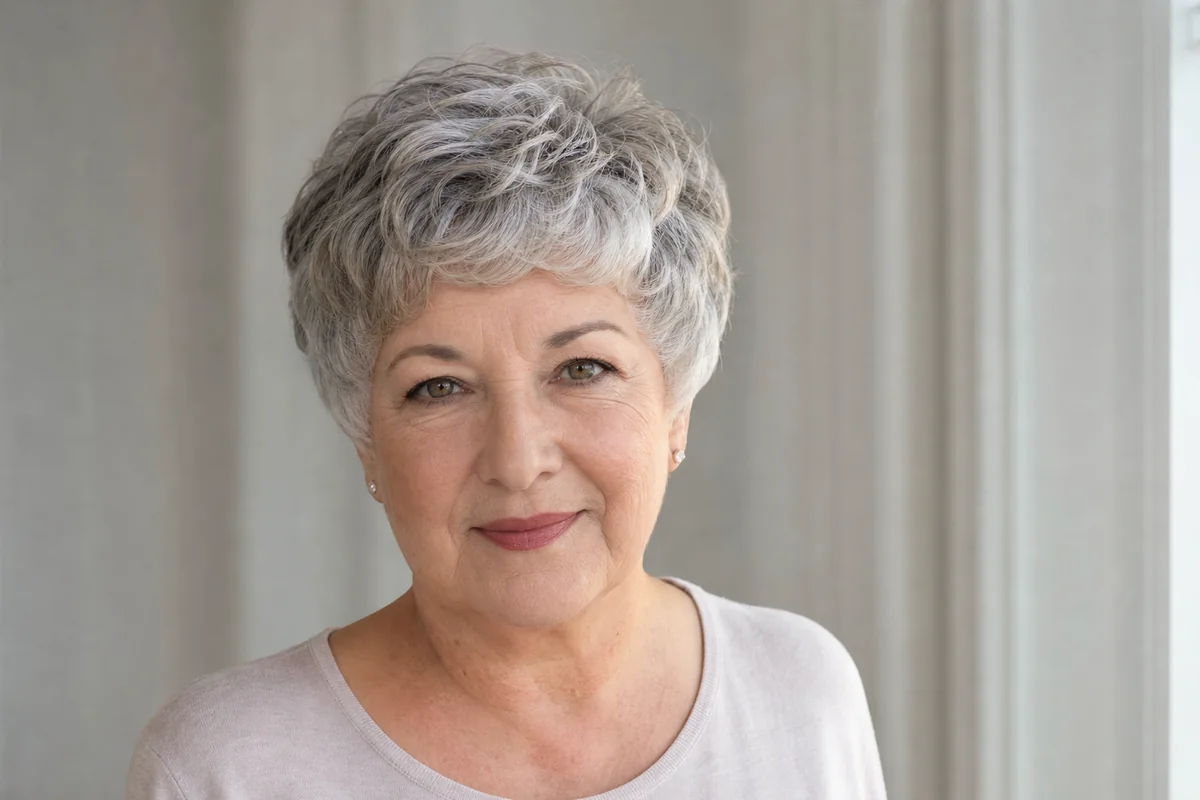
- Length
- 2 in layers, tapered sides
- Texture
- Wavy to curly
- Density
- Medium
- Face shapes
- Oval, long, heart
- Daily effort
- 3-5 minutes
- Trim every
- 5-6 weeks
One rounded dome, no part to find and nothing that needs a brush: this is the easiest cut here to describe and to dry. Waves and loose curls fill out the shape on their own, which is why it works best on those textures; on straight hair the same layers can look flat.
Ask for: "A rounded layered crop, about 2 inches all over, sides tapered above the ears, nape short. I want to finger-dry it."
Curly and Coily Silver Hair Cut Short
Curly and coily hair is cut dry and cut longer than the result you want, because curls shrink as they dry. That holds whether the hair is pigmented or silver. Our guide to short curly hair has the shrinkage numbers for each curl pattern. Texture can also shift over the years, so describe the hair as it is now, not as it was.
15. Tapered Coily Crop in Natural Silver
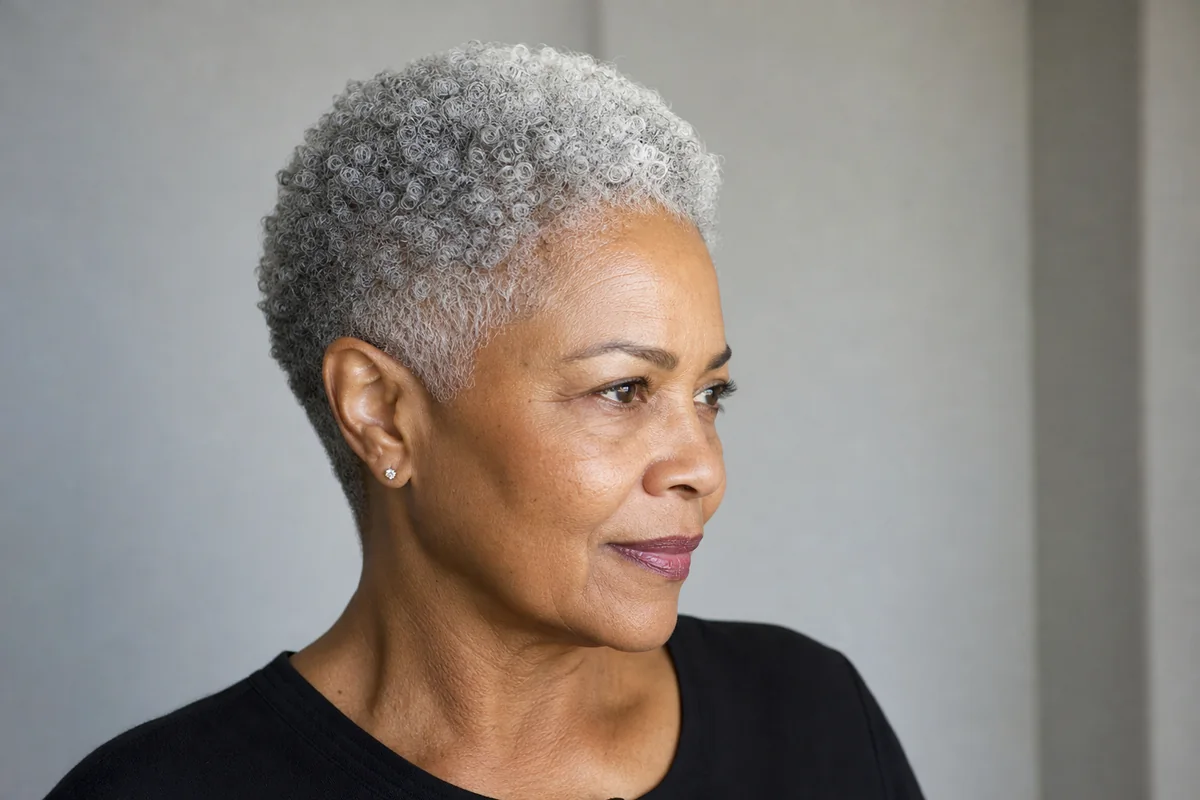
- Length
- 1-2 in shaped top, tapered sides and nape
- Texture
- Coily (4A-4C)
- Density
- Fine to thick
- Face shapes
- Oval, round, heart, long
- Daily effort
- 3-5 minutes
- Trim every
- 3-4 weeks
A coily crop is a sculpted shape rather than a layered cut, so the outline matters more than any length. Moisture matters too: a leave-in cream and a drop of light oil on the ends keep the coils defined, and a stylist experienced with coily hair will shape it dry.
Ask for: "A shaped, tapered crop cut dry, 1.5 inches on top once the hair is stretched, with the outline evened and the nape tapered."
16. Short Curly Layered Cut on Silver Curls

- Length
- Jaw to chin stretched, crown left longer
- Texture
- Curly (3A-3C)
- Density
- Fine to medium
- Face shapes
- Oval, long, square
- Daily effort
- 5 minutes plus drying
- Trim every
- 6-8 weeks
Curls lift whatever sits above them, so a thin crown on curly hair often looks fuller than the same density on straight hair, provided the cut stays rounded and the crown is not clipped short. The hem width at the jaw matters more than the length.
Ask for: "A rounded curly cut shaped dry, curl by curl, with the crown left a little longer and the hem narrow at the jaw."
How to Choose Short Haircuts for Women Over 60 by Texture and Density
Match the cut to the trait that bothers you most, then check the daily routine you will actually keep. The table pairs each trait with the cut feature that addresses it. Where traits overlap (fine, wiry and thin at once is common), start with the crown, because that is where the cut changes the most.
| Hair | Cut feature that helps | Cut feature to avoid | Looks |
|---|---|---|---|
| Fine, straight, low density | Blunt hem, 2.5-3 in top, side part | Thinned ends, long layers underneath | 2, 5, 7, 9 |
| Coarse or wiry gray, medium to thick | Point-cut ends, low graduation, interior weight removal | Very short top under 2 in, steep stacks | 1, 4, 8, 13 |
| Wavy gray | Curved hem, crown layers, air-dry finish | Blunt straight-across hem at the chin | 11, 12, 14 |
| Curly (3A-3C) | Rounded layers, shaped dry, crown kept longer | Wet-cut length judged by eye | 16 |
| Coily (4A-4C) | Sculpted tapered crop, moisture-first routine | Heat-straightened shapes | 15 |
| Thin crown or widening part | 3-3.5 in at the crown, side part | Clippered crown, center part | 5, 9, 16 |
What to Ask Your Stylist For
Describe the cut by inches and landmarks, and name the concern, such as a thin crown or wiry texture, because "a short bob" can mean three different cuts. Bring photos of two or three looks plus a photo of your hair as it falls dry, and wear the glasses you wear every day.
- Say where the top should land in inches (2.5-3 for most pixies) and where the front should end (cheekbone, earlobe, jaw).
- Name the concern: "my crown is thin" or "the gray is wiry". It changes how the stylist cuts.
- Ask for point cutting rather than thinning shears if your hair is fine or sparse.
- Describe the nape (tapered with scissors, clippered with a guard, or soft) and the ears (covered, half covered, out).
- Ask how often the shape needs a trim, and whether a short cleanup between cuts is possible.
Salon note: Thinning shears remove strands from the interior, which fine or sparse hair can't spare. On low-density hair, most stylists who specialize in short cuts build softness with point cutting and keep the density. The same shears are a normal tool on thick, coarse hair.
Salon note: Glasses change a cut's balance, so book the consultation with the glasses on. Fringes that touch the lenses, and sides that sit on the arms, both show up in the first week and are easier to plan for than to fix.
Styling and Care for Short Gray Hair
Short gray hair needs a light hand with product and moderate heat: a pea-sized amount of paste or a dime of cream on a pixie, a golf-ball amount of mousse on a bob, and a blow-dryer or iron kept to about 300-350°F on fine, gray or lightened hair. For the lowest-effort routines, see wash-and-wear haircuts for women over 60.
- Fine hair: mousse or root spray at the roots, dried upward with the dryer on medium heat.
- Coarse or wiry gray: a styling cream, or a drop or two of light oil on the ends, for softness.
- Wavy, curly and coily hair: a leave-in cream or gel on wet hair, air-dried or diffused.
- Yellowing: a violet-toned shampoo once a week or every two weeks neutralizes yellow tones on gray and white hair, and an occasional clarifying wash clears product build-up.
Salon note: Growing out dyed color is faster in a short cut than in a long one. A 2-3 inch pixie top grows past the dyed length in roughly 4-6 months of regular trims, at half an inch a month, so a gray transition does not need a long awkward stage.
Thinning Hair: What a Cut Can Do and When to See a Dermatologist
A cut can make thinning hair look fuller, but it cannot tell you why the hair is thinning. A widening part and a thinner ponytail are signs the American Academy of Dermatology associates with female pattern hair loss, the most common cause of hair loss in women, and dermatologists are the specialists who diagnose and treat it. Treatment tends to work best when it starts early.
Watch out: See a board-certified dermatologist for sudden shedding, patchy loss, bald spots, or a scalp that is itchy, sore or scaly. Other conditions can resemble pattern thinning, and a haircut will not rule them out.
While the cause is being sorted out, cuts work with what is there. Leave length at the crown, set a side part, keep the edge blunt on fine hair, and skip thinning shears and a clippered crown. If the scalp shows more after a few cut cycles, that is the cue to book the appointment, not to go shorter.
Maintenance and Grow-Out
Short cuts trade morning minutes for appointments: a pixie wants a trim every 4-6 weeks, a bob every 6-8, and clippered napes a cleanup every 2-4. Growth is about half an inch a month, so a pixie grows out to a chin bob in 8-12 months. Past 70, the concerns shift again, and short haircuts for women over 70 start from them.
| Cut | Trim every | Daily styling | Grow-out |
|---|---|---|---|
| Cropped pixie, clippered nape | 3-4 weeks (cleanups at 2-3) | 2-3 minutes | 3-5 months to a short pixie |
| Classic or textured pixie | 4-6 weeks | 5-8 minutes | 8-12 months to a chin bob |
| Bixie | 5-7 weeks | 5-8 minutes | 4-6 months to an ear or chin bob |
| Chin or graduated bob | 6-8 weeks | 8-12 minutes | 6-8 months to the collarbone |
| Short shag | 6-8 weeks, bangs 4-5 | 5-10 minutes | Layers need re-blending while growing |
| Curly or coily crop | 3-8 weeks by pattern | 3-5 minutes plus drying | Slowest; shrinkage hides the length |
When Short Hair Is Not the Right Choice
There is no age at which short hair is required or ruled out. These conditions, though, make a short cut harder to live with.
- When the thinning is sudden or patchy. A cut can't treat it; see a board-certified dermatologist first, then choose a length based on the diagnosis.
- When you want a bun, braid or ponytail. A pixie or bob can't be tied back, and a lob can. The long bob guide covers lengths that reach the collarbone and still read as short.
- When appointments are hard to keep. A pixie loses its shape by week five or six; if travel or mobility makes frequent trims difficult, a bob that tolerates 8 weeks suits better.
- When you plan to grow your hair long. From a pixie, reaching the collarbone takes roughly 14-20 months at half an inch a month, with awkward stages in between.
- When the crown has a strong whorl and thin cover. A very short cut there can stand up and show scalp, so leave length and ask the stylist to work with the whorl's direction.
The best short haircuts for women over 60 start with the hair, not the calendar: pick the cut that suits its texture, density and crown, then match the trim schedule to your life. Choose two looks from the tables above, bring a photo of your hair as it falls dry, and ask for the top a little longer than you think you want, since length can be taken off in a second visit but not put back.