
Short version: The short hairstyles for thin hair that look fullest are a blunt chin-length bob, a pixie with 3-3.5 inches left at the crown, and a bixie with solid sides, because each keeps the edge or the crown dense and puts any layers on the surface only. First work out which kind of thin you have: fine strands, few strands, or strands that are being lost. Expect a trim every 4-8 weeks and 5-12 minutes of styling, and see a board-certified dermatologist for sudden or patchy loss.
Fine, Low-Density and Thinning Hair Are Three Different Things
"Thin hair" can mean narrow strands, few strands, or strands that are disappearing, and each wants a different short cut. This page owns the first two at any age and sorts looks by the problem they solve; the wider range of lengths is in our guide to short haircuts for women, and lower density in older hair has its own treatment in short haircuts for women over 60.
Strand width (fine, medium, coarse) and strand count (density) are separate measurements. In a study of Caucasian women, shaft diameter and density changed differently with age, and neither alone explained how much hair a woman felt she had, which is why the researchers proposed a combined "hair amount" measure. A study of 2,249 young adults without alopecia found differences in density and growth rate by scalp area, sex and geographic origin, so low density or fine strands can be a normal baseline rather than a fault.
| Kind of thin | What it is | How it shows | What the cut should do |
|---|---|---|---|
| Fine strands | Narrow diameter, any number of strands | A single strand is hard to feel; hair goes flat and holds little shape | Blunt edge, no thinned ends, root lift |
| Low density | Fewer strands per square inch | Scalp shows at the part and in wet hair; ponytail is slim | Cover the part, keep length at the crown, concentrate weight at the hem |
| Thinning | Density falling over time | Wider part, more scalp, more shedding than before | Same cut choices as low density, plus a dermatologist visit for the cause |
| Fine and dense | Narrow strands in large numbers | Looks thin when limp, but the head is full | Often needs a blunt cut and lift more than coverage |
How a Short Cut Makes Thin Hair Look Fuller
A short cut looks fuller when the hem is solid, the crown keeps some length and any layers sit on the surface rather than through the middle. Short hair has no long, sparse ends, and a blunt edge reads as a thick line. Layers are the part that goes wrong: layers cut through the interior remove the little weight there is, and the hair beneath looks see-through.
| Layering method | Where the weight goes | Effect on thin hair | Use when |
|---|---|---|---|
| No layers, blunt hem | All at the edge | Densest-looking edge; flat on top | Fine, straight, dense or low density |
| Surface layers | Top section shortened, interior and hem kept | Lift and movement with the hem intact | Fine hair that falls flat |
| Crown layers or stacking | Weight shifted to the back of the head | Body at the crown; shows ends if overdone | Flat back of the head |
| Interior layers and thinning shears | Weight removed from inside | Wispy, see-through ends | Thick hair, rarely thin hair |
Salon note: A blunt cut often looks fuller on fine hair than a layered one, and a blunt bob usually looks fuller than a longer blunt cut. Most stylists who specialize in short cuts reserve thinning shears for thick hair and build softness on thin hair with point cutting on the ends only.
Blunt Bobs for Fine and Thin Hair
A blunt bob gives thin hair its densest-looking edge, and the choice of length matters more than the name. The five cuts here run from cheekbone to just below the jaw, with the hem left intact in every one, as in any short bob for fine hair.
1. Blunt Chin-Length Bob with a Deep Side Part

- Length
- Chin, one length
- Texture
- Straight to slightly wavy
- Density
- Fine, low to medium
- Face shapes
- Oval, long, heart
- Daily effort
- 8-10 minutes
- Trim every
- 6-8 weeks
A hem cut to a single length puts every strand at the same endpoint, so the edge reads as a solid line instead of a taper of see-through ends. The deep side part moves the hair over the widest stretch of scalp and gives the top some height.
Ask for: "Chin length, one length, cut blunt with no thinning or texturizing. Part it deep on my natural side."
2. Cheekbone-Length Blunt Bob on Very Fine Hair
- Length
- Cheekbone to earlobe
- Texture
- Straight
- Density
- Very fine, medium density
- Face shapes
- Oval, long, square
- Daily effort
- 7-10 minutes
- Trim every
- 5-7 weeks
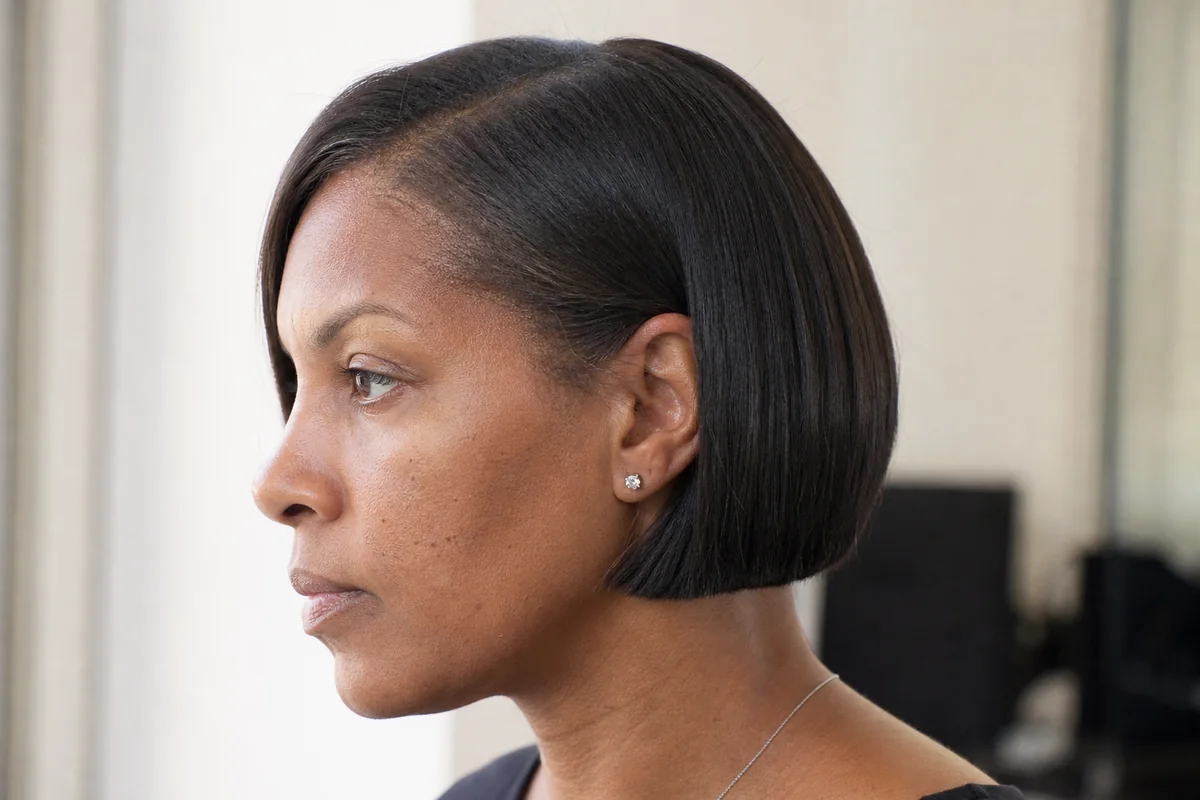
Very fine strands that are numerous do not need removing, they need a line. At this length the hem sits well above the shoulders, so it cannot flip, and fine but dense hair holds the shape without layers. Strand width and density point in opposite directions here, which is why a cut for "thin" hair starts with which kind of thin it is.
Ask for: "Cheekbone to earlobe length, blunt hem, no layers, cut dry or checked dry so I can see where it falls."
3. Stacked Bob with a Short Back and Blunt Front
- Length
- 1-2 in at nape, chin at front
- Texture
- Straight to wavy
- Density
- Fine, low density
- Face shapes
- Round, oval, square
- Daily effort
- 10 minutes
- Trim every
- 5-6 weeks
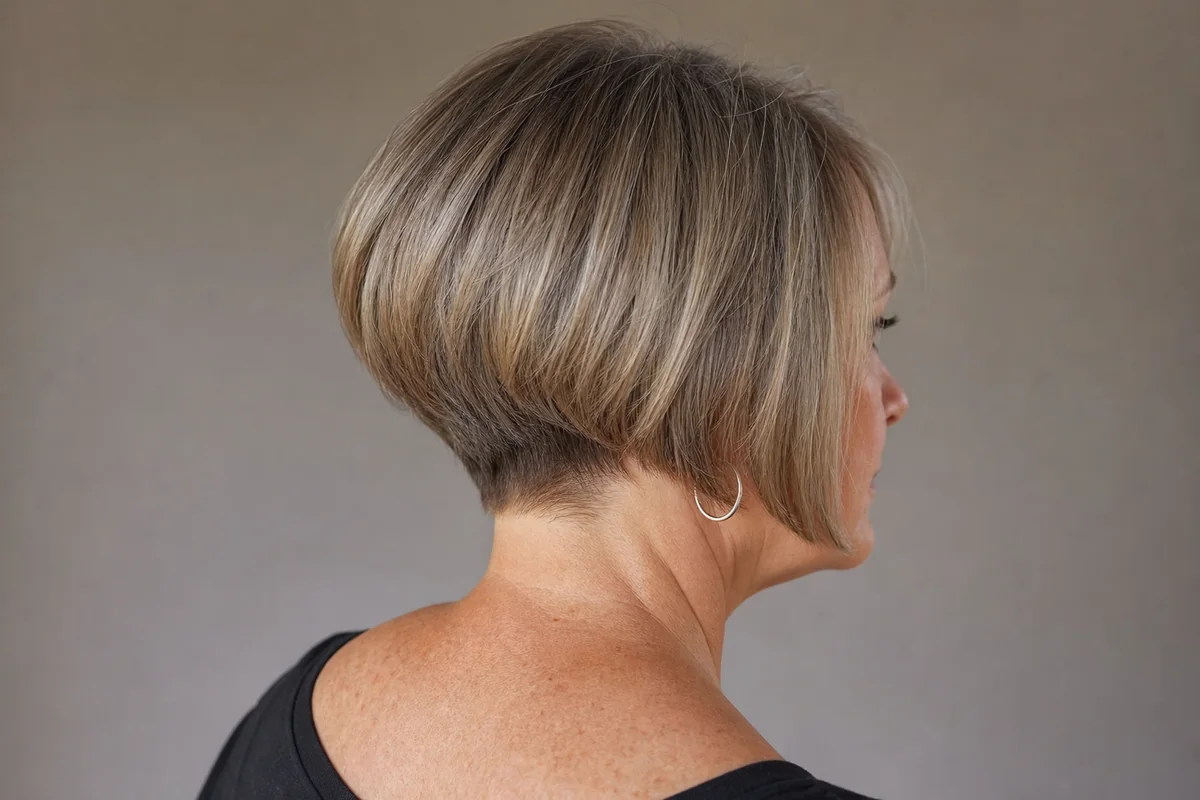
Stacking cuts the back short in steps, so the layers prop each other up and add body at the back of the head, where fine hair tends to lie flat. The front stays blunt, so the face-framing hair looks dense. The graduation mechanics are in the angle explanation in the bob guide.
Ask for: "A stacked back with a low graduation, no more than about 45 degrees, and a blunt front at the chin. Please do not thin the interior."
4. Blunt Long Bob That Stops Just Below the Jaw

- Length
- 1 in below the jaw
- Texture
- Straight
- Density
- Fine, low to medium
- Face shapes
- Oval, heart, long
- Daily effort
- 10 minutes
- Trim every
- 7-9 weeks
Fine hair looks wispier the longer it grows, because the ends are the oldest and most worn part of each strand and there are fewer of them per inch of length than at the root. Stopping a long bob at the jaw or just under keeps the line dense. The full range of long bob lengths runs to the collarbone; for thin hair the cut-off is the jaw.
Ask for: "A long bob that ends about an inch below my jaw, blunt, not touching my shoulders. If it needs more length, I would rather go up to the chin than add layers."
5. Chin Bob with Long Side-Swept Bangs

- Length
- Chin, bangs to cheekbone
- Texture
- Straight
- Density
- Fine, low density
- Face shapes
- Round, square, oval
- Daily effort
- 8-10 minutes
- Trim every
- Bangs 3-5 weeks, bob 6-8
Bangs borrow hair from the top of the head, so on low-density hair they should come from a narrow section, not the usual wide triangle. Taking too much leaves a thin crown behind them. Sectioning and trim schedules are laid out in the curtain bangs guide.
Ask for: "A narrow section for the bangs, long and swept to one side, cut blunt. Keep the rest of the hair full behind them."
Pixies and Bixies for Low-Density Hair
A pixie suits low-density hair when the top is longer than the sides, because the length at the crown covers the scalp while short sides keep the shape neat. Under about 2 inches on top, thin hair can show scalp in a pixie; the five cuts below keep 2.5-3.5 inches there.
6. Pixie with Extra Length at the Crown and a Side Part
- Length
- 3-3.5 in at crown, tapered sides
- Texture
- Straight to wavy
- Density
- Fine, low density
- Face shapes
- Oval, heart, long
- Daily effort
- 5-7 minutes
- Trim every
- 4-6 weeks
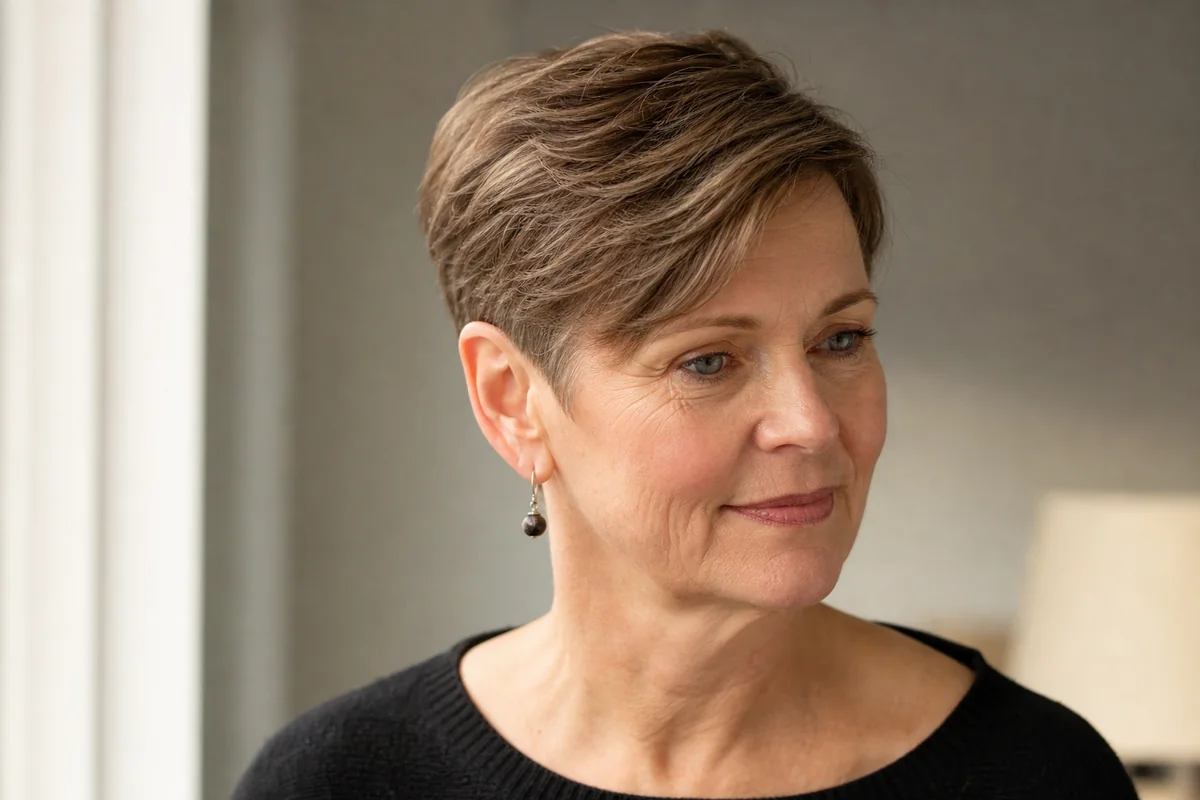
The crown is where a short cut first shows scalp, so the shortest hair goes to the sides and nape and the extra inch stays on top. A side part lets that length fall across the part line. For the nape options, see the nape section in our pixie guide.
Ask for: "Three to three and a half inches left at the crown, sides and nape tapered with scissors, side part. No thinning shears."
7. Tapered Pixie with a Long Side Fringe
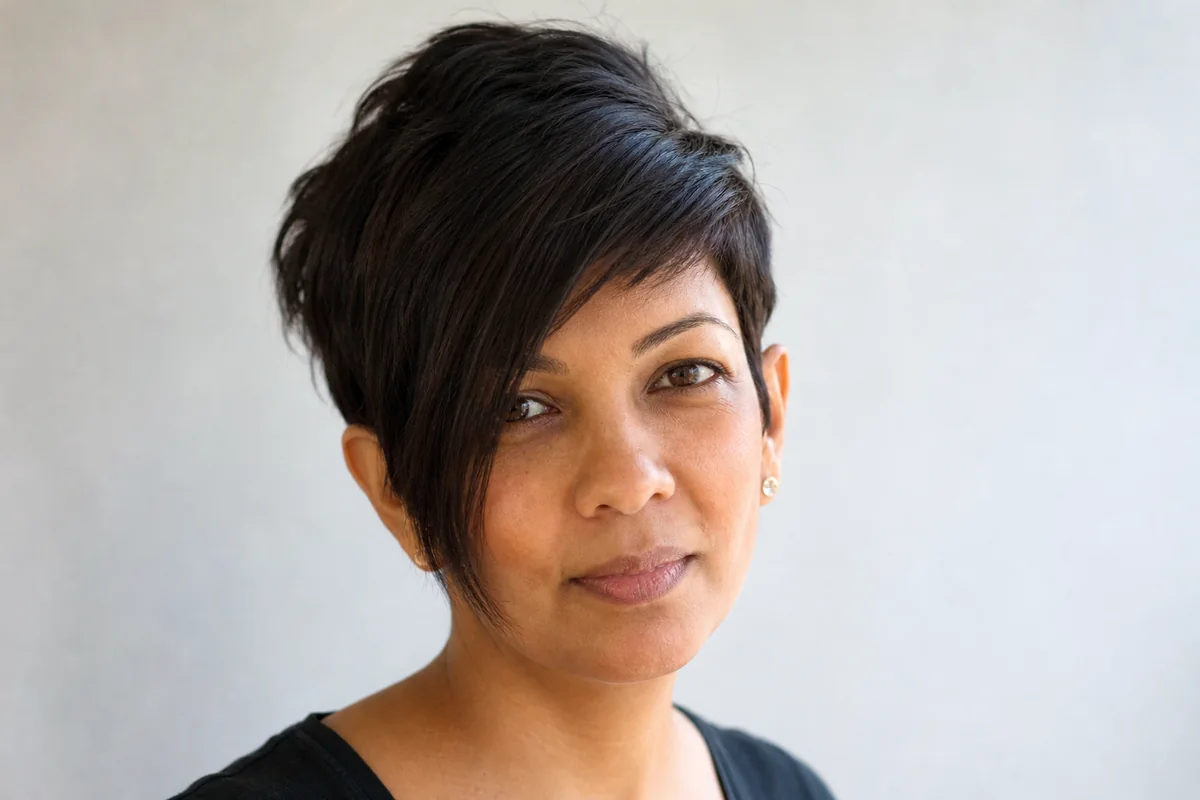
- Length
- 2.5 in on top, fringe to cheekbone
- Texture
- Straight
- Density
- Fine, medium
- Face shapes
- Round, square, diamond
- Daily effort
- 5 minutes
- Trim every
- 4-5 weeks
A long fringe concentrates the visible hair at the front, which is where a thin pixie is usually judged, and its diagonal line can cover a sparse temple. Keep the sides tapered but not clippered, so there is hair left to lie against the head.
Ask for: "Long side fringe to the cheekbone, cut blunt through the ends. Taper the sides with scissors, not clippers."
8. Textured Pixie with Point-Cut Ends and Root Lift

- Length
- 2.5 in on top, tapered nape
- Texture
- Straight to wavy
- Density
- Fine, low to medium
- Face shapes
- Oval, heart, round
- Daily effort
- 5-7 minutes
- Trim every
- 4-6 weeks
The texture on this one comes from styling and point cutting, not from removing hair. A golf-ball amount of mousse worked into damp roots and dried upward on medium heat does more for fullness than any layer. Finish with 4-8 spritzes of texture spray rather than paste, which can weigh fine roots down.
Ask for: "Point cut the ends for texture, but keep the density. Two and a half inches on top, tapered nape."
9. Bixie with Solid Sides and Soft Layers on Top
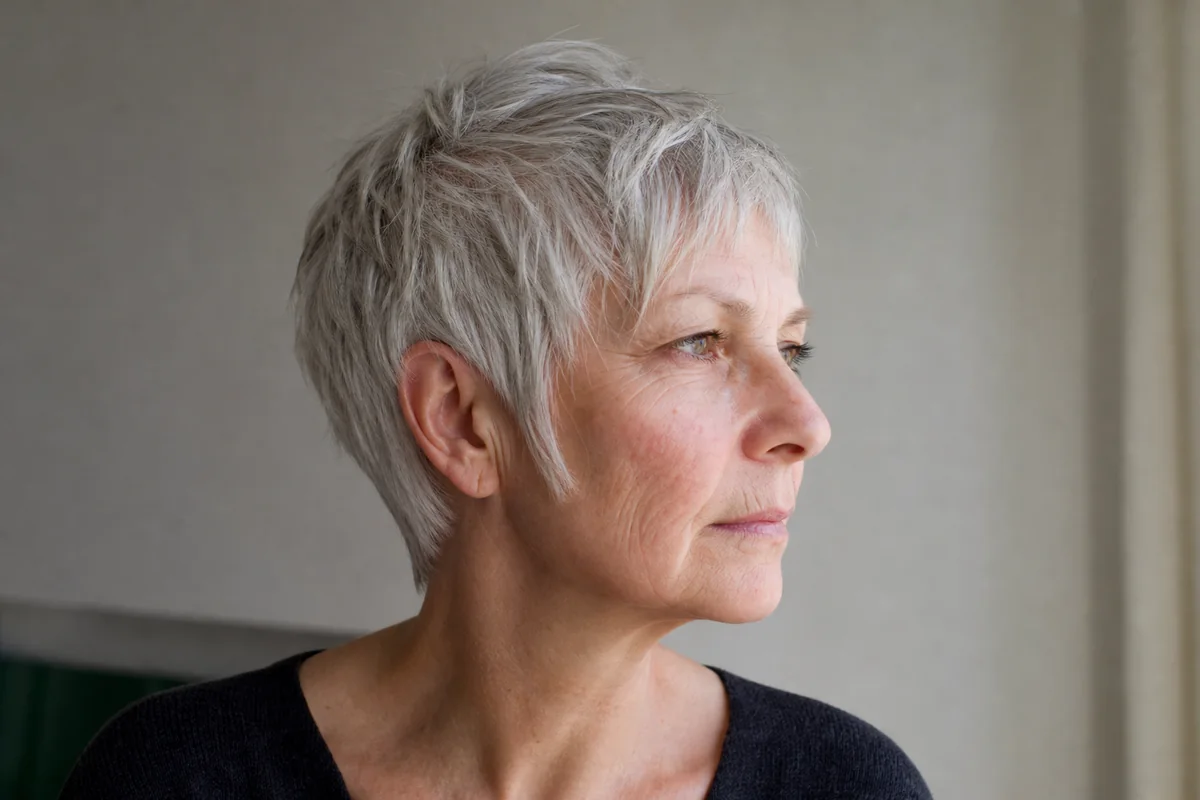
- Length
- Sides to earlobe, top 3 in
- Texture
- Straight to wavy
- Density
- Fine, low to medium
- Face shapes
- Oval, long, heart
- Daily effort
- 7 minutes
- Trim every
- 5-7 weeks
A bixie lets the sides keep a blunt edge, which reads as a thick border, while the top gets just enough short layering to lift. It suits someone who finds a pixie too exposed and a bob too heavy. The boundaries between these cuts are drawn in the bixie guide.
Ask for: "A bixie with blunt sides to the earlobe, a short back and a few soft layers on top only. Keep the edge solid."
10. Pixie Cut Around a Crown Whorl, Longer on Top
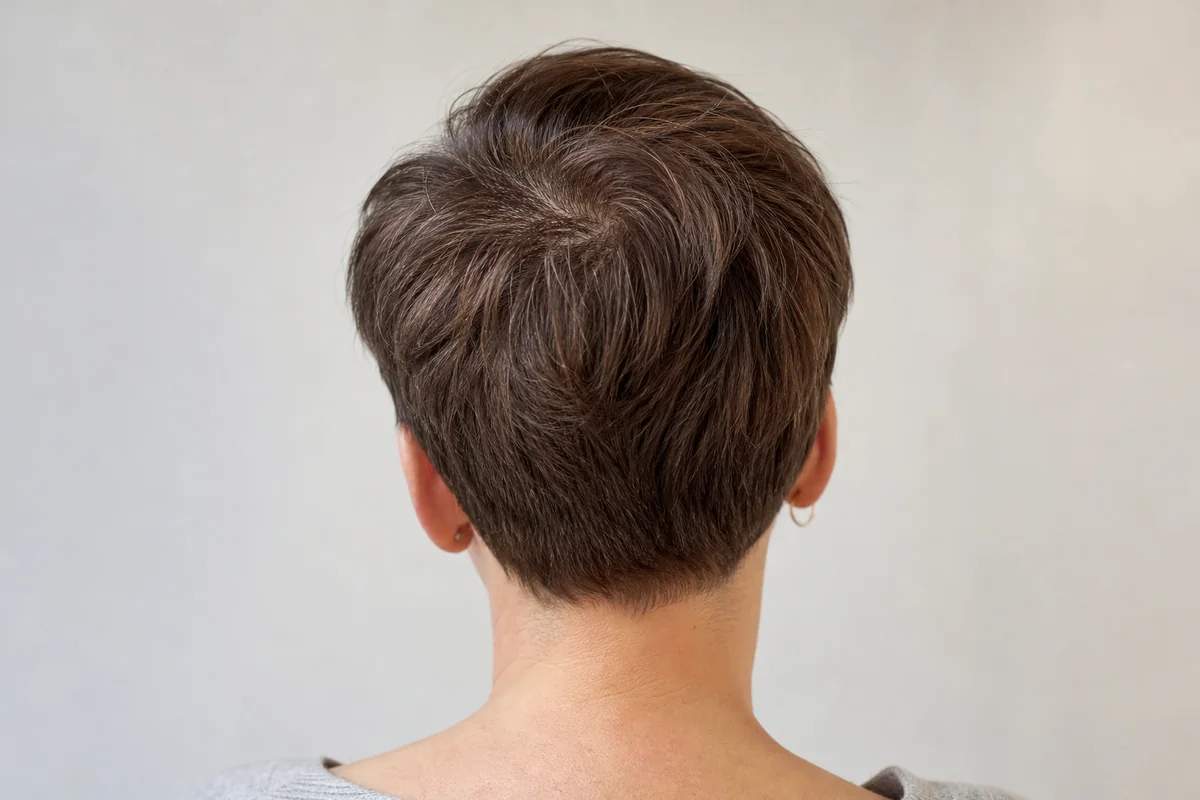
- Length
- 3 in at crown, tapered back
- Texture
- Straight
- Density
- Fine, low density
- Face shapes
- Oval, heart, square
- Daily effort
- 5-7 minutes
- Trim every
- 4-5 weeks
A crown whorl spirals the hair out from a center point, and on low-density hair that point can show scalp. Cut too short, the strands stand up and part; left long enough, they lie over the center. Have the stylist find the whorl on dry hair before cutting around it.
Ask for: "There is a whorl at my crown. Please check it dry and leave enough length there to lie flat, about three inches."
Layered and Shaggy Cuts That Keep Density
Layers help thin hair only when they stay on the surface, and they work best on fine hair with some density rather than sparse hair. These three cuts take movement from the top layer (layer types compared) and leave the hem untouched. They need more styling than blunt cuts.
11. Short Layered Bob with Surface Layers Only

- Length
- Chin, top layers 3-4 in
- Texture
- Straight to wavy
- Density
- Fine, medium
- Face shapes
- Round, oval, heart
- Daily effort
- 8-10 minutes
- Trim every
- 6-8 weeks
Surface layers are cut in the top section only, so the hair underneath stays at full length and the hem keeps its weight. That gives the movement people want from layers without the stringy ends that long layers create on fine hair.
Ask for: "Layers on the top section only, short enough to lift at the crown. Leave the hair underneath and the hem at one length."
12. Shaggy Bob with Crown Layers on Fine Hair

- Length
- Chin, crown layers 3 in
- Texture
- Straight to wavy
- Density
- Fine, medium
- Face shapes
- Oval, long, heart
- Daily effort
- 8-10 minutes
- Trim every
- 5-7 weeks
A shag depends on volume that sparse hair may not have, so the version for thin hair keeps the layers short and few and leaves the perimeter intact. Anyone with a visibly sparse crown should skip the choppy version; the short shag gallery shows where that style works best.
Ask for: "A shag with only crown layers and a full, unthinned perimeter. Keep the layers few and short."
13. Soft Graduated Bob Styled for Root Lift
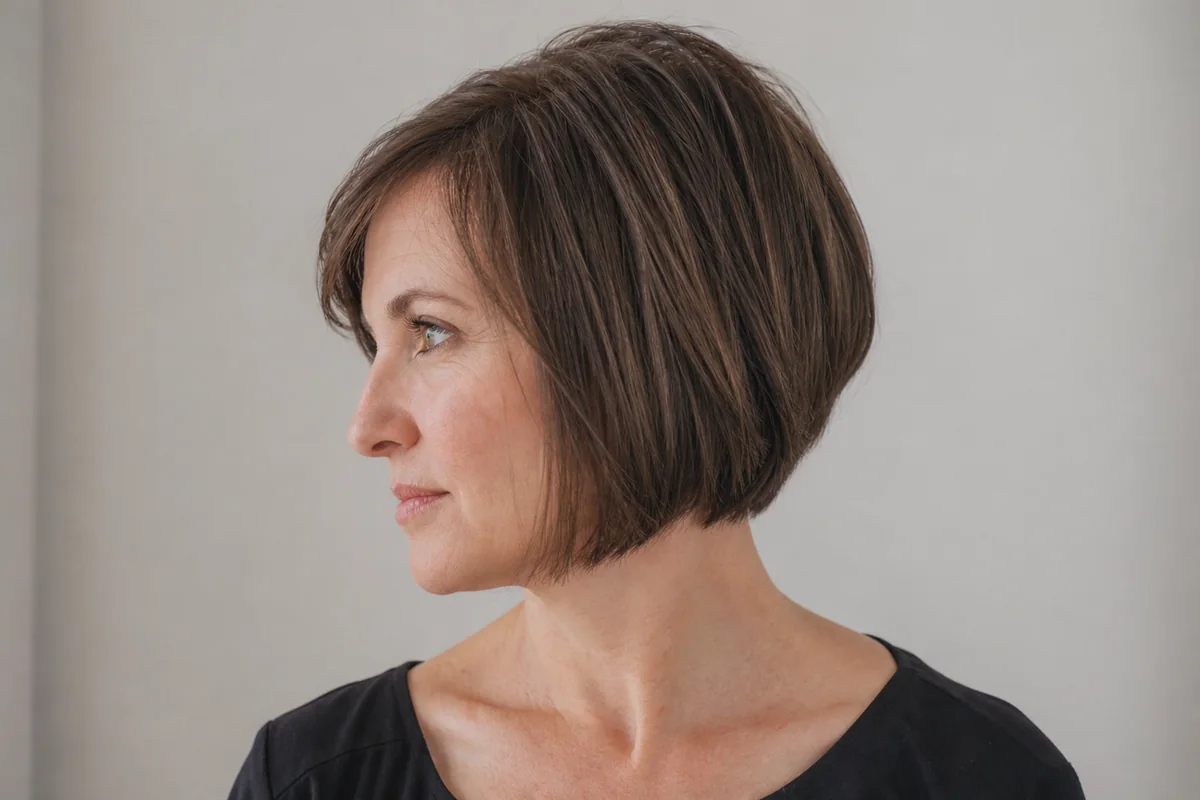
- Length
- Jaw, graduated back
- Texture
- Straight
- Density
- Fine, low to medium
- Face shapes
- Round, oval, square
- Daily effort
- 10-12 minutes
- Trim every
- 6-7 weeks
Much of this cut's fullness comes from how it is dried. A small round brush, 1-1.5 inches, rolled at the roots while the dryer points upward gives lift that a flat blow-dry cannot. A low graduation at the back adds to it, but a steep one shows the thin ends.
Ask for: "Low graduation at the back, jaw length, blunt front. Show me how to dry the roots."
Wavy, Curly and Coily Thin Hair
Waves and curls add width that fine hair lacks, but they shrink, so a short cut on thin wavy or curly hair is cut dry and left longer than the target. Waves can pull up about an inch, curls 1-3 inches or more, and coils often more. Low density shows as gaps between curls rather than as a scalp line, so the fix is a rounded shape, not a blunt edge.
14. Wavy Chin Bob with a Curved Hem

- Length
- Chin, curved hem
- Texture
- Wavy (2A-2C)
- Density
- Fine, low to medium
- Face shapes
- Oval, long, heart
- Daily effort
- 5-8 minutes
- Trim every
- 7-9 weeks
Waves add width, so fine wavy hair can look fuller than fine straight hair with no styling at all. The hem is cut on a slight curve rather than ruler-straight, because a straight line on waves turns into a shelf as the waves bounce up. Cut it dry, since wavy hair can shrink up to an inch.
Ask for: "A curved hem, chin length once dry, cut on dry hair. Few layers, and none thinned out."
15. Short Layered Curls for Fine, Low-Density Hair

- Length
- 3-4 in, rounded layers
- Texture
- Curly (3A-3C)
- Density
- Fine, low density
- Face shapes
- Round, oval, heart
- Daily effort
- 5-10 minutes
- Trim every
- 6-8 weeks
Curls take up space, so a short round shape looks fuller than the same hair cut straight, but low density shows as gaps between ringlets. Light layers let each curl sit on the one below, and the cut should be shaped dry, curl by curl, as the short curly hair guide explains.
Ask for: "Cut it dry, curl by curl, longer than I want it to end up. Rounded shape, light layers only."
16. Tapered Coily Crop with Length on Top
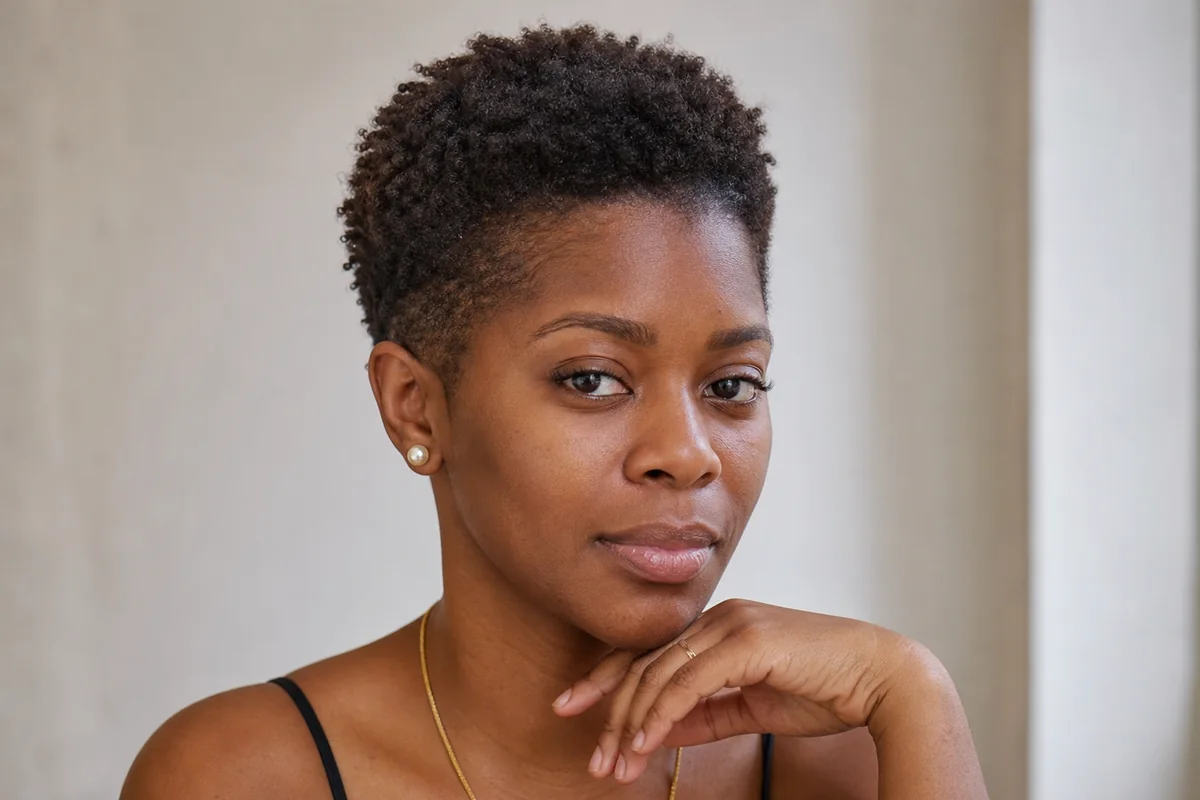
- Length
- 2 in on top, tapered sides
- Texture
- Coily (4A-4C)
- Density
- Fine to medium, low density
- Face shapes
- Oval, heart, round
- Daily effort
- 5 minutes
- Trim every
- 3-5 weeks
When density is low, very short coily hair shows the scalp between the coils. Leaving a little more on top, rounded, gives coverage and still allows a clean taper at the sides. Shrinkage is large on coily hair, so length is judged on stretched or dry hair, never by eye on wet hair.
Ask for: "Rounded shape with about two inches on top, tapered sides, cut by someone who works with 4A coils."
How to Choose Short Hairstyles for Thin Hair by Problem
Start with the problem that bothers you most, then pick the cut feature that answers it. Where problems overlap (fine, low density and a flat crown is common), solve the crown first, because that is where a short cut changes the most.
| Problem | Cut feature that helps | Cut feature to avoid | Looks |
|---|---|---|---|
| Scalp shows at the part | Deep side part, longer top, blunt hem | Center part on a short top, clippered crown | 1, 6, 7 |
| Wispy, see-through ends | One-length blunt hem, jaw or chin length | Long layers, thinning shears | 1, 2, 4 |
| Flat crown | Stacked back, surface layers, root lift | Heavy cream or oil at the roots | 3, 8, 11, 13 |
| Crown whorl or cowlick shows scalp | About 3 inches at the crown, whorl checked dry | Cutting the whorl short | 6, 10 |
| Sparse temples or hairline | Long side fringe or narrow bangs | Wide bangs that take hair from the crown | 5, 7 |
| Low density curls or coils | Rounded shape cut dry, a little length on top | Very short crop cut wet | 15, 16 |
Texture and Density Change How Each Cut Behaves
The same cut behaves differently on each texture, because hair that bends takes up more room than hair that lies flat.
| Texture | Fine and low density | Fine and dense |
|---|---|---|
| Straight | Blunt bob at the chin or jaw; pixie with 3 inches at the crown | Blunt cheekbone bob, stacked bob; layers can stay minimal |
| Wavy | Curved-hem chin bob; short surface layers | Soft shag bob with a full perimeter |
| Curly | Rounded cut with light layers, shaped dry; leave 3-4 inches | Layered rounded crop; more shaping allowed |
| Coily | Rounded, tapered crop with 2 inches or more on top | Tapered or sculpted crop; shorter tops work |
What to Ask Your Stylist For
Name the kind of thin and the part you want to cover, then describe the cut in inches and landmarks. "Short layered bob" can mean a blunt hem with surface layers or a choppy cut with thinned ends, and only the first suits thin hair. Bring a photo of your hair as it falls dry, including the part, and two or three reference looks.
- Say which problem is first: scalp at the part, flat crown, wispy ends or a cowlick.
- Ask for a blunt hem and no thinning shears or texturizing through the interior.
- Give a length for the top in inches (3-3.5 at the crown on a pixie) and a landmark for the hem (chin, jaw, earlobe).
- Ask for the whorl and cowlick to be checked dry before cutting.
- Ask how often the shape needs a trim and what it looks like in week five.
Salon note: Most stylists check where the hair naturally falls before cutting, because that fall decides where a part will hold. A part forced to the other side tends to flop back, and the line it leaves shows more scalp than a part on the natural side.
Styling Thin Short Hair for Lift
Thin short hair gets its fullness from the roots, so apply lightweight products to damp roots and dry upward with the dryer on medium heat, rather than layering heavy cream through the length. Keep hot tools near 300-350°F on fine hair, and use a pea-sized amount of paste or a dime of cream only on the ends.
- Prep damp hair. Work a golf-ball amount of volumizing mousse or 4-8 sprays of root spray into the roots only. Product through the lengths weighs fine strands down.
- Dry the roots first. Lift sections at the crown with fingers or a round brush of 1-1.5 inches and aim the dryer up and slightly forward from about 6 inches away, keeping it moving.
- Part last. Part the hair while it is still warm and slightly damp, so the part holds, and push the hair over it with a fingertip.
- Finish light. A pea of paste on a pixie's ends or a texture spray on a bob. Avoid oils at the roots.
Short hair gets flat at the roots sooner than long hair, and dry shampoo at the roots on day two returns some lift. Wavy hair can be diffused upside-down. Curly and coily hair is styled wet and air-dried or diffused, with a lightweight gel or cream raked through and no heavy butter at the roots. A longer routine is planned in how to style short hair, and the effort side of short cuts is covered in the low-maintenance short haircuts page.
Thinning Hair: What a Cut Can Do and When to See a Dermatologist
A cut can make thin hair look fuller, but it cannot tell you whether the hair is thinning or why. A part that is getting wider is one of the signs the American Academy of Dermatology lists for female pattern hair loss, which it describes as the most common cause of hair loss in women and one that often begins in midlife but can start earlier. Other conditions can look similar, and the diagnosis comes first.
Shedding is a separate matter. The AAD notes that shedding 50 to 100 hairs a day is normal, and that excessive shedding often follows an event such as illness, childbirth or a period of intense stress and starts a few months after it. Whether the cause is shedding or loss, a dermatologist can tell which it is.
Watch out: See a board-certified dermatologist for sudden shedding, patchy loss, bald spots, a visibly widening part, or a scalp that is itchy, sore or scaly. A haircut will not rule these out, and going shorter will not stop them.
While the cause is being sorted out, the cuts on this page work with the hair that is there. A blunt hem, extra length at the crown and a side part are the main tools.
Maintenance and Grow-Out
Thin hair has less weight to hold a line, so an overdue cut shows sooner than it does on dense hair: a pixie wants a trim every 4-6 weeks, a bixie every 5-7, a bob every 6-8 and a lob every 8-10. Growth is about half an inch a month, so a pixie grows out to a chin bob in 8-12 months.
| Cut | Trim every | Daily minutes | What looks overdue first |
|---|---|---|---|
| Blunt chin or jaw bob | 6-8 weeks | 8-10 | The hem thins as the ends split and lengthen |
| Crown-length pixie | 4-6 weeks | 5-7 | The nape and around the ears |
| Bixie with blunt sides | 5-7 weeks | 7 | Sides over the ears |
| Surface-layered bob | 6-8 weeks | 8-10 | Top layers lose their lift |
| Wavy or curly short cut | 6-9 weeks | 5-10 | The hem widens into a triangle |
When a Short Cut Is Not the Right Choice for Thin Hair
- A visibly sparse crown or a clear patch. Short hair shows scalp more than length does, and a cut will not explain it. See a board-certified dermatologist first, then choose a cut.
- Curly or coily hair of low density that you want cropped very short. The scalp shows between the coils at under about 2 inches; leave 2 or more inches on top, shaped round, or choose a bob.
- A routine with no time for trims. A thin pixie looks overdue by week 4-6, while a blunt bob tolerates 8 weeks; choose the bob.
- Dense hair that only looks thin because the strands are fine. Fine, dense hair may want weight removed rather than kept, and a stylist can tell which you have by lifting a section at the part.
The best short hairstyles for thin hair keep a solid edge and some length at the crown, then add lift at the roots. Pick the look that solves your first problem, bring a photo of your part to the consultation, and book the trim for 6 weeks out before you leave the chair.