
Short version: Short hair with bangs works best when the type of fringe matches both the cut and the head: micro and wispy fringes on pixies, blunt or side-swept bangs on bobs and lobs, choppy bangs on shags, and curly bangs cut dry and left long. Forehead height, the direction your front hair grows and your texture decide more than face shape does. Plan on a trim every 3-5 weeks and 3-8 minutes of styling a day.
Six Types of Bangs and Where Each Ends
Bangs on short hair are named by where they end and how the edge is cut, and the same name can mean different things on a pixie and a lob. Short hair with bangs comes down to six types: micro, blunt, wispy, side-swept, choppy and curly. The table gives the landmark for each, since a length in inches means little without a forehead to measure it on. Curtain bangs are a seventh type, covered in their own section below.
| Type | Where it ends | How the edge is cut | Trim every |
|---|---|---|---|
| Micro (baby) bangs | About 1-2 in above the brows, mid-forehead | Straight or lightly point cut | 3 weeks |
| Blunt (full) bangs | At the brow or just below it, temple to temple | Straight line with scissors | 3-4 weeks |
| Wispy (feathered) bangs | At the brow, skin showing through | Point cut, thin and uneven at the edge | 4-5 weeks |
| Side-swept bangs | 3-4 in long at the front, ending at the cheekbone or ear | Slanted, longest on the part side | 5-6 weeks |
| Choppy bangs | Brow to just above it, uneven | Razor or deep point cut | 3-4 weeks |
| Curly bangs | Cheekbone to brow, once dry | Cut dry, curl by curl | 4-6 weeks |
The weeks run shorter as the bangs get shorter and cleaner, because a straight edge above the brows shows growth within days, while a long slanted one blends into the sides. The gallery is grouped by the cut the bangs join, since a pixie, a bob, a lob and a shag each change what a fringe can do.
Bangs on Pixies
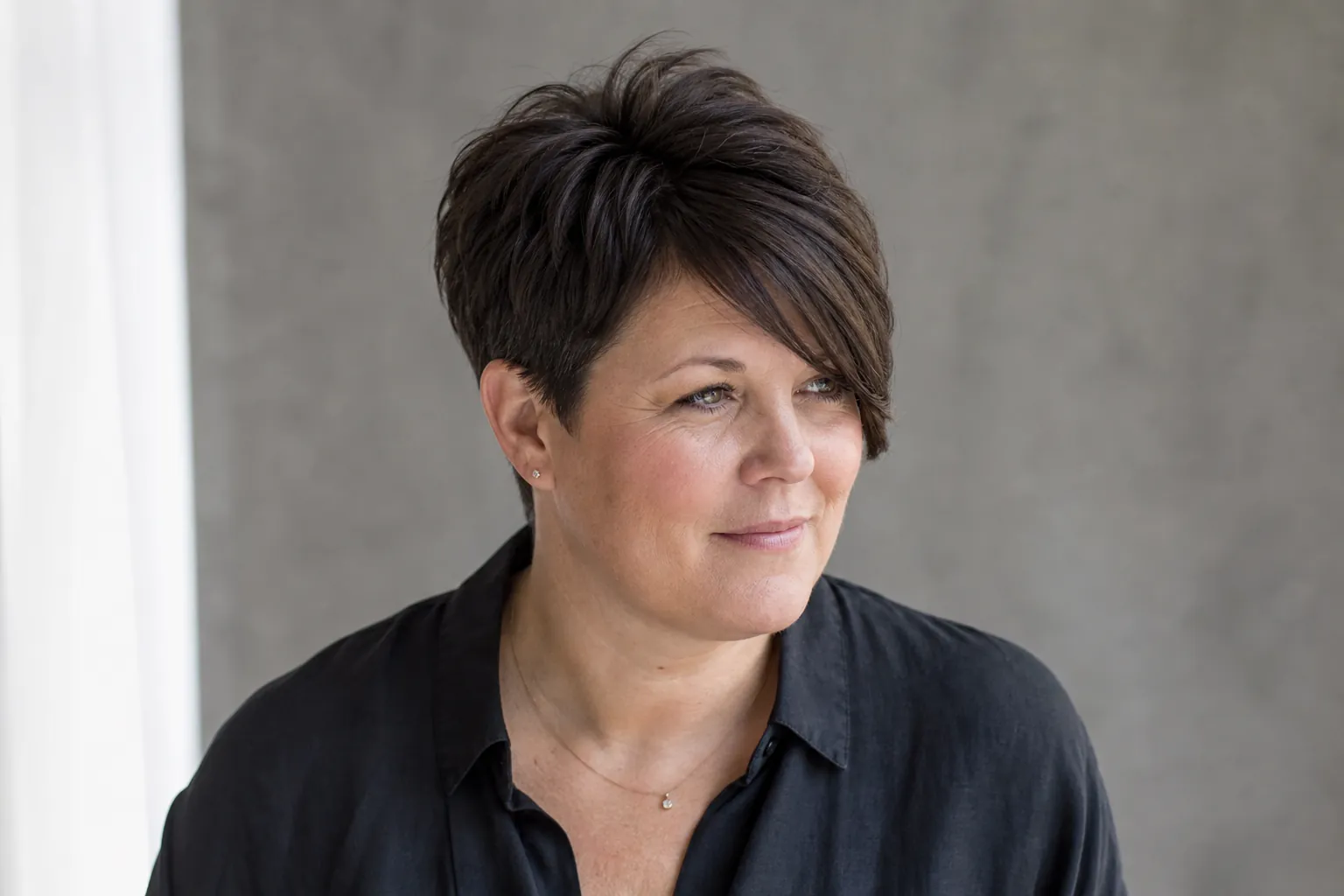
On a pixie the bangs are part of the cut, not an add-on, because the top is only 1.5-4 inches long and the fringe uses most of the front of it. Micro and wispy bangs fit the shorter tops; a long side-swept fringe needs about 3-4 inches in front. Cowlicks matter most here, since there is little length to weigh them down. The cut itself is explained in the pixie cut guide.
1. Pixie with Micro Bangs

- Length
- 1.5-2 in on top, bangs 1-2 in above the brows
- Texture
- Straight
- Density
- Medium to thick
- Face shapes
- Oval, long, diamond
- Daily effort
- 3 minutes
- Trim every
- 3 weeks
Micro bangs put the whole forehead on show, so they work only when you like the forehead and the hairline is even. A straight line this short needs thick enough hair to hold its edge; on fine hair it turns into a see-through strip.
Ask for: "Micro bangs cut straight, about an inch and a half above my eyebrows, with the rest of the top at 2 inches, point cut. Check my hairline before you cut."
2. Pixie with a Wispy Feathered Fringe
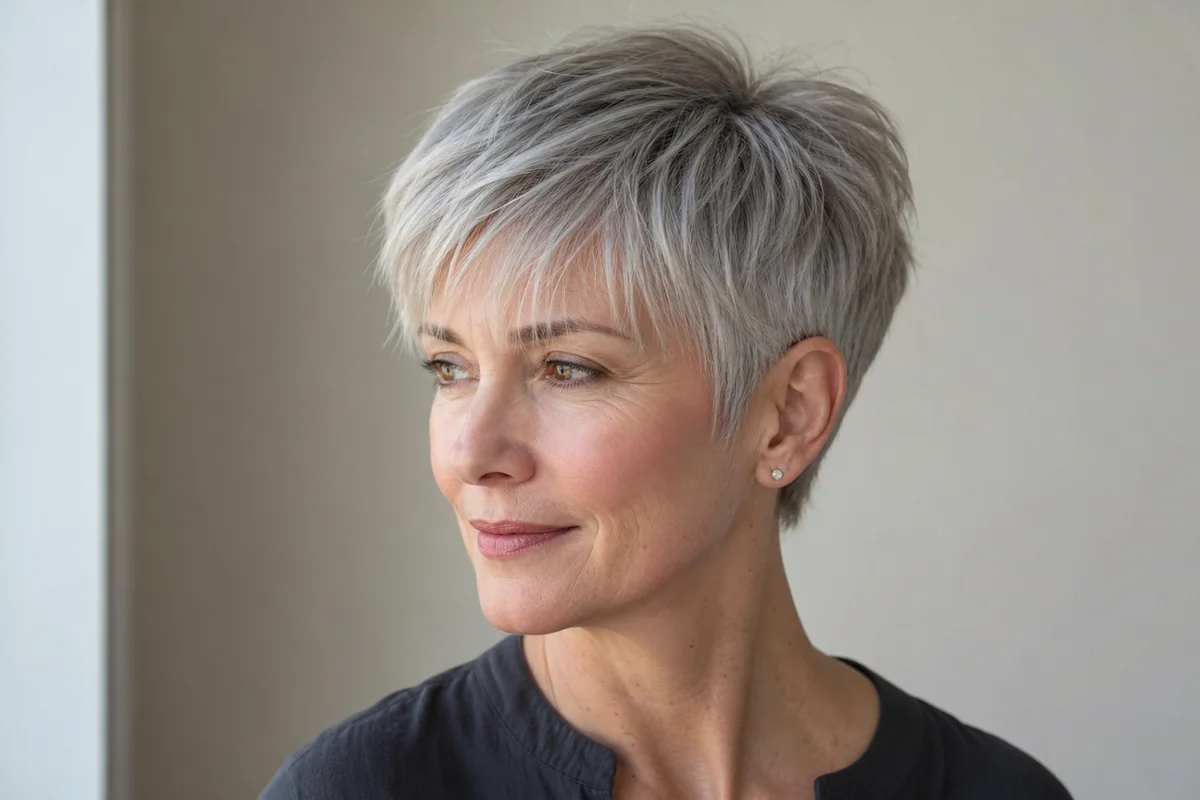
- Length
- 2-3 in on top, fringe at the brow
- Texture
- Straight to slightly wavy
- Density
- Fine to medium
- Face shapes
- Oval, heart, square, round
- Daily effort
- 3-5 minutes
- Trim every
- 4 weeks
Point cutting leaves the ends at different lengths, so the fringe lets the forehead show instead of covering it. That makes it the gentlest first fringe. On fine hair it also keeps the front from looking sparse, because a soft, uneven edge hides gaps that a ruler-straight line would show.
Ask for: "A wispy fringe ending at the brow bone, point cut, not thinned. Keep the sides tapered and leave the front 2-3 inches."
3. Pixie with Long Side-Swept Bangs
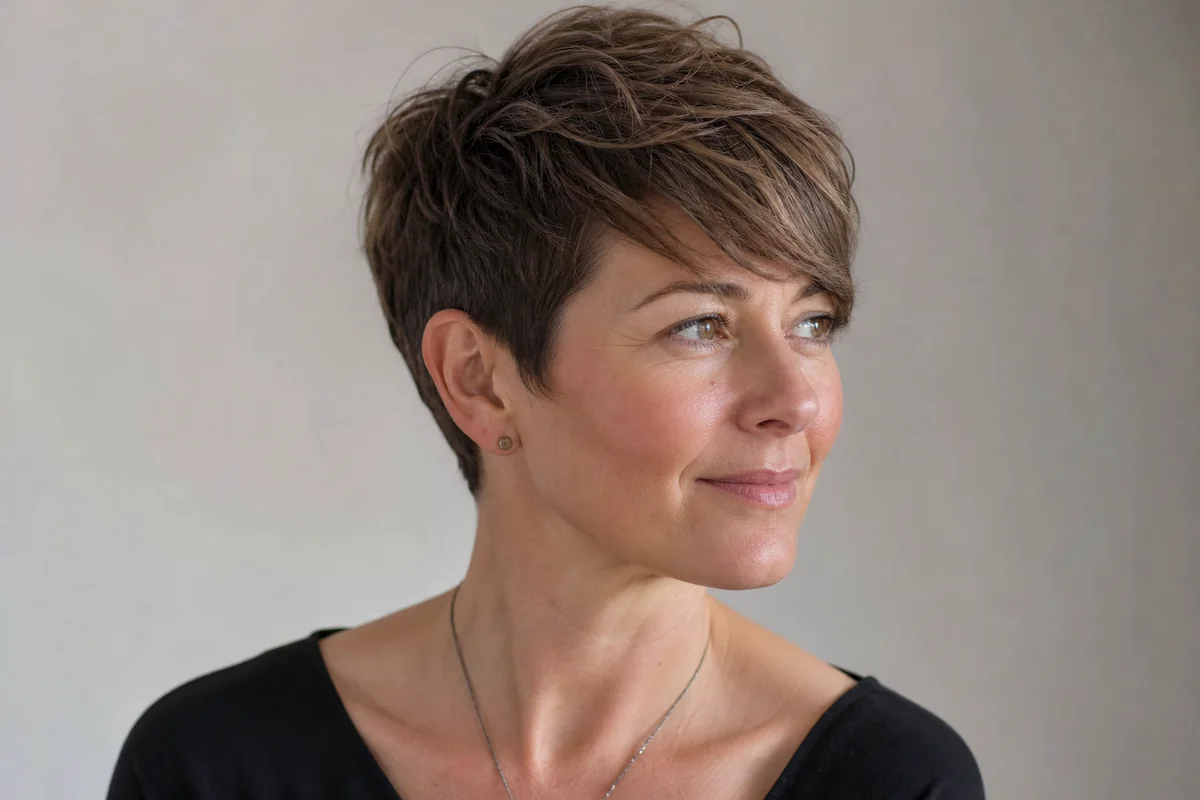
- Length
- 3-4 in at the front, 1.5 in at the sides
- Texture
- Straight to wavy
- Density
- Medium to thick
- Face shapes
- Round, square, heart, diamond
- Daily effort
- 5 minutes
- Trim every
- 4-5 weeks
The slanted line cuts across the forehead and breaks up a round or square outline, so this is the pixie fringe with the widest face-shape range. It also works around a cowlick, because the part can sit wherever the hair already falls. With less than about 3 inches in front it stands up instead of sweeping, and the extra length is the price of the shape.
Ask for: "Four inches in front, swept to the left, ending at the cheekbone. Keep the sides short, tapered above the ears."
4. Coily Pixie with a Sculpted Fringe
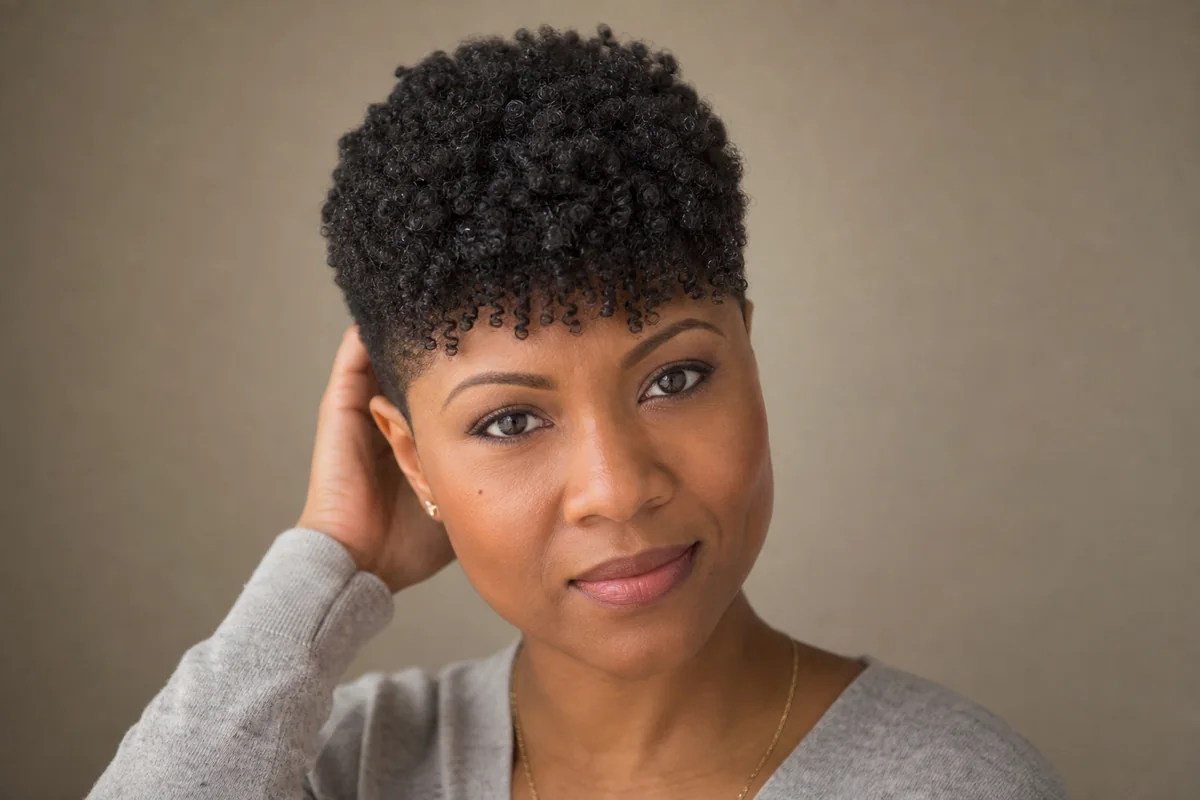
- Length
- 2 in on top, fringe at the brow once stretched
- Texture
- Curly to coily (3C-4C)
- Density
- Medium to thick
- Face shapes
- Oval, round, heart, long
- Daily effort
- 3-5 minutes
- Trim every
- 3-4 weeks
Coils spring up as they dry, so the fringe is shaped dry with a razor or small scissors, curl by curl, and left longer than it will look. The edge is curved rather than ruler-straight, because a straight line on coils loses its definition as soon as they shrink. Ask for a stylist who regularly cuts coily hair.
Ask for: "Cut dry. Sculpt a soft curved fringe at the brow, about an inch longer than the finished length, and taper the sides and nape."
Bangs on Bobs
A bob has a perimeter that bangs either echo or contrast, and that choice sets the look. A blunt hem takes blunt bangs; a stacked or angled hem is softened by wispy or side-swept ones. How the bob itself is built is covered in graduation, stacking and angle, and fringe on the shortest bob is part of the French bob.
5. Blunt Chin-Length Bob with Full Bangs

- Length
- Chin; bangs at the brow, temple to temple
- Texture
- Straight
- Density
- Medium to thick
- Face shapes
- Long, oval, diamond
- Daily effort
- 10 minutes
- Trim every
- 3-4 weeks for the bangs, 6-8 for the bob
The most graphic of the six, and the one with the strictest upkeep. The bangs are the first part to look overdue, so they are often trimmed on their own between full cuts. A straight horizontal line shortens a long face, and it needs smooth, flat-ironed hair for the edge to read.
Ask for: "A blunt chin-length bob with full bangs at the brow, cut dry once the hair has been blown straight. Keep the bangs wide, from temple to temple."
6. A-Line Bob with Long Side-Swept Bangs
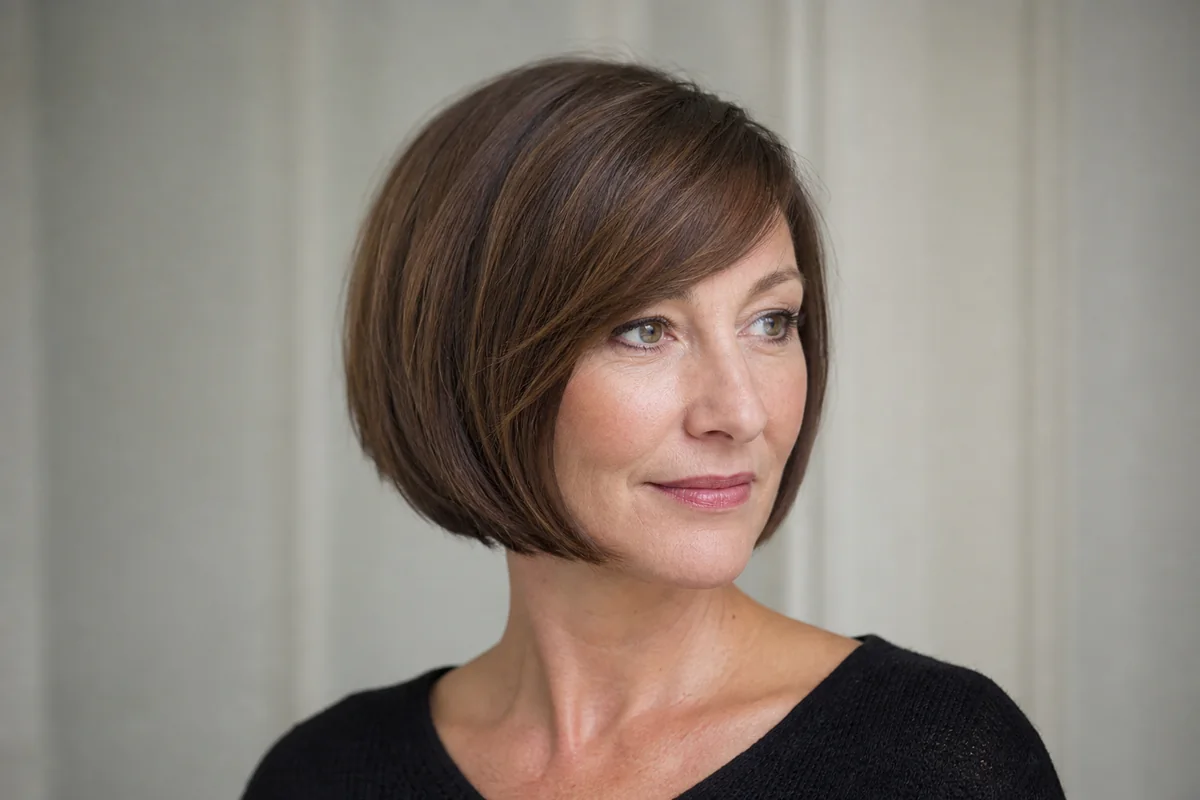
- Length
- Jaw in back, chin in front; bangs to the cheekbone
- Texture
- Straight to wavy
- Density
- Medium
- Face shapes
- Round, square, oval
- Daily effort
- 8 minutes
- Trim every
- 5-6 weeks
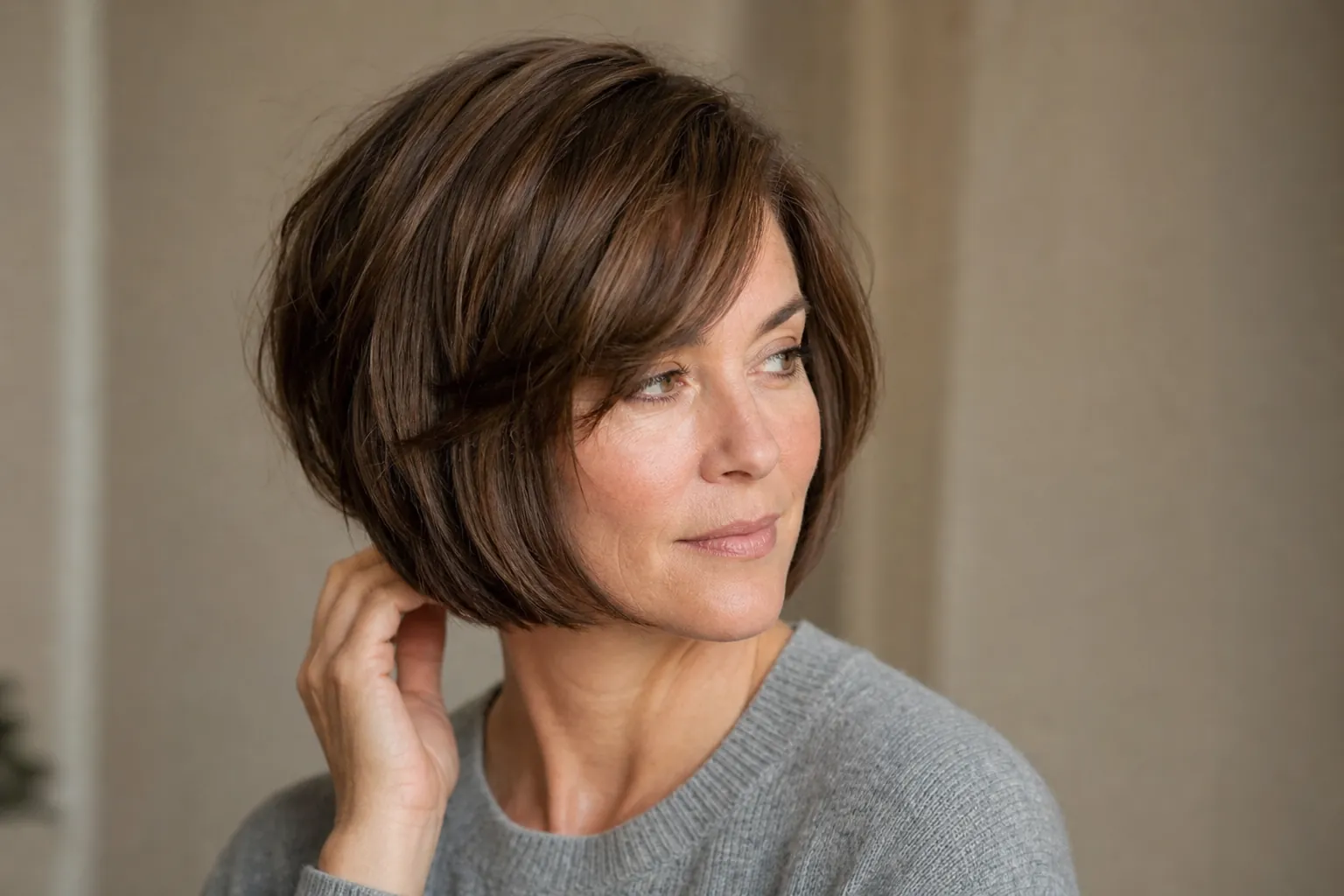
The longer front of an A-line bob and a long side bang move in the same direction, which makes a single diagonal from the part to the chin. That diagonal is why it is chosen for round and square faces. The bangs blend into the front of the bob, so a trim reshapes them rather than shortening them.
Ask for: "An A-line bob, jaw at the back and chin at the front, with long side-swept bangs that end at the cheekbone and blend into the front length."
7. Textured Bob with Wispy Bangs

- Length
- Earlobe to jaw; bangs at the brow
- Texture
- Straight
- Density
- Fine
- Face shapes
- Oval, heart, square
- Daily effort
- 5 minutes
- Trim every
- 4-5 weeks
Fine hair can look thin when a fringe is cut wide and heavy, so the section stays narrow, from temple to temple but not back into the crown. See-through bangs let the forehead show and keep the bob's weight in the hem. If the part is widening, the cuts that work on thin hair cover what to change.
Ask for: "Wispy bangs at the brow, point cut, from a narrow section only. Leave the weight in the hem."
8. Curly Bob with Dry-Cut Bangs
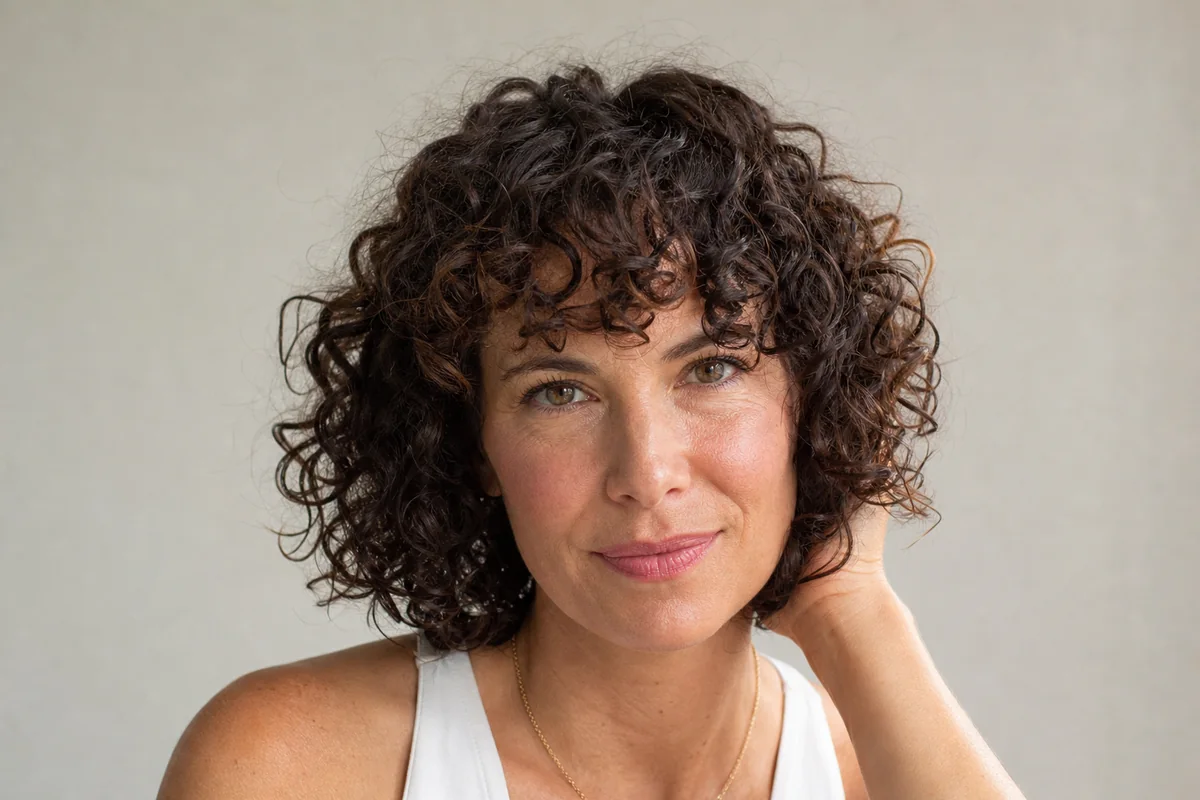
- Length
- Chin; bangs at the brow once dry
- Texture
- Wavy to curly (2C-3C)
- Density
- Medium to thick
- Face shapes
- Oval, long, heart
- Daily effort
- 5 minutes
- Trim every
- 4-6 weeks
Curls shrink as they dry, by about an inch for loose waves and 1-3 inches for curls, so the bangs are cut dry or checked dry, one curl at a time. A fringe cut wet at the brow can end up mid-forehead. Curly bangs usually sit as a few curls over the forehead rather than a solid curtain.
Ask for: "Cut the bangs dry, curl by curl, to end at the brow when dry. Leave them a little long and show me the bounce before you go shorter."
9. Stacked Bob with Choppy Bangs

- Length
- Chin in front, stacked nape; bangs above the brow
- Texture
- Straight to wavy
- Density
- Thick
- Face shapes
- Oval, heart, long
- Daily effort
- 8 minutes
- Trim every
- 3-4 weeks for the bangs, 6 for the bob
Stacking builds weight at the back, so choppy bangs balance it with movement at the front. The jagged ends show less regrowth than a straight line, which stretches the time between trims. Thick hair can take the razor without frizzing; on fine hair it can leave the front looking ragged and thin.
Ask for: "Stacked at the nape, chin at the front, with choppy bangs just above the brow, razor or deep point cut, on dry hair."
Bangs on Lobs
On a lob, bangs are the one short element in a long shape, so they change the proportions more than the length. They need to end well above the jaw, or they read as a separate cut. A lob also has the length to absorb a trim that went slightly short. See the long bob guide for the cut itself.
10. Blunt Lob with Full Bangs

- Length
- Collarbone; bangs at the brow
- Texture
- Straight
- Density
- Medium to thick
- Face shapes
- Oval, long, heart
- Daily effort
- 10 minutes
- Trim every
- 3-4 weeks for the bangs, 8-10 for the lob
A one-length lob can look plain, and full bangs give it a focal point; they are also the only part that needs frequent visits. A wide fringe from temple to temple takes hair from the front of the crown, so thick hair carries it best.
Ask for: "A blunt collarbone lob with full bangs at the brow. Section the bangs from a triangle behind the hairline, not from the crown."
11. Layered Lob with Side-Swept Bangs
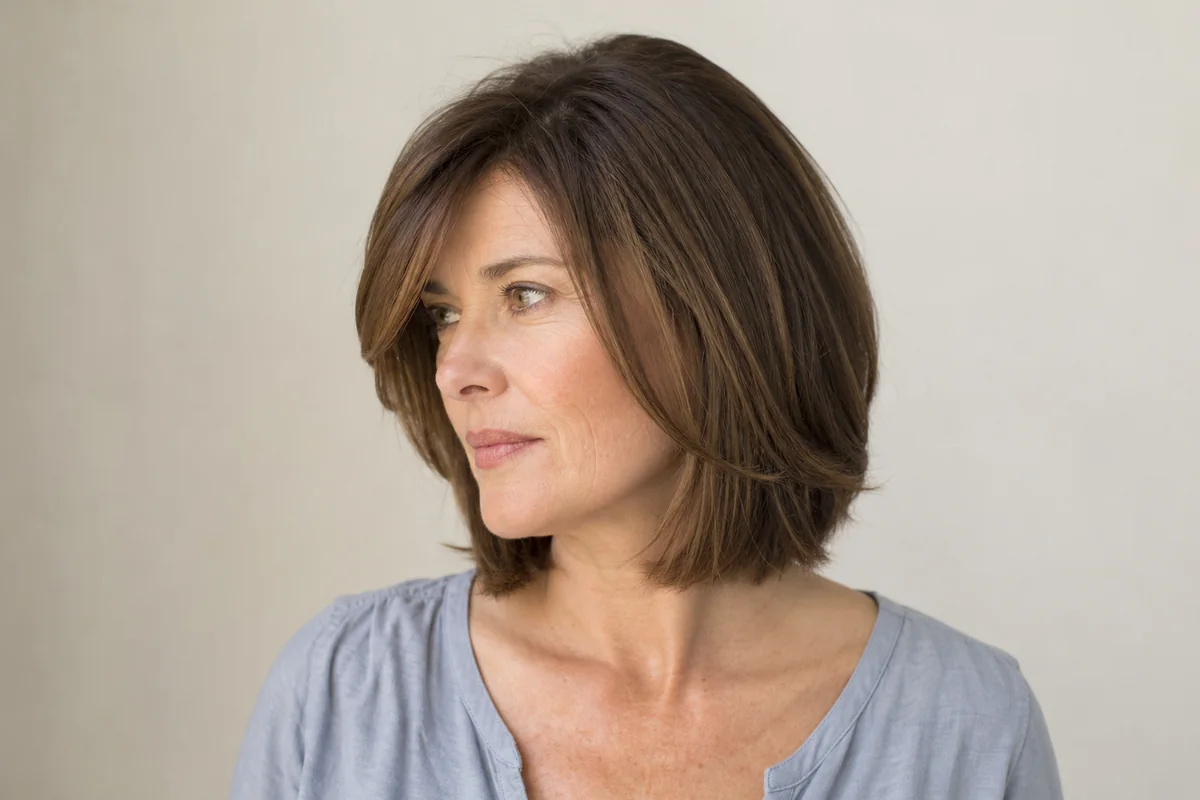
- Length
- Collarbone; bangs to the cheekbone
- Texture
- Straight to wavy
- Density
- Medium
- Face shapes
- Round, square, oval, heart
- Daily effort
- 8 minutes
- Trim every
- 6-8 weeks
Here the bangs and layers form one line from the part to the ends, so the trim schedule is the gentlest on the page. They are also easy to grow into the layers, which makes this the low-commitment entry for anyone unsure about a fringe. The layers themselves are explained in short layered haircuts.
Ask for: "A layered lob with long side bangs that start at the brow and slope to the cheekbone, blended into the first layer."
12. Wavy Lob with Long Wispy Bangs

- Length
- Collarbone; bangs just below the brow
- Texture
- Wavy (2A-2C)
- Density
- Fine to medium
- Face shapes
- Oval, heart, round
- Daily effort
- 5 minutes
- Trim every
- 4-5 weeks
Waves bend as they dry and lift the bangs a little, so the fringe is cut dry or left about half an inch long. Flat-ironing the bangs straight while the rest stays wavy usually looks mismatched. Let them dry with the waves and smooth them only if they flip.
Ask for: "Long wispy bangs that reach just below the brow when dry, point cut, parted a little off-center to follow my waves."
Bangs on Shags
A shag expects bangs, and the bangs decide how the whole cut reads, since the layers are cut to flow out from the fringe. Choppy and feathered bangs suit it best. Shags also need the most fringe upkeep of any cut here, because the layers are short enough to show regrowth quickly. The full cut is in short shag haircuts.
13. Short Shag with Choppy Bangs

- Length
- Chin to jaw; bangs above the brow
- Texture
- Straight to wavy
- Density
- Medium
- Face shapes
- Oval, heart, round, long
- Daily effort
- 5-8 minutes
- Trim every
- 3-4 weeks
With no straight line anywhere, the bangs can be as messy as the layers, and a dry texture spray does most of the styling. The trade-off is regrowth: once the bangs reach the lashes, the shag loses its shape from the front, which is the cue to book a fringe trim.
Ask for: "A short shag with choppy bangs above the brow, razor cut and dry. The shortest layer should connect to the bangs."
14. Curly Shag with Full Curly Bangs

- Length
- Chin to jaw; bangs at the brow once dry
- Texture
- Curly (3B-3C)
- Density
- Medium to thick
- Face shapes
- Oval, long, heart, diamond
- Daily effort
- 5-8 minutes
- Trim every
- 4-6 weeks
A full curly fringe adds volume above the eyes, so it suits curls dense enough to fill it. The shape comes from where each curl is cut, not from a line, and the curl pattern in the front sets the finish. Humidity can make the bangs a size larger by afternoon. The wider texture picture is in short curly hair.
Ask for: "A curly shag with full bangs, cut dry and one curl at a time, ending at the brow when the curls have dried. Keep them slightly long."
15. Gray Shag Bob with Feathered Bangs

- Length
- Jaw; bangs at the brow
- Texture
- Wavy to coarse straight
- Density
- Medium
- Face shapes
- Oval, square, heart
- Daily effort
- 5 minutes
- Trim every
- 4-5 weeks
Gray hair can turn wiry, and a feathered fringe gives that texture some movement while the soft edge forgives a little regrowth. If the ends frizz, one or two drops of oil or a light cream keeps them smooth. More on gray, density and cut choice is in short haircuts for women over 60.
Ask for: "Feathered bangs that end at the brow, swept a little to one side, point cut, on a shag bob with layers at the crown."
16. Bixie with Short Choppy Bangs

- Length
- 3 in at the front; bangs 1 in above the brow
- Texture
- Straight to wavy
- Density
- Medium to thick
- Face shapes
- Oval, long, diamond
- Daily effort
- 5 minutes
- Trim every
- 3 weeks
A micro fringe with a razored edge shows the forehead without looking cut with a ruler. The sides of a bixie are long enough to frame the bangs, which gives the cut more shape than a pixie with the same top length.
Ask for: "A bixie with short choppy bangs about an inch above the brow, razored lightly, with the sides covering the tops of my ears."
Curtain Bangs on Short Hair
Curtain bangs part in the middle and sweep to each side, so they are longest at the outer edges and open at the center, and they grow into layers more easily than any other fringe. They need about 3 inches at the front on a pixie and are simpler on a bob, lob or shag. The sixteen cuts, cowlick fixes and grow-out stages are in the curtain bangs guide; the decisions below apply to every type, curtain included.
Choosing Bangs by Face Shape and Forehead Height
Forehead height and hairline decide how far the bangs can go, and face shape decides how they are cut. Face-shape matching is a stylist's convention for balancing proportions, not a rule, so treat the table as a starting point. A high forehead can wear micro bangs, a low one usually needs wispy or side-swept, and a round face gains most from length and slant. The wider cut rules are in the full range of short haircuts, with short haircuts for round faces to follow.
| Face or forehead | Bangs that usually work | Why | Skip or adjust |
|---|---|---|---|
| Oval | Nearly any type | Proportions are balanced, so the choice is about hair and upkeep | Nothing in particular |
| Round | Long side-swept, wispy, choppy | A diagonal and an uneven edge break up the width | Heavy blunt bangs that end at the widest point |
| Square | Wispy, side-swept, feathered | Soft edges ease the corners of the forehead and jaw | Blunt micro bangs, which repeat the straight lines |
| Heart | Side-swept, wispy, brow-length | A fringe that slants away covers part of a wide forehead and balances a narrow chin | Micro bangs, which put the whole forehead on view |
| Long or oblong | Full blunt, brow-length, choppy | A horizontal line shortens the length | Very long side-swept bangs that add vertical length |
| Diamond | Wispy, side-swept, micro | A fringe adds width across a narrow forehead and keeps the cheekbones open | Heavy bangs that fall to the cheekbones |
| High forehead | Full, micro, brow-length | There is enough area for the fringe to show | Very sparse wispy bangs, which leave the forehead on view |
| Low forehead | Wispy, side-swept, brow-length or longer | Full bangs cover a short forehead and make it look shorter still | Blunt or micro bangs |
Salon note: A stylist checks the hairline before cutting, not only the face shape. A widow's peak, a receding temple or a hairline that sits higher on one side changes which bang type lies flat, and the fringe is then cut to follow the hairline instead of a straight guide.
Cowlicks, Hairline and Part Direction
The way your front hair grows can rule out a bang type before you choose it. A cowlick is a swirl where hair grows against the rest, and at the front it makes bangs stand up or split. The fix depends on where the swirl sits, and bangs cut too short make it worse. The logic matches the curtain bangs cowlick fixes, extended here to every other type.
| What you have | Bangs that work | What to avoid | The reason |
|---|---|---|---|
| Cowlick at the center of the hairline | Long side-swept, or full blunt bangs with weight | Micro and curtain bangs | Length lets the hair lie down; a center part fights the swirl |
| Cowlick at one side of the hairline | Side-swept in the direction the hair already grows | Bangs cut short on that side | Hair that grows one way lies flat when it is allowed to |
| Widow's peak | Side-swept, wispy, longer than the brow | Micro and blunt bangs | A straight line shows the point; a slanted one lets it blend |
| Double crown | Any fringe, with the top kept at 3 in or more | A very short crown | Two whorls stand up on a short top, though not at the front |
| Receding temples | Wispy or side-swept bangs, brow-length | Micro bangs, a high side part | A fringe across the corners covers the temples |
To see where the swirl sits, wet the hair and comb it forward. Cutting the bangs dry, with the part where the hair falls, shows how it really behaves. Direct a cowlick with a dryer while the roots are damp, brushing from side to side; if it still lifts, a longer fringe or a side part is the answer, not shorter bangs.
Bangs by Texture and Density
Straight hair keeps the line it is cut with, while waves and curls move after the cut. A wide, full fringe borrows hair from the crown, and that costs fine hair the most. Choose the type by texture first and by how wide a section the density can spare second.
| Texture | Fine to thin hair | Thick hair | Cut note |
|---|---|---|---|
| Straight | Wispy or side-swept; narrow section | Blunt, choppy or full; thinning shears are fine | Cut wet or dry; no shrinkage |
| Wavy (2A-2C) | Long wispy or side-swept; leave 0.5 in extra | Choppy or side-swept; remove weight inside | Check dry; waves shrink up to about 1 in |
| Curly (3A-3C) | Soft curly bangs; keep the section small | Full curly bangs shaped curl by curl | Cut dry, 1-3 in longer than the target |
| Coily (4A-4C) | Sculpted, tapered fringe from a small section | Curved, shaped fringe, sculpted to the hairline | Cut dry, by a stylist who cuts coily hair |
On curly and coily hair a blunt edge is not the aim, because curls spring up and break the line. Thinning shears are a normal tool on straight, thick hair; on wavy and curly hair they tend to frizz, so deep point cutting is used instead. Bangs on any texture also need washing more often than the rest, since they rest against the forehead, which picks up oil.
What to Ask for When You Want Bangs on Short Hair
Describe the bangs by landmark, edge and the hair they sit on. The word bangs can mean anything from micro to chin-length, so a photo and one landmark remove the guesswork. Read the checklist off your phone.
- The type by name (micro, blunt, wispy, side-swept, choppy, curly) and the landmark where it ends: above the brow, at the brow, at the cheekbone
- The edge: straight, point cut, razored or shaped curl by curl
- Where the bangs begin: a narrow triangle behind the hairline for fine hair, a wider section for thick hair
- Where your cowlick is, and that the bangs should be cut on dry hair
- Whether they should blend into the sides now or grow out later
Tip: Ask for the bangs to be left a little long the first time, and book a trim three weeks later. A fringe can be shortened in a minute; it takes months to put back.
Styling Bangs Day to Day
Bangs need their own few minutes, because they pick up oil and bend out of shape faster than the rest of the hair. Dry-shampoo or rinse them between full washes. The wider routine is in how to style short hair.
- Start at the front. Rough-dry the fringe with a few passes side to side, so the roots lie flat and the cowlick is cancelled, before the rest is dry.
- Shape with a small round brush. A 1-inch brush gives straight and wavy bangs a slight bend. Skip it on curls, which are shaped by finger or diffuser.
- Set with a light product. A dime of cream on wiry hair, 4-8 sprays of dry texture spray spread through choppy bangs, a dab of gel on curls.
- Refresh at midday. A little dry shampoo at the roots lifts the bangs and absorbs oil without a wash.
Trim Intervals and Growing Out Bangs
Bangs need a trim every 3-5 weeks, and growing them out takes roughly 4-7 months to reach the cheekbone, depending on type. Hair grows about half an inch a month on average, though the rate varies by person and scalp area, as a study of hair growth, diameter and shape in young adults found. The times below are arithmetic from that average, so treat them as estimates.
| Bang type | Awkward stage | Time to reach the cheekbone | What to do meanwhile |
|---|---|---|---|
| Micro | Months 2-3, reaching the brows and then the eyes | About 6-7 months | Clip or pin to the side; ask for a slanted trim instead of a straight one |
| Blunt | Months 2-4, in the eyes with a heavy line | About 4-5 months | Part it in the middle and have the edge point cut to soften it |
| Wispy or feathered | Months 2-3 | About 4 months | Sweep to the side; the soft edge blends in |
| Side-swept | Barely a stage | Already near the cheekbone | Blend into the face-framing layers |
| Choppy | Months 2-3 | About 4-5 months | Let the layers blend; keep the sides short |
| Curly | Months 1-3, since curls shrink and hide growth | About 4-5 months | Reshape dry every 4-6 weeks; do not cut it back |
Salon note: Growing out is easiest when the trims only reshape. Ask the stylist to take length from the sides and the middle of the bangs, not the front edge, so the fringe turns into a face-framing layer as it grows, and to hold the nape on a pixie while the front catches up.
When Bangs Are Not the Right Choice
- A strong cowlick at the center of the hairline. Short bangs stand up or split. Try a long side-swept fringe, or skip the bangs and grow the front into layers.
- Hair too fine to spare a section. A wide fringe takes density from the crown and part. Use a narrow triangle with wispy edges, or face-framing layers only.
- An oily forehead or scalp. Bangs get oily within a day and may need daily washing, so face-framing layers are less work.
- Glasses with thick or low frames. Bangs that touch the lenses smear and push the frame. Cut them to clear the frame, or choose side-swept bangs.
- No time for a daily routine. Straight bangs left to air-dry tend to fall flat. Waves and curls are the exception.
- A widening part or thinning at the temples. Bangs can cover the front but not treat it; see a board-certified dermatologist for new or sudden thinning.
Short hair with bangs works when the fringe is chosen for your hairline, your cowlick and your texture first, and the trend second. Bring a photo and one landmark to your stylist, ask for the bangs to be left slightly long, and book the first trim three to four weeks later.