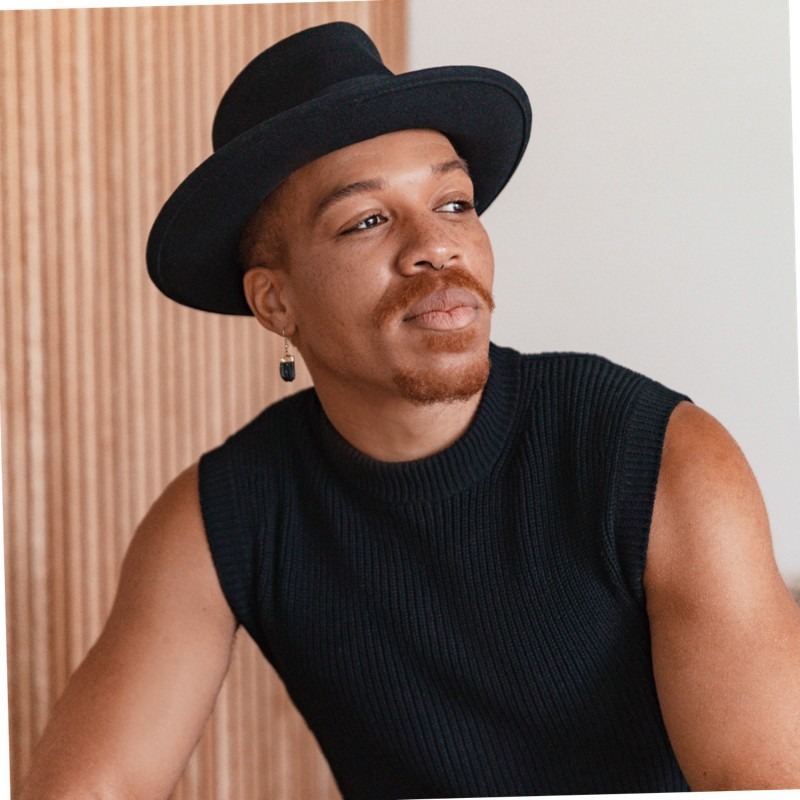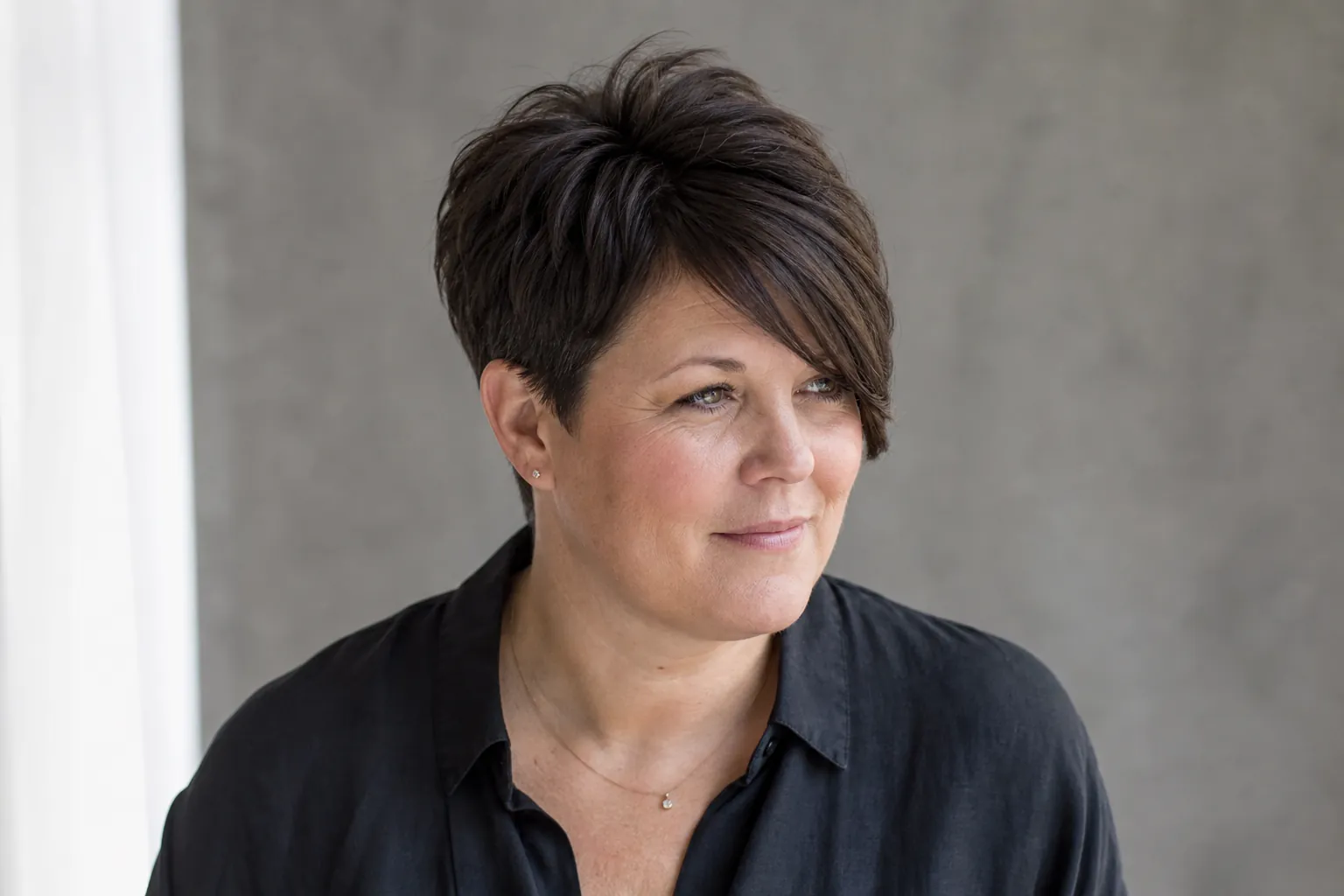

Short version: A bixie haircut is a pixie-bob hybrid: the top and sides grow long enough to cover the ears and reach somewhere between the cheekbone and the jaw, while the nape stays short and tapered like a pixie's. It suits fine hair that wants more cover than a pixie, thick hair cut with weight taken out, and curls cut dry. Expect a trim every 5-7 weeks and 5-10 minutes of styling.
What a Bixie Haircut Is, and Where It Ends
A bixie is defined by long, layered sides over a short back: the ears are covered or half covered, the front falls to a landmark on the face, and the back tapers in close below the occipital bone (the ridge at the back of the skull) instead of ending in a bob's weight line. On a map of every short length band, it sits between the long pixie and the ear-length bob.
The back is where a bixie borrows most from the pixie. It can be scissor-tapered, clippered or undercut, and each choice sets how often you return; the trade-offs and cleanup weeks are covered in the nape section of our pixie cut guide. Most bixies use the soft scissor taper.
The word is recent, popularized on social media in the early 2020s, but the shape is the choppy, ear-covering crop of the 1990s. The labels blur at the edges, so this table settles them by landmark:
| Cut | Ears | Front ends at | Back | Trim every |
|---|---|---|---|---|
| Long pixie | Out or just touched | Brow to cheekbone | Short, close nape | 5-6 weeks |
| Bixie | Half to fully covered | Cheekbone to jaw | Short tapered nape, no weight line | 5-7 weeks |
| Ear or jaw bob | Covered | Earlobe to jaw | A weight line at the perimeter | 6-8 weeks |
| Mixie or short wolf cut | Partly covered | Varies | Nape left longest, to the neck | 6-8 weeks |
Classic and Sleek Bixies
The cleaner versions of the bixie rely on a defined outline rather than choppy texture, so they read as polished on straight hair and look fuller on fine hair. They also show a lazy cut quickly, which is why they need the most precise layering.
1. Soft Layered Bixie at Cheekbone Length

- Length
- 4-5 in on top, front to the cheekbone, 1.5 in at the nape
- Texture
- Straight to wavy
- Density
- Fine to medium
- Face shapes
- Oval, heart, long, square
- Daily effort
- 5-8 minutes
- Trim every
- 5-7 weeks
The reference version, and the one to bring if you are unsure. Layers start around the top of the ear, so the sides fall over it without bulk.
Ask for: "A bixie with soft layers that cover my ears, the front landing at my cheekbone when dry, and a short scissor-tapered nape."
2. Sleek Side-Part Bixie Tucked Behind One Ear

- Length
- Jaw-length front, 3 in at the crown, short nape
- Texture
- Straight
- Density
- Medium to thick
- Face shapes
- Round, square, oval
- Daily effort
- 8-10 minutes with a flat iron
- Trim every
- 5-6 weeks
A deep part sends the longest piece diagonally across the forehead, which narrows a round or square face. Smooth straight hair shows every uneven layer, so check the tuck dry.
Ask for: "A sleek bixie with a deep left part, long enough on the right to reach my jaw and on the left to tuck behind my ear. Tapered nape, minimal texturizing."
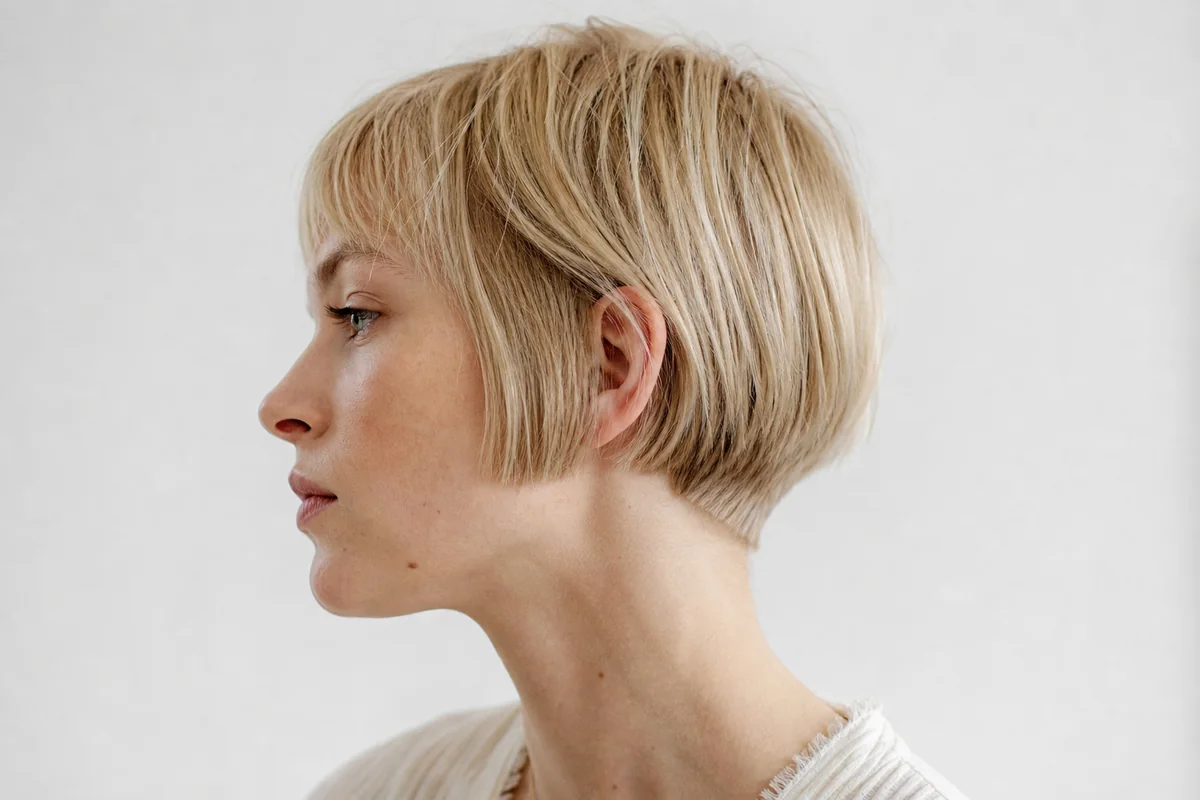
3. Blunt-Edged Bixie for Fine Straight Hair
- Length
- Sides to mid-cheek, 4 in on top, 1.5 in at the nape
- Texture
- Straight
- Density
- Fine or low density
- Face shapes
- Oval, long, heart
- Daily effort
- 5 minutes
- Trim every
- 5-6 weeks
Fine hair gets its density from the edge. Keeping the sides blunt, with layers only at the crown, leaves the perimeter as thick as the hair allows; the shaggy version on fine hair can look see-through by the ears.
Ask for: "A bixie with blunt sides at mid-cheek and layers only at the crown. My hair is fine, so no thinning shears and no razor."
4. 90s Bixie with a Feathered Brow Fringe

- Length
- Fringe to the brows, sides to the jaw, short nape
- Texture
- Straight to slightly wavy
- Density
- Medium
- Face shapes
- Long, oval, heart, diamond
- Daily effort
- 8-10 minutes
- Trim every
- 5-6 weeks, fringe at 3-5
The 90s version is defined by flicked, piecey ends and a fringe on the brows; a round brush turned outward gives the flick. On a round face, skip the flick at cheek level, which adds width exactly where it shows.
Ask for: "A 90s-style bixie: feathered fringe to my brows, choppy layers over the ears, ends point cut so they flick out at the jaw."
Shaggy, Choppy and Wolf-Leaning Bixies
A shaggy bixie moves the layering higher and breaks up the ends, so the cut looks intentional even as it grows. These suit medium to thick hair best; on fine hair, keep the shag at the crown and the edges solid.
5. Shaggy Bixie with Curtain Bangs

- Length
- Curtain bangs to the cheekbone, 3 in crown layers, sides to the jaw
- Texture
- Straight to wavy
- Density
- Medium to thick
- Face shapes
- Long, heart, square, oval
- Daily effort
- 5-10 minutes
- Trim every
- 6-7 weeks, bangs at 3-5
Curtain bangs blend into the side layers, framing the face from brow to jaw in one line. A few weeks overdue, the shag simply reads as softer.
Ask for: "A shaggy bixie with center-parted curtain bangs to my cheekbones, short layers at the crown, and choppy sides over the ears. Soft, wispy nape."
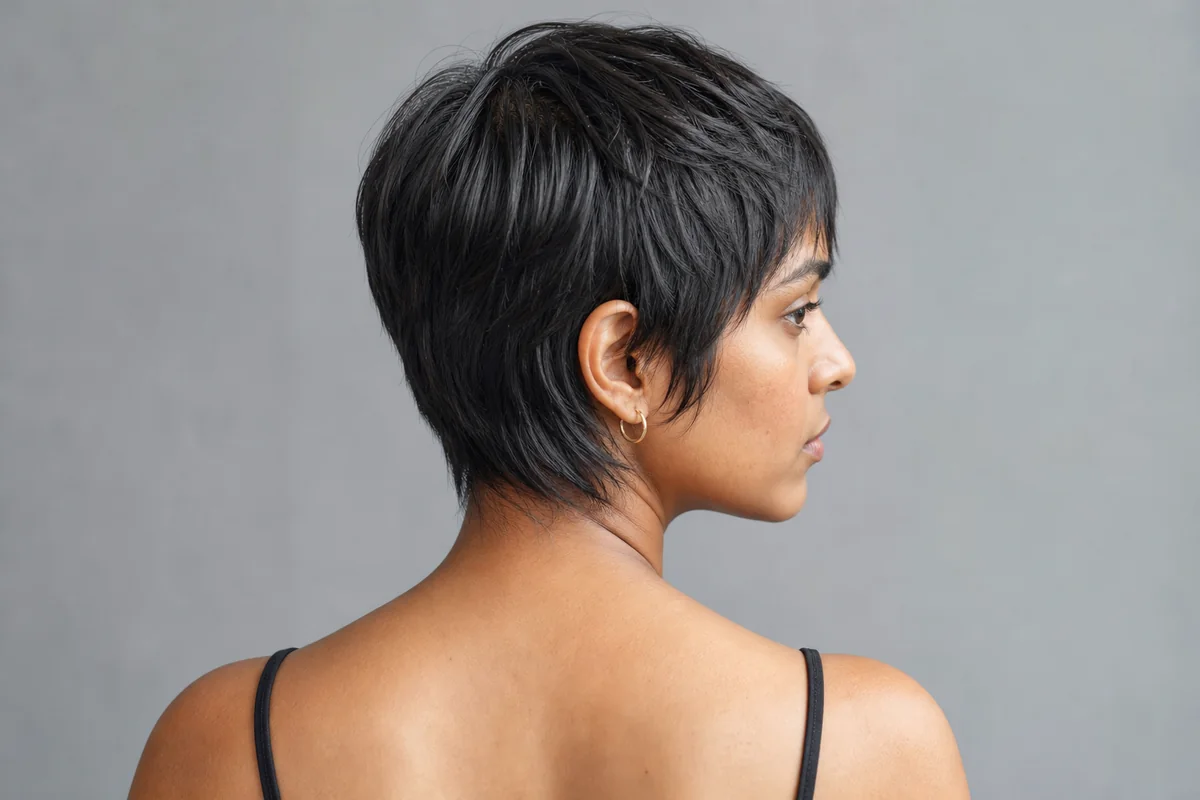
6. Choppy Bixie with Weight Taken Out for Thick Hair
- Length
- 4 in on top, sides to the earlobe, 1 in at the nape
- Texture
- Straight
- Density
- Thick, coarse
- Face shapes
- Oval, long, heart, diamond
- Daily effort
- 5 minutes
- Trim every
- 5-6 weeks
Thick straight hair cut to cover the ears tends to mushroom: the sides stack up and push outward. Slide cutting (gliding open shears down a section) and point cutting through the interior let the layers collapse onto the head, so the outline stays narrow.
Ask for: "A choppy bixie, sides to my earlobe. My hair is thick, so slide cut or point cut weight out from underneath at the sides and back, checked dry."
7. Bixie Wolf Cut with a Wispy Neckline

- Length
- 2.5 in crown layers, sides over the ears, 2.5-3 in wispy nape
- Texture
- Wavy to curly
- Density
- Medium to thick
- Face shapes
- Oval, heart, long
- Daily effort
- 5 minutes, air-dry
- Trim every
- 6-8 weeks
The wolf version breaks the bixie's one firm rule by letting wispy pieces grow onto the neck. Past about 3 inches at the nape it stops being a bixie and becomes a short wolf cut, which has its own gallery in our guide to the wolf cut for short hair. Waves fill the longer pieces; on fine straight hair they can look thin.
Ask for: "A bixie wolf cut: heavy short layers at the crown, choppy sides over my ears, and wispy pieces at the nape about 2.5 inches long."
8. Bixie with a Micro Fringe

- Length
- Fringe 1-1.5 in, sides to mid-cheek, short nape
- Texture
- Straight
- Density
- Medium to thick
- Face shapes
- Oval, long, heart
- Daily effort
- 5 minutes
- Trim every
- 5-6 weeks, fringe at 3-4
Readers with a front-hairline cowlick should skip a fringe this short, because there is no weight to hold it down. Without one, it is the most graphic bixie here and shortens a long face.
Ask for: "A bixie with a micro fringe about an inch and a half long, cut dry, and textured sides covering my ears to mid-cheek."
9. Undercut Bixie for Very Thick Hair
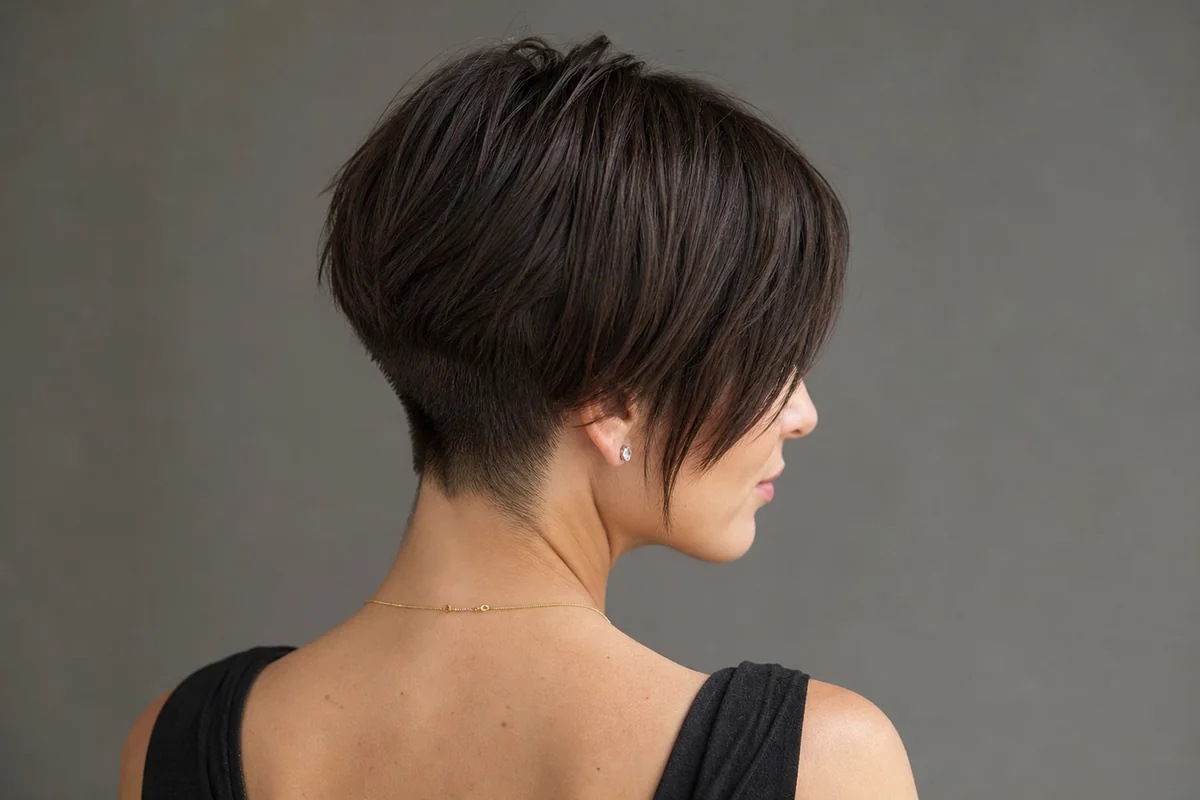
- Length
- Jaw-length sides, #2 undercut below the occipital bone
- Texture
- Straight to wavy
- Density
- Very thick
- Face shapes
- Oval, square, long
- Daily effort
- 5-8 minutes
- Trim every
- 6 weeks, undercut cleanup at 2-4
When weight removal alone can't stop the back from bulging, an undercut takes the bottom layer away entirely. The top drops over it, so the bixie looks soft from the front and slim from the side.
Ask for: "A bixie with an undercut at the nape, clippered with a #2 up to the occipital bone and hidden under the top. Sides to my jaw."
Wavy, Curly and Coily Bixies
A textured bixie needs more length than it shows, and its shape is finished dry, because waves, curls and coils shrink as they dry; a front that measures to the jaw stretched may land at the cheekbone. Our short curly hair guide covers shrinkage by curl type.
10. Wavy Bixie with Air-Dried Bends

- Length
- Front to the jaw, 4 in on top, soft 1.5 in nape
- Texture
- Wavy, 2A-2C
- Density
- Fine to medium
- Face shapes
- Oval, square, long, round
- Daily effort
- 5 minutes, air-dry
- Trim every
- 6-7 weeks
The longer sides give waves the few inches they need to bend, which a pixie rarely does. Scrunch a light mousse or cream into damp hair and leave it; thinning shears through wavy layers turn the bend into frizz.
Ask for: "A wavy bixie, front to my jaw, point cut so the waves form. No thinning shears, and check the shape once it's dry."
11. Curly Bixie Shaped Curl by Curl
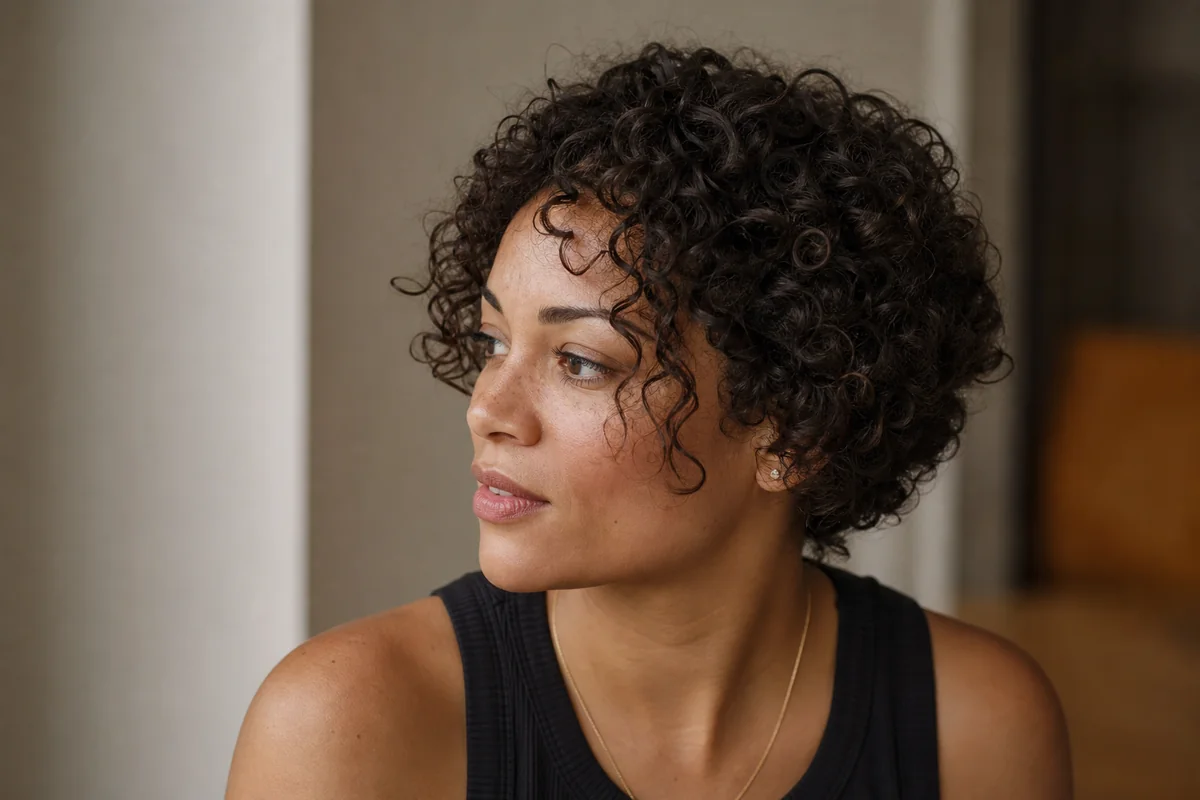
- Length
- Front 5-6 in stretched (cheekbone when dry), close nape
- Texture
- Curly, 3A-3B
- Density
- Medium to thick
- Face shapes
- Oval, long, heart, square
- Daily effort
- 5 minutes, wash-and-go
- Trim every
- 7-8 weeks
Cut wet, a curly bixie springs up into a pixie. Cut dry, each curl is shortened where it sits. Rake gel through dripping-wet curls over a leave-in, and diffuse without touching until dry.
Ask for: "A curly bixie cut dry, curl by curl. I want the front to land at my cheekbone dry, the sides covering my ears, and the nape close."
12. Tight-Curl Bixie with Height at the Crown

- Length
- 3 in of curl at the crown (shrunken), shorter at the sides, tapered nape
- Texture
- Curly, 3C
- Density
- Thick
- Face shapes
- Round, oval, heart
- Daily effort
- 5 minutes, plus wash day
- Trim every
- 6-8 weeks
On 3C curls, volume naturally goes outward, so the sides are kept a little shorter than the crown and the shape rises instead of widening. That height is what makes it work on a round face.
Ask for: "A curly bixie shaped dry, with the most length at the crown and shorter sides so it doesn't get wide. Taper the nape."
13. Coily Tapered Bixie with a Longer Front
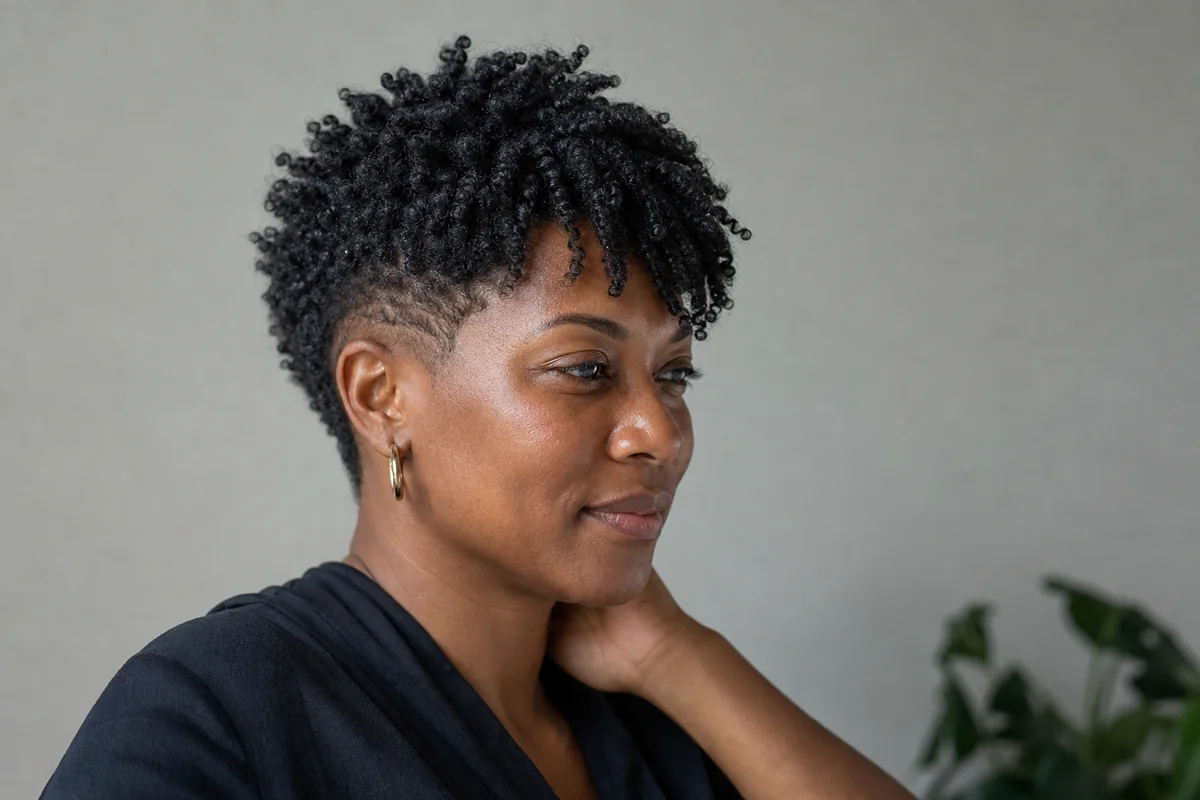
- Length
- 3 in at the front (shrunken), tapered to #1-#2 at the nape
- Texture
- Coily, 4A-4B
- Density
- Medium to thick
- Face shapes
- Oval, heart, square, diamond
- Daily effort
- 5 minutes, twist-out set weekly
- Trim every
- 4-6 weeks for the taper
On coily hair the bixie shape is built with a taper rather than layers: length stays at the front and crown, where a twist-out or finger coils sit, while the sides fade down. Moisture does the work here: a watery leave-in first, then a twisting cream.
Ask for: "A tapered cut shaped dry, longest at the front and crown, about 3 inches shrunken, with the sides and nape tapered from a #2 to a #1."
14. Silk-Pressed Bixie on Coily Hair
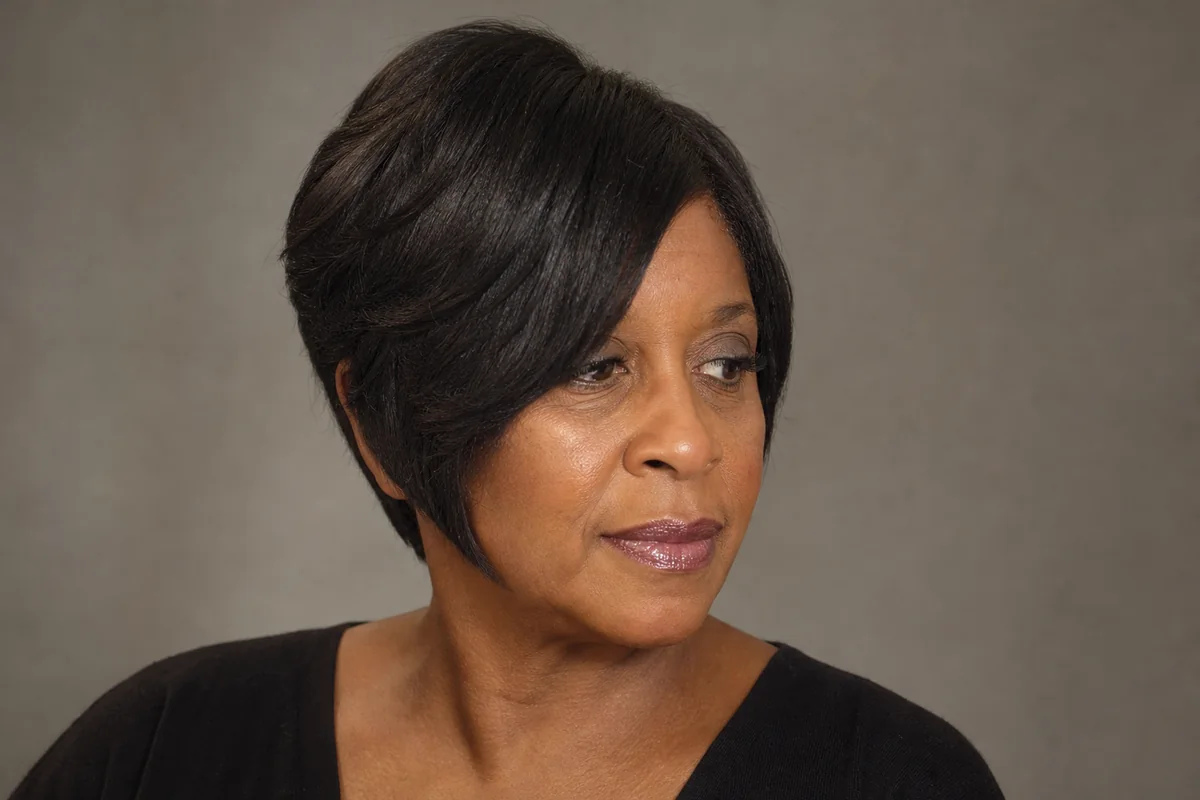
- Length
- Jaw-length front pressed, short nape
- Texture
- Coily, worn heat-straightened
- Density
- Medium
- Face shapes
- Round, oval, square
- Daily effort
- 5 minutes; press redone every 1-2 weeks
- Trim every
- 5-6 weeks
A press shows the layering the way straight hair does, but humidity and sweat revert it to coils, and the cut then sits much shorter. Choose a stylist who checks how it will look curly too.
Ask for: "A bixie cut on my silk press: side part, front to my jaw, layers over my ears. Show me where it will sit if it reverts."
Bixies for Fine, Gray and Over-60 Hair
For fine or graying hair, the bixie often solves a pixie's problem: the longer sides cover the ears and temples where fine hair looks sparse, while the short back keeps weight off the crown so it can lift. Cuts built around a thinning crown or a widening part are the focus of our short haircuts for women over 60.
15. Stacked Bixie with Lift for Fine Hair
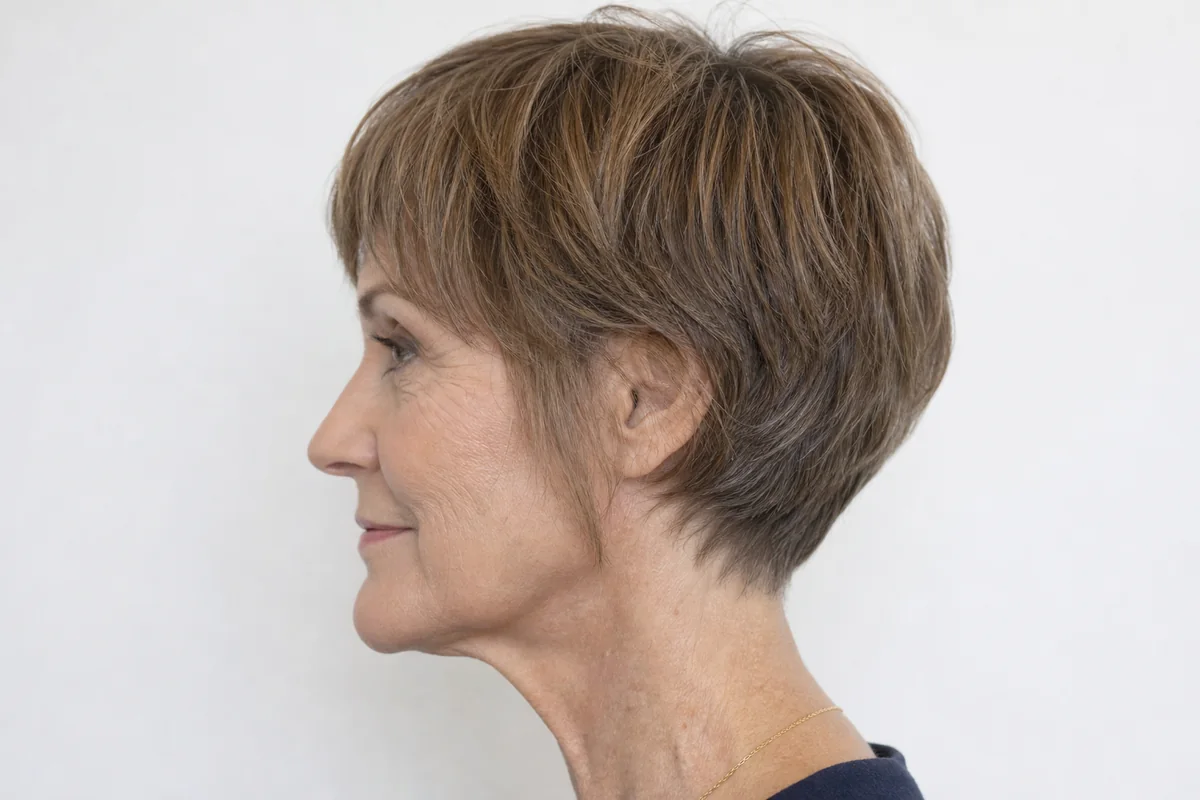
- Length
- 2.5-3 in at the crown, sides to the cheekbone, close nape
- Texture
- Straight to slightly wavy
- Density
- Fine, low density
- Face shapes
- Round, oval, heart
- Daily effort
- 5-8 minutes with a blow-dryer
- Trim every
- 5-6 weeks
Graduation at the back gives the crown something to rest on, which fine hair can't build alone. Mousse at the root and a minute of drying against the fall set it.
Ask for: "A stacked bixie with graduation at the back so the crown lifts, sides to my cheekbone. Fine hair, so texturize the ends only."
16. Silver Bixie with a Side-Swept Front

- Length
- Front to the cheekbone, 3.5 in on top, short nape
- Texture
- Straight to wavy, including coarse gray
- Density
- Fine to medium
- Face shapes
- Oval, square, round, heart
- Daily effort
- 5 minutes
- Trim every
- 5-7 weeks
Gray that has turned wiry tends to stick out at the ends, and a side-swept front gives it a direction to follow. A dime of smoothing cream calms the ends; a violet-toned shampoo every week or two keeps white from turning yellow.
Ask for: "A bixie with a side-swept front to my cheekbone and soft layers over the tops of my ears. Point cut the ends rather than thinning them."
17. Salt-and-Pepper Bixie Cut to Clear Glasses

- Length
- Front to the cheekbone, sides resting on the upper ear
- Texture
- Wavy, 2A-2B
- Density
- Medium
- Face shapes
- Oval, long, square
- Daily effort
- 5 minutes, air-dry
- Trim every
- 6 weeks
Glasses arms push ear-covering hair outward into a ledge. Wear them to the appointment so the side layers can be cut to rest over the arms, not under them. Mixed gray and pigmented strands often wave differently, so this is one to check dry.
Ask for: "A bixie cut with my glasses on, side layers falling over the arms, front at my cheekbone. Check the wave dry."
18. Long-Front Bixie for a Round Face

- Length
- Front just past the jaw, 3 in at the crown, short nape
- Texture
- Straight to wavy
- Density
- Medium
- Face shapes
- Round, square
- Daily effort
- 8-10 minutes
- Trim every
- 5-6 weeks
Front pieces that end below the jaw draw the eye past the widest point of the face, and crown height adds length above it. Fullness at cheek level is what to avoid.
Ask for: "A bixie with height at the crown and long angled front pieces just past my jaw. Keep the sides smooth and flat over my ears."
Bixie Haircut Fit by Texture and Density
The bixie works on every texture once the front length is set for shrinkage and weight is handled for density. Curl pattern is set at the hair bulb, as a study of curly follicles showed, so a cut decides where texture falls, not how much of it there is.
| Texture | Fine or low density | Thick or high density | Front length to ask for | Cut wet or dry |
|---|---|---|---|---|
| Straight | Blunt sides, layers at the crown only (looks 3, 15) | Choppy with slide cutting, or undercut (looks 6, 9) | The dry landmark you want | Wet, edges checked dry |
| Wavy (2A-2C) | Soft layers, no thinning (looks 10, 17) | Shaggy or wolf-leaning (looks 5, 7) | About 1 in past the landmark | Either; finish dry |
| Curly (3A-3C) | Fewer layers so the sides keep cover | Shorter sides, length at the crown (looks 11, 12) | 1-3 in past the landmark, stretched | Dry, curl by curl |
| Coily (4A-4C) | Taper that keeps the front dense | Tapered with a longer front, or pressed (looks 13, 14) | Set by shrunken length; often more than curly | Dry, natural state |
A bixie can look fuller on fine hair than a pixie does, but only while its sides stay solid. Once the ear-covering layers are thinned or razored, light shows through them, and that is the version people describe as limp by midday.
Salon note: On thick straight hair, the bulk that makes a bixie mushroom sits underneath, in the hair from the occipital bone down and behind the ears. Removing weight there, rather than shortening the top layer, keeps the outline narrow without losing the length that covers the ears.
Choosing a Bixie for Your Face Shape
On a bixie, where the front ends does most of the face-shape work, because the cut is short everywhere else. Moving the front from cheekbone to lip to jaw changes which part of the face it emphasizes. Fuller cheeks and a short chin have a whole gallery of short haircuts for round faces.
| Face shape | End the front at | Put volume | Usually skip |
|---|---|---|---|
| Oval | Any landmark | Anywhere | Nothing in particular |
| Round | Just past the jaw, angled | Crown | Cheekbone-length fullness, outward flicks at the cheeks |
| Square | Cheekbone or lip, soft ends | Crown and temples | A blunt edge exactly at the jaw |
| Long | Cheekbone, with a fringe | Sides, at ear level | Tall crown height |
| Heart | Lip to jaw | Below the cheekbones | Lift and width at the temples |
| Diamond | Cheekbone, with a fringe | Forehead and jaw | Very short pieces exposing the full cheekbone width |
How to Ask for a Bixie Haircut
Because "bixie" means different lengths to different stylists, describe it by landmark: where the front ends, how much of the ear is covered and how the nape is finished. Bring two photos of the cut on hair like yours, ideally one from the side, and one of what you don't want.
- Front. Cheekbone, lip or jaw, dry. Curly and coily hair: ask what that means stretched.
- Ears. Half covered or fully covered. Ears out is a long pixie; say so if that is what you want.
- Layering. Soft, choppy or shaggy, and whether the edges should stay blunt.
- Nape. Short and scissor-tapered for most bixies; clippered or undercut on very thick hair.
- Weight and whorls. Mention thick hair, a nape whorl or a cowlick before the cut starts.
Ask for: "A bixie with the front at my cheekbone when dry, sides covering half my ears and a short scissor-tapered nape. Soft layers, blunt edges, because my hair is fine. I have a cowlick at the back of my crown, so please leave it some length."
Salon note: Coming from long hair, a bixie is easier to judge in two steps: a jaw-length bob first, then the back taken short once you have seen the front on your face. The second step takes ten minutes; undoing a nape cut too short takes months.
Styling a Bixie Every Day
Most bixies take 5-10 minutes: a little longer than a pixie, because the sides need direction, and much shorter than a sleek bob. Curly and coily bixies can be under 5 minutes on non-wash days. Products by finish and hold, with amounts by length, are in our guide to styling short hair.
- Start damp. Rewet the sides and front on second days; curly and coily hair may need a full spray to re-form.
- Add one product for the base. A dime of cream for smooth or wavy bixies, a small handful of mousse at fine roots, leave-in and gel for curls.
- Dry the sides forward and down. Fingers or a 1-1.5 in round brush, aiming the ends toward the face. Diffuse curls on low.
- Separate the ends. A pea of paste or a few spritzes of texture spray for shaggy cuts; 1-2 drops of oil for coarse gray or pressed hair.
Short hair tempts you to dry it on high at close range. In a study of hair dryer heat and distance, drying at about 15 cm (6 inches) with the dryer kept moving caused less overall damage than letting hair dry naturally, while closer, hotter drying increased surface damage. Keep the nozzle moving and a hand's width away.
Tip: If the sides keep flipping out over the ears, dry them flat against the head with your palm before touching the top. Short side layers set in whatever direction they dried.
Bixie Maintenance and Growing It Out
Plan on a trim every 5-7 weeks, with fringes at 3-5 weeks and clippered or undercut napes cleaned up every 2-4. The nape and the hair behind the ears lose shape first; the front can usually go longer. Curly and coily bixies often stretch to 7-8 weeks, apart from tapers.
| Weeks after the cut | Nape | Over the ears | Front | Usual fix |
|---|---|---|---|---|
| 0-3 | Close and tidy | Lies flat | At the landmark | None |
| 4-5 | Starts touching the collar | Thickens; may push outward | About half an inch longer | Style the sides flat; fringe trim if any |
| 6-7 | Fuzzy, reads as grown out | Bulky on thick hair | Past the landmark | Full trim |
| 8+ | Heading toward a mullet | Shape starts reading as a short bob | About an inch longer | Trim, or start a planned grow-out |
Timing varies even across one head: a study of 2,249 adults across 24 ethnic groups found growth rates differed by scalp area, sex and origin. Plan around half an inch a month.
A bixie is also the middle stage of growing out a pixie; the full month-by-month route is in our guide to growing out a pixie. Going from bixie to bob usually takes about 4-6 months, depending on how short the nape started: stop tapering the back, let it catch up with the sides, and trim only bulk. The shapes it can land on are in our gallery of bob haircuts.
Salon note: When a bixie is being grown into a bob, the nape is left alone from the first appointment, but the hair behind the ears still gets weight taken out. Skip that and the cut passes through a wide, triangular stage at months 2-3.
When a Bixie Is Not the Right Choice
A bixie is a between length, and some hair or habits don't suit being in between. In these cases a different short cut usually works better.
- Your hair is thick and straight, and the cut can't include weight removal or an undercut. Ear-covering sides stack into a mushroom. A long pixie with the ears out, or a lob, carries the weight better.
- Your curls or coils shrink a lot and you want the front to swing at the jaw. Shrinkage pulls it up to the cheekbone or higher. Ask for more stretched length, or choose a tapered cut built around the top.
- You want to tie your hair back. The nape is too short to gather. A chin bob can be pinned; a lob can be tied.
- Your fine hair has been razored or heavily thinned. The sides need a solid edge to look full. Wait for the ends to grow back before cutting a bixie, or go shorter to a pixie.
- What you want is a bob. A bixie with a longer back is a bob that needs more trims. Get the bob.
- You won't style it. On straight hair the sides need direction every morning; a blunt bob or a wash-and-go curly cut asks for less.
A good bixie haircut is decided by three landmarks: where the front ends, how much of the ear it covers and how short the nape sits. Pick the look in this gallery closest to your texture and density, read its script from your phone, and name the front length dry, adding stretched length if your hair curls.