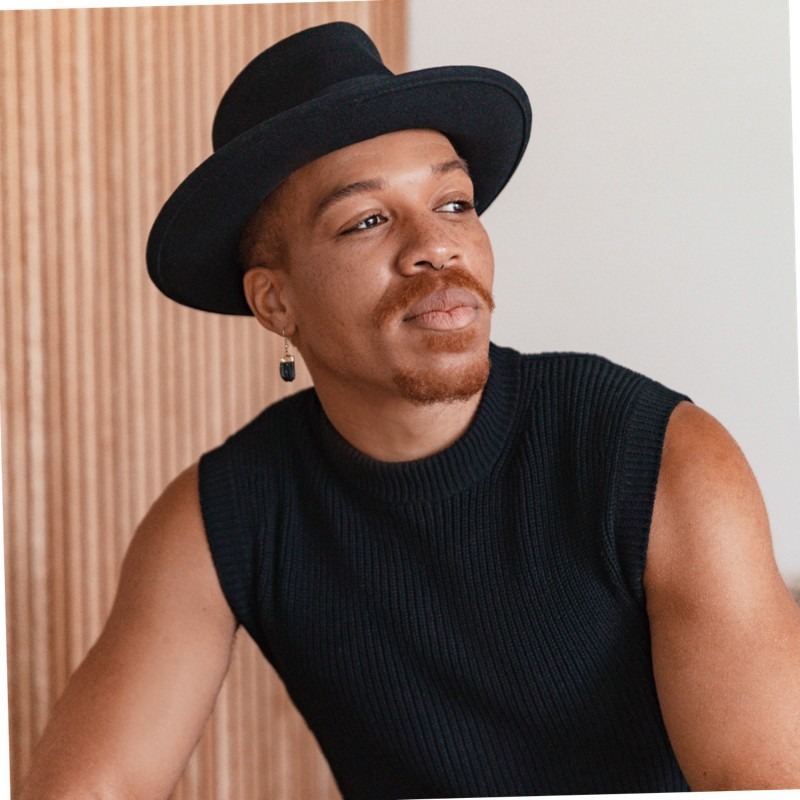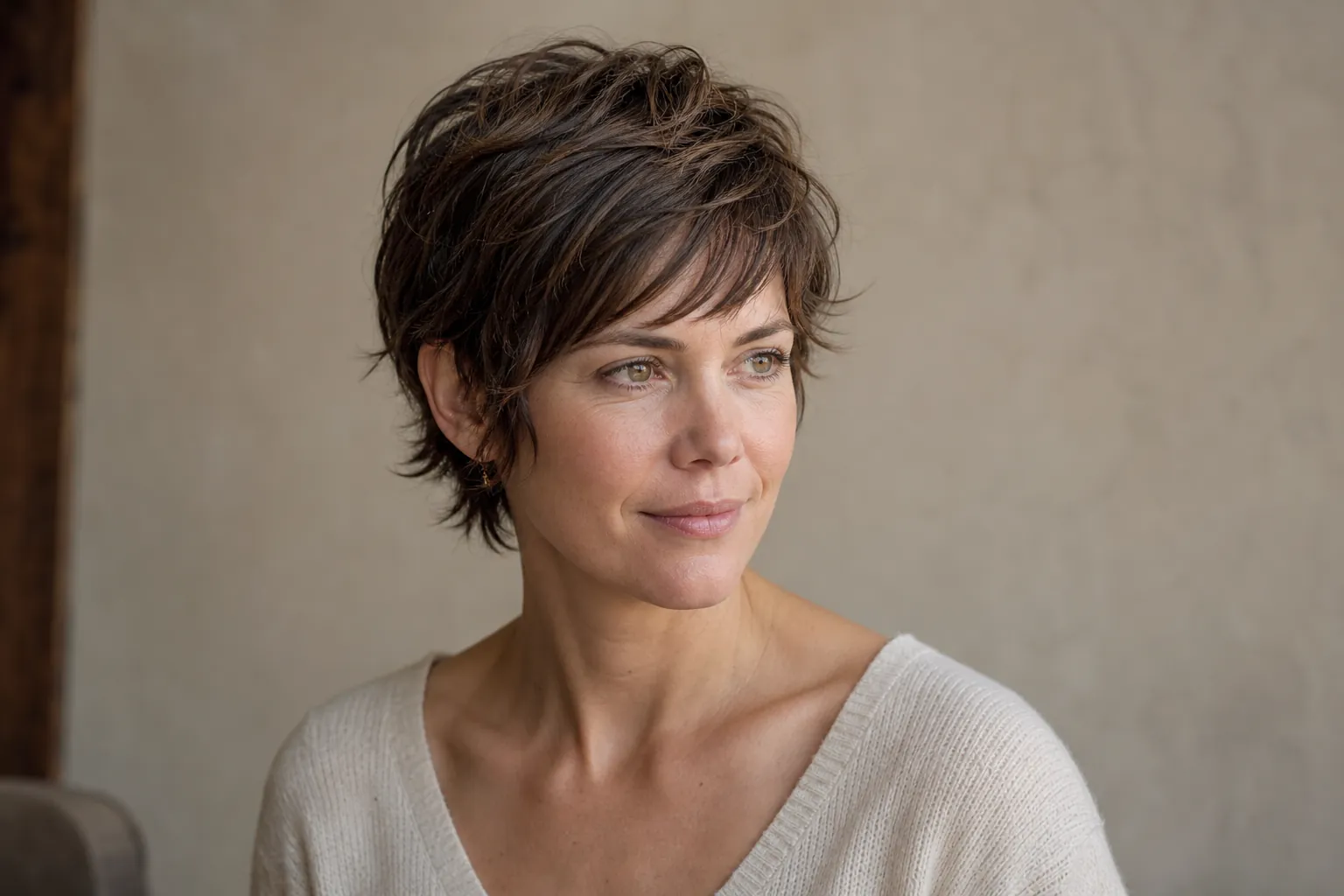

Short version: Curtain bangs on short hair are a parted fringe that sweeps off the forehead and blends into the side layers, ending between the brow bone and the cheekbone depending on the cut. Pixies and bobs wear them shorter and wispier, while lobs and shags carry cheekbone-length bangs; curly and coily hair is cut dry so shrinkage can be seen. Expect a trim every 3-5 weeks while the bangs are short, 6-8 once they reach the cheekbone, and about 5 minutes of styling.
What Curtain Bangs Are on Short Hair
Curtain bangs are longest at the outer edges and shortest at the part, so the hair opens like a curtain and slides into the side layers instead of ending in a straight line across the forehead. On a short cut the whole fringe is shorter, which changes how it behaves: there is less weight to pull it flat, and the bangs sit closer to the other layers. They are a way to add shape within the wider range of short haircuts, not a cut on their own.
Full, micro and blunt fringes end in a line and need constant restyling; curtain bangs are parted, so the part does the styling. The length depends on the cut underneath, and the table shows where each one usually ends.

| Cut | Where the bangs end | Part | What the bangs join |
|---|---|---|---|
| Pixie | Brow bone to top of the cheekbone, wispy | Center or slightly off-center | Longer top and short sides |
| Bixie or ear-length bob | Cheekbone | Center or soft side | Side layers covering the ears |
| Chin bob | Cheekbone to just above the jaw | Center, soft side or off-center | The first face-framing layer |
| Lob | Cheekbone to jaw | Center | Long face-framing layers |
| Short shag | Cheekbone, choppy | Center or loose | Cheekbone and crown layers |
Curtain Bangs on Pixies
A pixie takes curtain bangs only if the top is long enough to part, about 3 inches at the front. Shorter than that the hair stands up instead of sweeping, and the result reads as a standard fringe. The three pixies here run from wispy to short, with the cowlick case placed where it matters most.
1. Long Pixie with Wispy Curtain Bangs

- Length
- 3-4 in on top, bangs to the cheekbone
- Texture
- Straight
- Density
- Fine to medium
- Face shapes
- Oval, long, square
- Daily effort
- 5 minutes
- Trim every
- 4-5 weeks
The bangs are cut as the front of the top, not as a separate piece, so they keep the pixie's lift while parting at the middle. Wispy means point cut at the ends, which on fine hair is a texture decision rather than thinning: the bulk stays and only the edge is broken.
Ask for: "A long pixie with about 3.5 inches on top, curtain bangs parted in the middle and ending at my cheekbones, point cut at the ends, checked dry. Scissor-tapered nape."
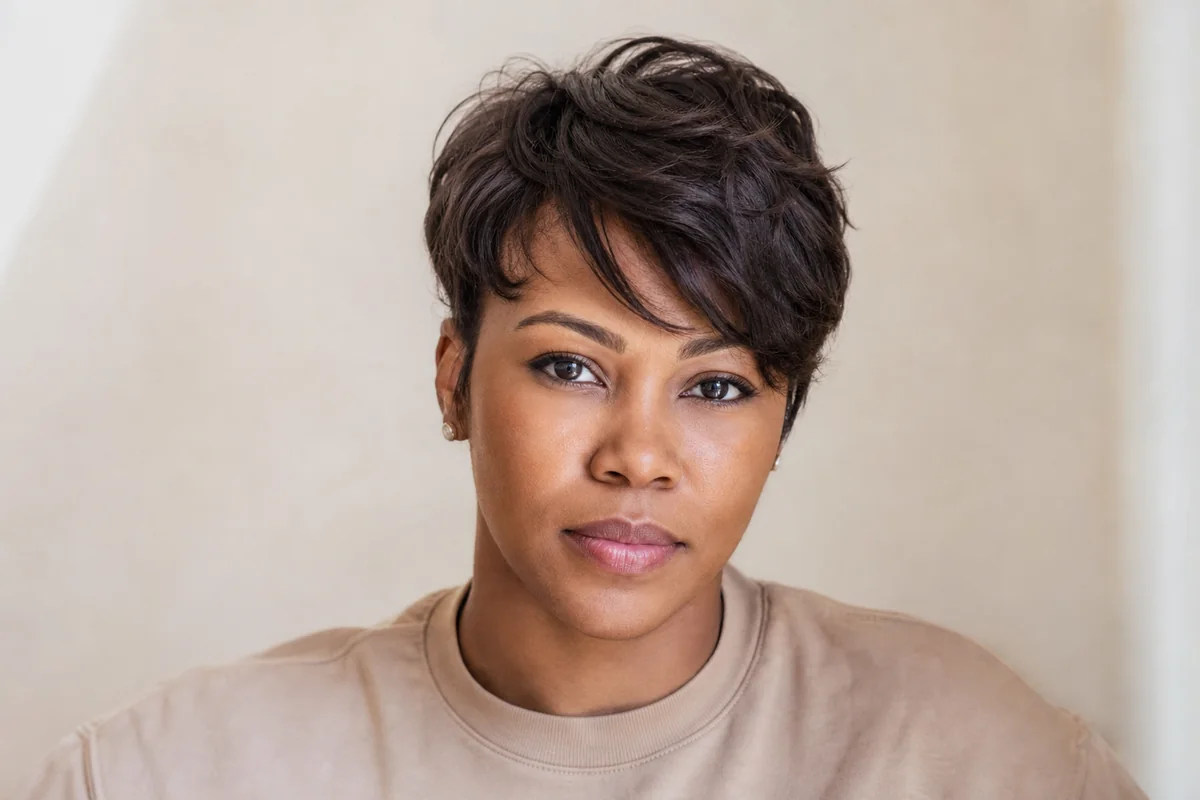
2. Pixie with Curtain Bangs Cut Around a Front Cowlick
- Length
- 3 in on top, bangs to the brow ends
- Texture
- Wavy
- Density
- Medium
- Face shapes
- Oval, heart, round
- Daily effort
- 5-7 minutes
- Trim every
- 4 weeks
The part is placed where the hair already wants to go, here a half inch off center, which turns the cowlick into the side the bangs sweep away from. Leaving the front a little longer than the cowlick's push gives it enough weight to lie down; the full method is in the cowlick section below.
Ask for: "Curtain bangs parted where my front whorl pushes, left long enough to lie flat, cut dry so you can see which way they fall. Pixie sides tapered."
3. Tapered Pixie with Short Curtain Bangs at the Brow

- Length
- 2.5 in on top, bangs at the brow
- Texture
- Straight, coarse gray
- Density
- Medium
- Face shapes
- Oval, long, diamond
- Daily effort
- 3-5 minutes
- Trim every
- 3-4 weeks
At brow length the bangs behave like a soft fringe with a split. They need the most frequent trims on the page, because a quarter inch of growth is a third of their length. Coarse gray hair holds the part more firmly than fine hair, so a dab of cream is usually enough.
Ask for: "Short curtain bangs that end at my eyebrows, parted in the center, blended into a tapered pixie. Please leave them a touch long, since I can always shorten them."
More pixie lengths, napes and fringes are in the pixie cut guide, the shaggier versions are on the shaggy pixie page, and the longer-sided version is covered in the bixie haircut guide.
Curtain Bangs on Bobs
On a bob the bangs should end above the hem or at it, never below, so the face-framing line steps down to the length instead of competing with it. A bob's weight sits at the perimeter, which is why a soft, parted fringe breaks up the line that a blunt cut would otherwise draw across the cheeks. For the bob shapes themselves, see the bob section.
4. French Bob with Curtain Bangs

- Length
- Earlobe to chin, bangs to the cheekbone
- Texture
- Straight to slightly wavy
- Density
- Medium to thick
- Face shapes
- Oval, heart, long
- Daily effort
- 5-8 minutes
- Trim every
- 5-6 weeks
A French bob ends high on the face, so the bangs are the only softness above it. Keep them about as long as the bob is deep: the shorter the bob, the shorter and lighter the bangs, or the head reads top-heavy.
Ask for: "A French bob at my earlobes with curtain bangs to the cheekbones, parted in the middle, blended into the sides, checked dry."
5. Blunt Chin Bob with Soft Curtain Bangs

- Length
- Chin, bangs to the cheekbone
- Texture
- Straight
- Density
- Thick
- Face shapes
- Oval, round, long
- Daily effort
- 8-10 minutes
- Trim every
- 6-8 weeks, bangs at 4-5
This is the contrast cut: a hard hem against a soft, feathered opening. The bangs are the only layered part, so they get their own appointment rhythm and the bob keeps its edge. Blunt hems on thick hair lose their line quickly, which is the reason the bangs and the hem rarely need trimming on the same schedule.
Ask for: "A blunt chin-length bob with feathered curtain bangs that start at the part and end at my cheekbones. Do not layer the rest of the hair."
6. A-Line Bob with Off-Center Curtain Bangs

- Length
- Nape short, front to the chin, bangs to the cheekbone
- Texture
- Straight
- Density
- Medium
- Face shapes
- Round, square, oval
- Daily effort
- 8-10 minutes
- Trim every
- 5-6 weeks
Moving the part off center lengthens one side of the bangs into a diagonal, which reads as a long face-framing line rather than a curtain. Both of the A-line's angles then point the same way. The steeper the A-line, the more often the angle needs resetting, as the bob guide's angle section explains.
Ask for: "An A-line bob, short in the nape and chin-length at the front, with a deep side part and curtain bangs that sweep to my cheekbone on the long side."
7. Layered Bob with Curtain Bangs on Fine Hair

- Length
- Jaw, bangs to the cheekbone
- Texture
- Straight
- Density
- Fine
- Face shapes
- Oval, heart, square
- Daily effort
- 8 minutes
- Trim every
- 6 weeks
On fine hair the bangs are taken from a narrow section, so the back and sides keep every strand they have. A wide section gives a fuller fringe but robs the hem of density, and the bob ends up looking thinner behind than in front. Layers stay on top; the edge stays solid.
Ask for: "Narrow curtain bangs taken from a small section at the front, so my hem stays dense. Layers on top only, and a solid edge at the jaw."
8. Thick Straight Bob with Curtain Bangs and Interior Weight Removal

- Length
- Chin, bangs to the cheekbone
- Texture
- Straight, coarse
- Density
- Thick
- Face shapes
- Oval, round, long
- Daily effort
- 8-12 minutes
- Trim every
- 6 weeks
Thick straight hair is where curtain bangs most often look heavy, because a wide section arrives as a block. Weight comes out from the inside of the bangs, with slide cutting or point cutting, rather than by chopping the ends shorter, so they part cleanly and still have a solid edge.
Ask for: "Curtain bangs with the weight taken out from inside, not shortened at the ends, so they split in the middle and lie flat against my forehead."
9. Gray Chin Bob with Curtain Bangs and Glasses

- Length
- Chin, bangs ending at the tops of the frames
- Texture
- Straight, coarse gray
- Density
- Medium
- Face shapes
- Oval, square, long
- Daily effort
- 6-8 minutes
- Trim every
- 5-6 weeks
Glasses limit the bangs more than anything else on this page. Bangs that touch the lenses pick up smears and push the frame forward, so the length is chosen with the glasses on, and the bangs are cut to rest on or above the top rim. Coarse gray hair keeps a clean part, but needs a moisturizing cream because it frizzes where it meets the frame.
Ask for: "Curtain bangs cut with my glasses on, ending at or above the top of the frames, parted in the middle."
Curtain Bangs on Lobs and Shags
A lob or shag gives curtain bangs the most room, since the face-framing layers they melt into are long enough to carry them past the cheekbone. The bangs then read as the start of the layers rather than a separate cut, which is why they grow out without a visible stage. The full cut details sit in the long bob guide and the short shag guide.
10. Layered Lob with Long Curtain Bangs

- Length
- Collarbone, bangs to the jaw
- Texture
- Straight to wavy
- Density
- Medium
- Face shapes
- Square, round, long
- Daily effort
- 8-10 minutes
- Trim every
- 8 weeks, bangs at 6-8
Long curtain bangs on a lob are the lowest-effort version: they already reach the first layer, so growth only moves the opening a little lower. Because there is a lot of length to blend, the transition is cut as a gradual slope rather than one step.
Ask for: "A layered lob at the collarbone with long curtain bangs to my jaw, sloped into the face-framing layers so there is no step."
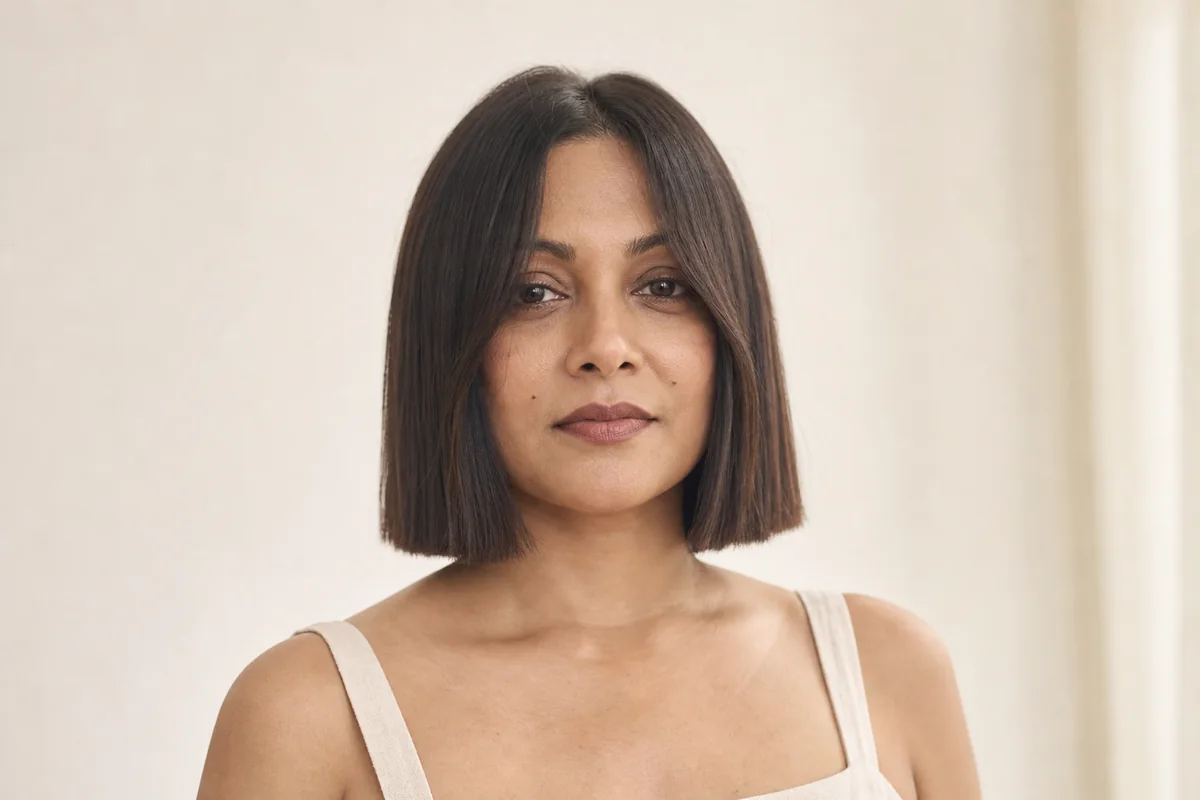
11. Blunt Lob with Jaw-Length Curtain Bangs
- Length
- Just above the shoulders, bangs to the jaw
- Texture
- Straight
- Density
- Medium to thick
- Face shapes
- Oval, round, heart
- Daily effort
- 10 minutes
- Trim every
- 8-10 weeks
Here the bangs end low enough to behave like two long face-framing pieces, which is the version least likely to need a trim. The part has to be straight and the ends clean, so this suits a sleek blow-dry more than an air-dried finish. Because they are long, the bangs can go the interval of the lob itself.
Ask for: "A blunt lob just above my shoulders with long curtain bangs ending at my jaw. Keep the lengths clean, no short layers."
12. Short Shag with Wispy Curtain Bangs

- Length
- Jaw, bangs to the cheekbone
- Texture
- Wavy
- Density
- Medium
- Face shapes
- Oval, square, heart
- Daily effort
- 5-8 minutes
- Trim every
- 5-6 weeks
Wispiness is the point of a shag, so the bangs share the same choppy ends as the crown and need little product. They belong to the cheekbone layer, which means that when the bangs lengthen the shape stays whole.
Ask for: "A jaw-length shag with wispy curtain bangs that start at the middle part and join the cheekbone layers. Texturized, not thinned."
Wavy, Curly and Coily Curtain Bangs
Curly and coily curtain bangs are cut dry and cut longer than they will look, because the bangs spring up as they dry and shrink more than the rest of the hair. Wavy bangs shrink up to about an inch, curls 1-3 inches or more, and a bang that falls to the cheekbone stretched will sit near the brow once the curl pulls up. The curl-pattern details are on the short curly hair page.
13. Wavy Bob with Curtain Bangs Cut Dry

- Length
- Chin, bangs to the cheekbone dry
- Texture
- Wavy, 2B-2C
- Density
- Medium
- Face shapes
- Oval, heart, long
- Daily effort
- 3-5 minutes
- Trim every
- 5-6 weeks
Waves bend the bangs outward at the ends on their own, so styling is mostly leaving them alone. They are measured wet only as a starting guide, then checked dry, because the same section can lift an inch as it dries. A hairdryer with a diffuser takes the place of the round brush.
Ask for: "Curtain bangs for wavy hair, cut dry so we see where they land, about a half inch longer than the final length."
14. 3B Curly Bob with Curly Curtain Bangs
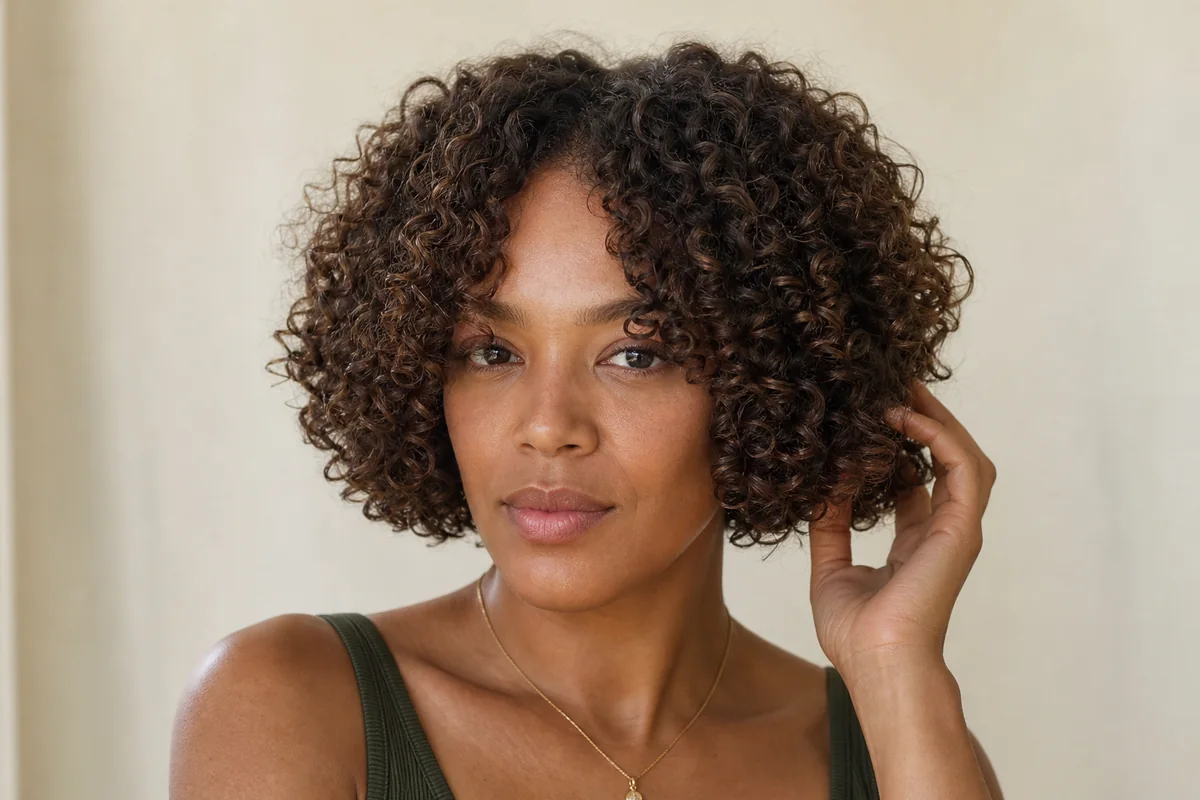
- Length
- Jaw, bangs to the cheekbone once dry
- Texture
- Curly, 3B
- Density
- Thick
- Face shapes
- Oval, long, heart
- Daily effort
- 5-10 minutes
- Trim every
- 4-6 weeks
Curly bangs are cut curl by curl on dry hair, a little at a time, because a curl cut while stretched will jump above the line on its first spring. The result is a shaped, springy part rather than a straight fringe. Expect them to sit higher than a straight cut at the same measurement.
Ask for: "Curly curtain bangs, cut dry, curl by curl, starting long. I want them to land at my cheekbones once the curl is in place."
15. 3C Curly Pixie with Stretched Curtain Bangs
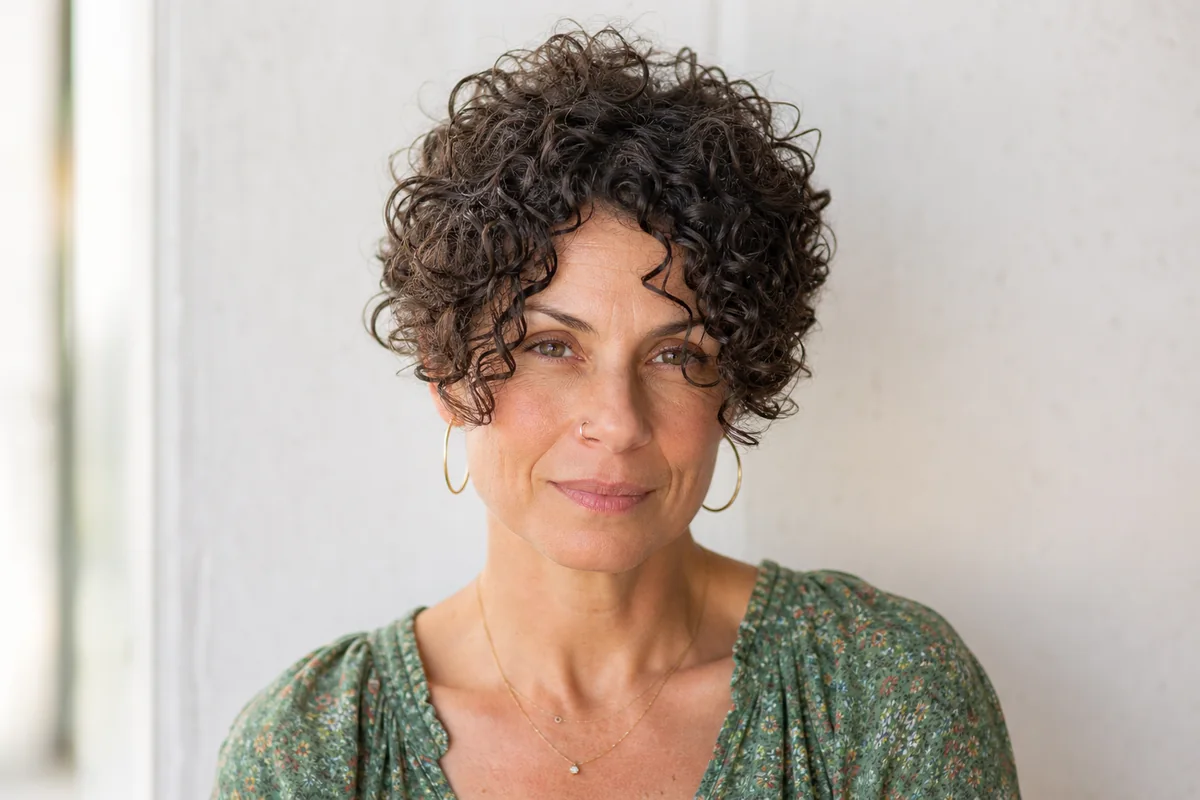
- Length
- About 3 in of curl on top, bangs to the cheekbone
- Texture
- Curly, 3C
- Density
- Medium to thick
- Face shapes
- Oval, square, long
- Daily effort
- 5 minutes
- Trim every
- 4-5 weeks
In tight curls the bangs can be left longer than the shape wants and shaped by the curl itself, since the curl pattern does the shortening. The curls part at the middle only if the root is raked in that direction while wet. Without that, they fall wherever the root points.
Ask for: "A curly pixie with long curtain bangs I can part in the middle, cut dry and shaped curl by curl, leaving them longer than the rest."
16. 4C Tapered Crop with Side-Swept Curtain Bangs
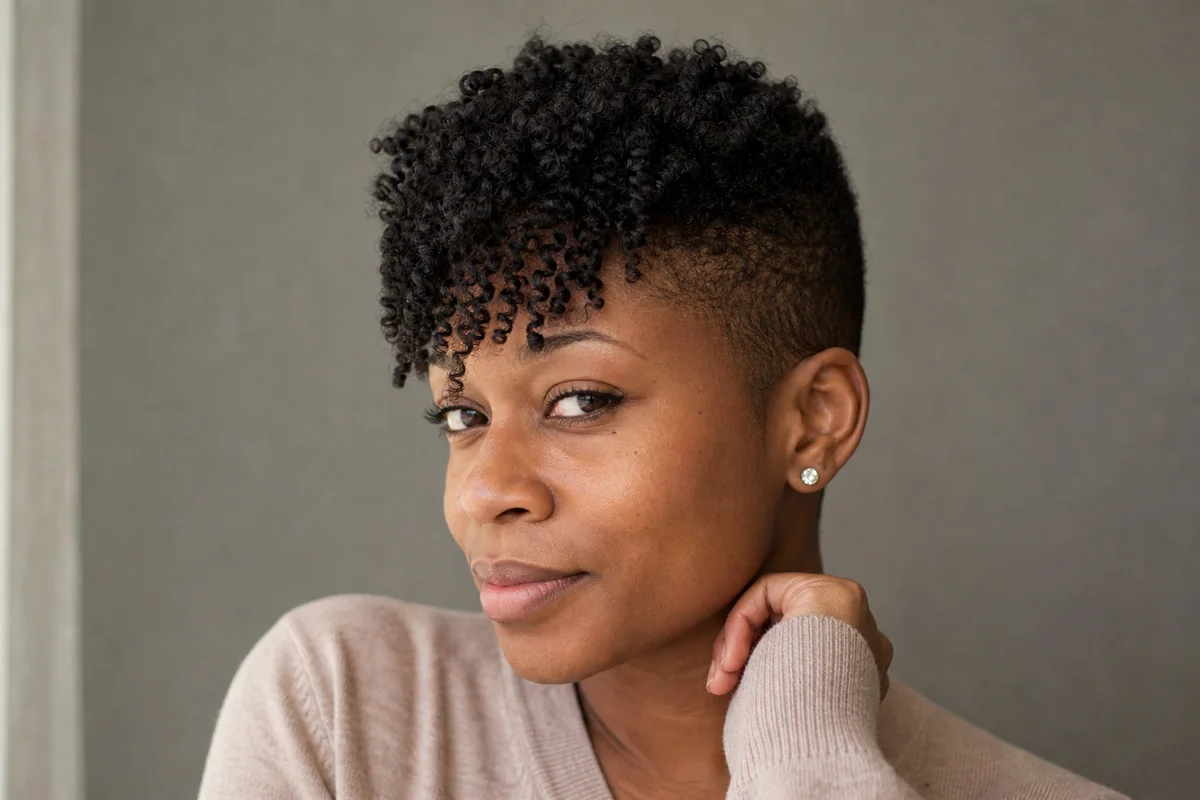
- Length
- 2 in on top, bangs to the brow
- Texture
- Coily, 4C
- Density
- Medium
- Face shapes
- Oval, heart, round
- Daily effort
- 3-5 minutes
- Trim every
- 3-4 weeks
On 4C hair a curtain fringe is a shaping decision: the coils are sculpted and directed to one side at the front, and the taper below keeps the outline clean. The bangs hold their direction when the hair is moisturized and set, and look lifted rather than parted. It needs a stylist who cuts coils dry.
Ask for: "A tapered crop with a sculpted side-swept front that works as curtain bangs. Shape it dry and leave the front a half inch long."
Curtain Bangs by Texture and Density
Texture decides how the bangs are cut, and density decides how wide a section can be spared. A section taken from the crown is not free: it moves hair from where the cut needs it to where it only shows. The table gives the cutting rule for each combination.
| Texture and density | Section and method | What goes wrong | Fix |
|---|---|---|---|
| Straight, fine | Narrow section, point cut ends | Wide bangs thin the hem; strands separate into strings | Keep the section small; roots lifted, layers on top only |
| Straight, thick | Wide section, weight taken from inside | Bangs arrive as a block and will not part | Slide or point cut from the interior; leave the edge |
| Wavy | Medium section, cut dry | Lifts an inch as it dries, flips at the ends | Cut half an inch long, diffuse or air-dry |
| Curly | Medium section, cut dry curl by curl | Springs up 1-3 in; unruly if cut wet or stretched | Start long, take off a little at a time |
| Coily | Shaped dry, front directed to a side | Shrinkage hides length; part will not hold | Moisture, set while damp, stylist who cuts coils |
Salon note: Most stylists cut the bangs as a triangle, with the point at the part and the base running about as wide as each eyebrow's arch. A wider triangle pulls hair from the crown and thins the cut; a narrower one leaves a gap at the temples. Cutting dry rather than wet shows where the section really falls.
Face shape adds one more decision: where the bangs should end. Curtain bangs steer attention to the cheekbones, so the target is the feature to be emphasized or softened.
| Face shape | Bangs end at | Why | Avoid |
|---|---|---|---|
| Round | Cheekbone to jaw, parted in the center | The long diagonals lengthen the face | Short, wide bangs at the brow |
| Square | Cheekbone, wispy | Soft ends break up a strong jaw | A blunt line at the jaw |
| Long or oval | Brow bone to cheekbone | Shortens the forehead; adds width | Very long bangs that extend the face |
| Heart | Cheekbone to chin | Adds width below a narrow chin | Heavy bangs at the temples |
Cowlicks and Part Direction
A cowlick at the front hairline decides where the part goes and how long the bangs can be. Hair grows in a swirl at that spot, so bangs cut too short stand up or split to one side. A center part forces a split the cowlick may not accept, while an off-center part that follows the swirl usually lies flat. Cowlicks are common and are set by the follicles, so a cut can work around one but not remove it.
Salon note: Cowlick bangs are cut dry, with the hair parted where it naturally falls. A stylist can then leave the cowlick area a little longer, which gives it weight, and cut the bangs shorter only where the hair behaves. Taking the bangs shorter at the cowlick is the most common reason they stand up.
Two fixes cover most cases. Part where the hair falls, even half an inch off center, and keep the front long enough to lie down; or direct the hair with heat while it is damp, brushing across the forehead from side to side to cancel the swirl before turning it away from the part. A very strong cowlick at the exact center is the reason some people are better with a side-swept fringe, covered in the guide to short hair with bangs.
What to Ask for When You Want Curtain Bangs
Name the landmark where the bangs end, the part, the cut underneath and whether they are cut dry. "Curtain bangs" alone can mean anything from brow-length wisps to jaw-length layers, and photos on a screen hide cowlicks and texture. The words below work for most of the cuts above.
- Where the bangs end: brow bone, cheekbone or jaw, with your hair dry and in its natural fall.
- The part: center, slightly off center, or where your front whorl pushes.
- The section: narrow for fine hair, wide with interior weight removed for thick hair.
- Method: dry cut for waves, curls and coils; whether to point cut or leave the ends blunt.
- Growth plan: a little long on the first cut, with a quick trim booked 3-4 weeks later.
A full script reads: "Curtain bangs parted in the middle, ending at my cheekbones when dry, taken from a narrow section, blended into my side layers. Please leave them a bit long, and I will come back for a trim."
Styling Curtain Bangs: Round Brush or Air-Dry
A round brush gives bangs a bend and a lift; air-drying keeps the texture the hair already has. The two methods suit different hair, and short hair can use both on different days. Heat protectant goes on before either hot tool, and fine, gray or lightened hair is safest at the lower end of the range, around 300-350°F.
| Method | Time | Heat | Result | Best for |
|---|---|---|---|---|
| Round brush blow-dry | 3-5 minutes for the bangs | Medium, dryer moving | Smooth bend, lifted roots | Straight and thick hair, blunt bobs, lobs |
| Air-dry with a few passes of the fingers | 1-2 minutes plus drying time | None | Natural movement, more texture | Wavy hair, shags, fine hair that flattens under heat |
| Diffuser on low | 3-5 minutes | Low to medium | Defined waves or curls, light lift | Wavy, curly and coily hair |
- Wet and rough-dry the bangs first. Dry them while the rest of the hair is still wet, brushing back and forth across the forehead so the roots lose their direction. This is the step that cancels a cowlick, and done after the rest it is much harder.
- Add lift at the roots. A small amount of mousse or root spray at the front sets the lift that the brush will shape. Too much mousse turns bangs into a flat block.
- Roll with a 1-1.5 inch brush. Pull each side away from the part, roll the ends slightly outward and keep the dryer moving, about 15 cm from the hair. In a lab study of hair dryers, hair surfaces became more damaged as drying temperature rose, which is why distance matters.
- Cool and set. Hold the shape for a few seconds with the cool button, then finish with 4-8 spritzes of texture spray worked through the ends.
- Refresh the next day. Bangs sit against the forehead and get oily first, so a pinch of dry shampoo or washing only the bangs in the sink keeps the rest for the second day.
Curly bangs follow the diffuser route on soaking-wet hair, as in the curly styling section. The wider routine for each length is in the upcoming guide to how to style short hair.
Trim Intervals and Growing Out Curtain Bangs
Curtain bangs need a trim every 3-5 weeks while they are short and every 6-8 once they reach the cheekbone, with curly bangs often at 4-6 because shrinkage hides growth. Hair grows about half an inch a month on average, though the rate differs between people and by scalp area, according to a study of more than 2,000 adults. That is why short bangs lose their shape in a month and long ones last two.
| Bangs length | Trim every | What the trim does | Daily effort |
|---|---|---|---|
| Brow bone, on a pixie | 3-4 weeks | Restores length and part | 3-5 minutes |
| Cheekbone, on a bob or shag | 5-6 weeks | Reopens the curtain at the center | 5-8 minutes |
| Jaw, on a lob | 8-10 weeks, with the cut | Refreshes the face-framing slope | 5-10 minutes |
| Curly or coily bangs | 4-6 weeks | Reshapes dry, curl by curl | 3-5 minutes |
Curtain bangs are the easiest bang to grow out, because they are already parted and already layered into the sides. The aim is to turn them into face-framing layers, and to book a trim only to reshape, not to shorten.
| Stage | Time at half an inch a month | What it looks like | What to do |
|---|---|---|---|
| Brow to cheekbone | About 4 months | Bangs reach the eyes and fall to the side | Part and sweep; pin or clip if needed |
| Cheekbone to jaw | About 5-6 months | Becomes the first face-framing layer | Blend with a slope trim; do not square the ends |
| Jaw and beyond | 6 months or more | No bangs, only layers | Return to a normal cut schedule |
Salon note: The awkward stage is brow length, when the bangs reach the eyes. Ask for a trim that only softens the front edge and sweeps the bangs into the sides, and avoid cutting them back to the brow. On curly hair the pattern lengthens faster than it looks, so the grow-out feels slower than the numbers.
When Curtain Bangs Are Not the Right Choice
- A strong cowlick exactly at the center. The part will fight the swirl and the bangs will stand up or split unevenly. Try an off-center part that follows the cowlick, or a side-swept fringe.
- Hair too fine to spare a section. If the hem or the crown would look thin without it, a narrow section or face-framing layers only are the alternatives.
- Glasses with thick or low frames. Bangs that touch the lenses smear and push the frame forward, so choose a length that clears the frame, or skip the fringe.
- No time for the first five minutes of styling. Straight bangs left to air-dry fall flat and fall straight; they need a few minutes with a dryer. Waves and curls are the exception.
- A very oily forehead. Bangs get oily first and may need washing every day, which is more upkeep than the cut suggests.
- A pixie with less than 3 inches in front. Too short to part, the bangs stand up and read as a plain fringe.
Curtain bangs on short hair work best when the bangs end at a landmark that suits the cut, the part follows the hair's own direction, and the first cut is made dry and a little long. Bring one script and a photo of the length, book the first trim for three to four weeks later, and decide whether you want to keep them or grow them into layers.