

Short version: The best low maintenance short haircuts for women depend on which cost you want to cut, because daily styling minutes and salon visits pull in opposite directions. Pixies and crops style in 2-5 minutes but need a trim every 4-6 weeks (2-4 for a crop), while a chin bob, shag bob or lob with internal layers styles in 5-10 minutes, often by air-drying, and can wait 6-10 weeks. Curly and coily hair gets the same trade through a wash-and-go shape cut to its pattern.
Low Maintenance Means Two Different Costs
A cut can be low maintenance in the morning and high maintenance in the calendar, and most advice mixes the two. Daily effort is the minutes of washing, drying and styling you repeat every day. Salon effort is how many weeks pass before the shape is gone, which becomes appointments a year. Across the whole range of short haircuts, the shorter the cut, the lower the first cost and the higher the second.
That is why a pixie is called easy by one person and a chore by another. The first counts a 3-minute morning; the second counts 10 or more appointments a year. Decide which cost you would rather pay before choosing a cut, then use the tables below to match it.
Daily Minutes Against Weeks Between Trims
Every short cut trades minutes at home for weeks between trims, and the table puts both costs side by side with the appointments a year they add up to. Visits a year is simple arithmetic (52 divided by the weeks between trims), so it is a planning figure, not a promise. Hair grows about half an inch a month on average, and a study of 2,249 young adults measured different growth rates by scalp area, sex and geographic origin, so a nape that grows faster than the top will shorten any of these intervals.
| Cut | Daily minutes | Weeks between trims | Full visits a year | What gives first |
|---|---|---|---|---|
| Crop or soft buzz | 1-3 | 2-4 | 13-26 | Nape and sideburns, often by week 2 |
| Pixie, scissor-tapered nape | 3-5 | 4-6 | 9-13 | Ears and fringe |
| Pixie, clippered nape | 3-5 | 4-6, with cleanups at 2-4 | 9-13, plus cleanups | The clippered line at the nape |
| Bixie | 3-6 | 5-7 | 7-10 | Sides over the ears |
| Blunt chin bob | 5-10 | 6-8 | 7-9 | The hem line |
| Shag bob or short shag | 3-6 | 6-10 | 5-9 | The fringe, long before the layers |
| Layered lob | 5-10 | 8-10 | 5-7 | Ends meeting the shoulders |
| Curly or coily wash-and-go cut | 3-10, by length | 8-12 for bobs; 4-6 for crops | 4-7 for bobs; 9-13 for crops | Hem width on a bob; outline on a crop |
Salon note: Ask what a cut costs in appointments, not only in styling time. A cleanup of the nape and ears is often a short visit between full cuts, and a stylist can tell you which parts of a particular cut lose shape first.
Lowest Daily Effort, Highest Salon Effort
The shortest cuts are the fastest to style and the most demanding to keep. With almost no length there is nothing to dry, part or smooth, but the outline is the whole cut, so a nape or ear line that has grown a quarter inch reads as overdue. Choose these if appointments are easy to book and mornings are the problem. The nape options explained in the pixie guide decide most of the upkeep.
1. Crop with a Scissor-Tapered Nape on Fine Straight Hair

- Length
- About 1.5 in on top, tapered nape
- Texture
- Straight
- Density
- Fine, low to medium
- Face shapes
- Oval, heart, long
- Daily effort
- 2 minutes
- Trim every
- 3-4 weeks
On fine hair the crop is the quickest style on the page: it dries standing up and needs a pinch of root lift at most. The cost is the calendar, because at this length a month of growth is a visible change. A scissor taper softens the nape and grows out more kindly than a clippered one.
Ask for: "About an inch and a half on top, scissor-taper the nape and sides rather than clipper, ears clear, and book me again in 4 weeks."
2. Close Coily Taper with a Short Natural Top
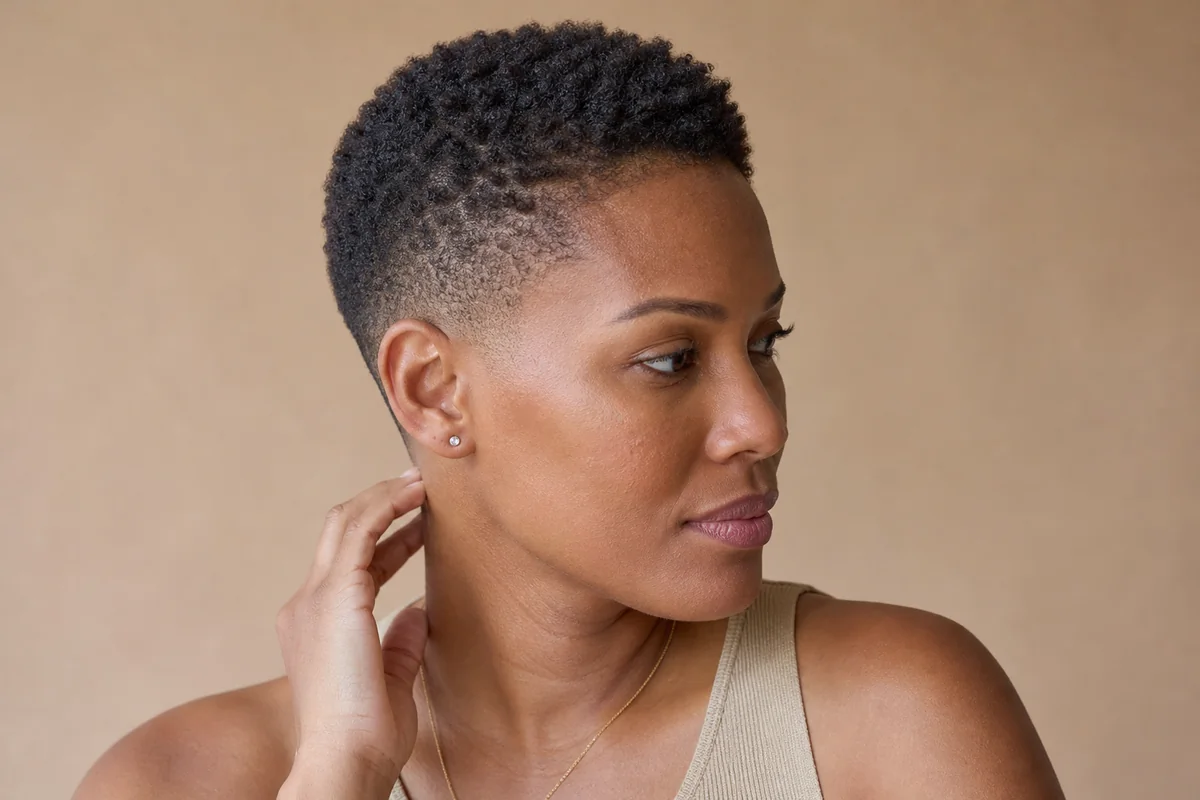
- Length
- About 1 in on top, tapered sides (#2-#3 guard)
- Texture
- Coily, 4B-4C
- Density
- Medium to thick
- Face shapes
- Oval, round, square
- Daily effort
- 2-3 minutes
- Trim every
- 3-4 weeks
Coily hair shrinks so much that a short natural top needs no heat and little else beyond moisture: a light leave-in and a pick or soft brush is a complete routine. The taper is the high-effort part, since the blend between sides and top shows growth within about three weeks. A stylist experienced with coily hair will keep the top rounded instead of flat.
Ask for: "A #2 or #3 guard on the sides and nape, blended into about an inch on top. Keep the natural shape and finish with the line-up I'll keep every 3-4 weeks."
3. Pixie with a Longer Top That Dries Flat

- Length
- About 3 in on top, tapered sides and nape
- Texture
- Straight to wavy
- Density
- Medium
- Face shapes
- Oval, square, round
- Daily effort
- 3-4 minutes
- Trim every
- 5-6 weeks
Extra length on top is the cheap way to lower effort, because 3 inches lies down on its own and can be pushed to either side with fingers. The sides still set the schedule. Leaving the top a little long also buys a week, since growth changes a 3-inch top far less than a quarter-inch nape.
Ask for: "Three inches on top, cut so it falls to the side without product, scissor-tapered sides, and a nape I can go 6 weeks with."
Air-Dry Short Cuts for a Longer Gap Between Trims
A cut air-dries well when the shape is built into the cut instead of the blow-dry: a steady weight line, layers placed inside the hair and a part that follows the natural fall. These sit around chin to collarbone, where growth shows slowly, so they trade a few extra minutes of styling for 6-10 weeks between visits. The graduation and angle section of the bob guide explains why a gentle angle costs less upkeep than a steep one.
Tip: Air-drying works only if the hair is parted where it already falls. Hair forced into the wrong part lifts and flips as it dries, so style in the direction the cowlick wants to go.
4. One-Length Chin Bob with a Soft Edge, Left to Air-Dry

- Length
- Chin, slight angle forward
- Texture
- Straight
- Density
- Medium
- Face shapes
- Oval, heart, long
- Daily effort
- 5 minutes
- Trim every
- 6-8 weeks
With one length and no layers there is little for a blow-dryer to do, so the bob dries into its own shape: towel-blot, a dime of cream through the ends, part and leave. A softly point-cut edge hides the first two weeks of growth better than a razor-sharp one. The line, not the layers, is what loses shape at week 8.
Ask for: "A chin-length bob with a slight angle forward, point-cut edge, no layers on top, and check that it dries into place before I leave."
5. Jaw Bob with Hidden Interior Layers for Thick Straight Hair

- Length
- Jaw, short tapered nape
- Texture
- Straight, coarse
- Density
- Thick
- Face shapes
- Oval, long, heart
- Daily effort
- 5-8 minutes
- Trim every
- 6-8 weeks
Thick straight hair is low maintenance only when the bulk is taken out of the interior, where it cannot be seen, and the surface stays intact. Without that the sides puff by the second week and each morning becomes a fight. Removing weight inside costs nothing in daily minutes and is the main reason this cut air-dries into a neat line.
Ask for: "Remove weight from the inside, not the surface. Jaw length, short tapered nape, and no thinning shears on the ends."
6. Wavy Bixie That Dries into Its Own Movement

- Length
- 3-4 in on top, sides to mid-ear, short nape
- Texture
- Wavy, 2A-2C
- Density
- Medium
- Face shapes
- Oval, heart, round
- Daily effort
- 3-5 minutes
- Trim every
- 5-7 weeks
Waves need a little length to form, so the 3-4 inches on top is what lets the cut dry with movement instead of lying flat. A scrunch of cream on damp hair and a hands-off dry finish the routine. The bixie guide shows where the sides can sit before they start covering the ears.
Ask for: "A bixie with about 3.5 inches on top for my waves, sides to mid-ear, nape kept short, and cut dry so you can see where the waves fall."
7. Soft Shag Bob That Dries in Place

- Length
- Chin, layers from cheekbone
- Texture
- Straight to wavy
- Density
- Medium to thick
- Face shapes
- Round, square, heart
- Daily effort
- 3-5 minutes
- Trim every
- 6-10 weeks, fringe at 4-6
A shag bob is made to look slightly undone, so the daily work is mostly texture spray and fingers, and growth reads as part of the style. The fringe is the weak point: it needs a trim long before the layers do. The short shag guide covers where the layers begin on fine and thick hair.
Ask for: "A chin-length shag bob with layers starting at the cheekbone and a long side fringe I can tuck, finished with a point-cut edge."
8. Collarbone Lob with Long Layers and No Styling Heat

- Length
- Collarbone, long layers from the chin
- Texture
- Straight to wavy
- Density
- Medium
- Face shapes
- Oval, round, square
- Daily effort
- 5-10 minutes
- Trim every
- 8-10 weeks
The lob is the longest cut on this page and among the slowest to show growth, which is why it suits readers who find the appointment harder than the morning. It can be tied back on bad days, and the shape takes months to lose. The flip where the ends meet the shoulders is the price; the lob guide explains how to cut for it.
Ask for: "A collarbone lob with long layers starting at the chin, no short layers, and the back cut half an inch to an inch shorter so it does not flip."
Wash-and-Go Short Cuts for Wavy, Curly and Coily Hair
A wash-and-go cut works because the hair is shaped to the pattern it already has, so the routine is product on soaking-wet hair and then leaving it alone. The trade is the same as everywhere: crops need frequent shaping and bobs need fewer visits, and the hem of a curly bob matters more than its length. The full method is in the curly hair styling steps, and a short version follows the gallery.
9. Rounded Curly Crop for a Wash-and-Go Routine
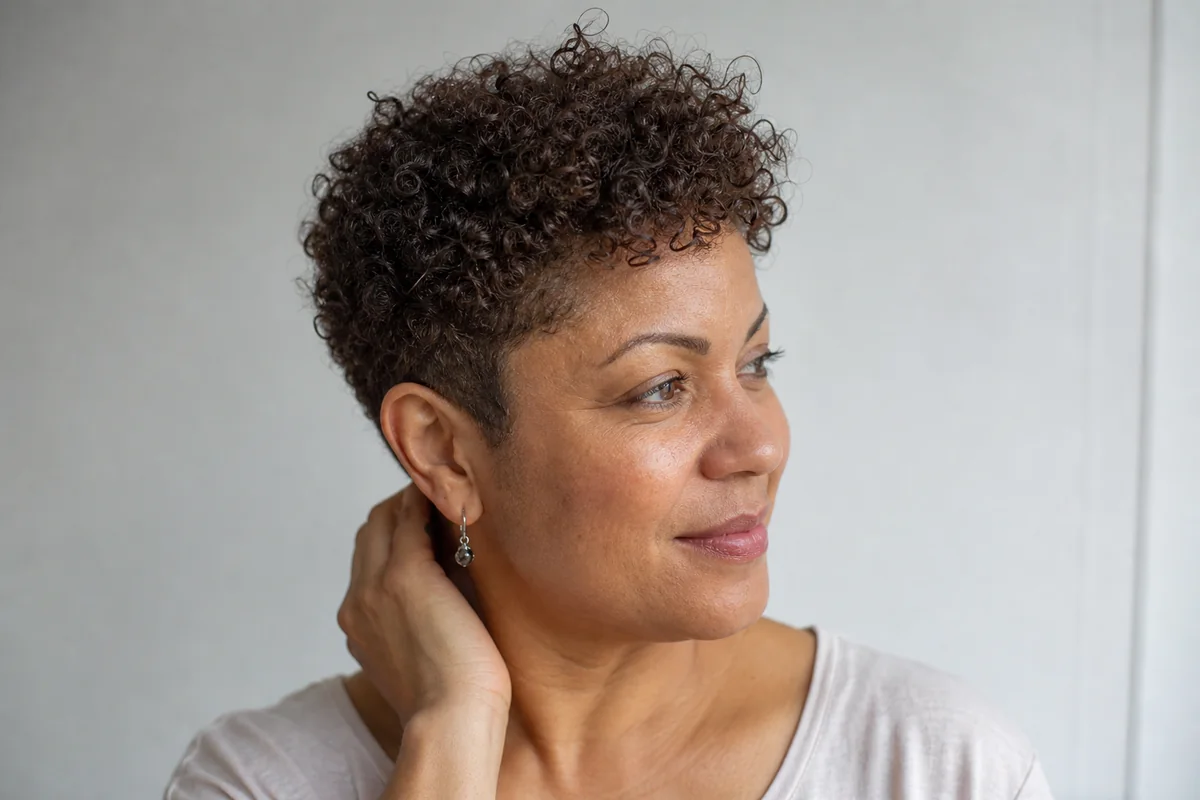
- Length
- About 2 in stretched, 1 in dry; sides shaped close
- Texture
- Curly, 3A-3C
- Density
- Medium to thick
- Face shapes
- Oval, heart, long
- Daily effort
- 3-5 minutes
- Trim every
- 5-6 weeks
Curls spring up as they dry, so this crop is cut dry, curl by curl, to a round outline that holds with a gel or cream and a diffuser or air. Because the shape is the outline, it loses definition at the sides first, and week 6 is the realistic limit. A cut done only wet tends to come out shorter than planned.
Ask for: "Cut dry, rounded shape, about 2 inches when stretched and more at the crown, sides kept close but not clippered."
10. Wavy Chin-Length Cut with Round Layers for Wash-and-Go

- Length
- Chin, rounded layers from the cheekbone
- Texture
- Wavy, 2B-2C
- Density
- Medium
- Face shapes
- Oval, round, heart
- Daily effort
- 5 minutes
- Trim every
- 7-9 weeks
For waves, the work is done at the cutting stage: rounded layers stop the hem from flipping and keep the waves from stacking into a triangle. At home it is a light mousse or cream on wet hair, then air or a diffuser. Heavy products pull waves straight, so use less than you think.
Ask for: "Rounded layers that follow my wave, hem on a soft curve rather than a straight line, no thinning shears."
11. Low-Manipulation Coily Shape, Refreshed Weekly

- Length
- About 3 in on top, sides slightly shorter
- Texture
- Coily, 4A-4C
- Density
- Medium to thick
- Face shapes
- Oval, round, square
- Daily effort
- 2-4 minutes, plus a weekly wash day
- Trim every
- 6-8 weeks
The low-effort routine here is spread across the week instead of every morning: a weekly wash, a moisturizing leave-in and a quick daily fluff or pick. Leaving the top longer than the sides lets shrinkage set the final size, and a satin bonnet or pillowcase at night helps the shape last between washes.
Ask for: "A rounded shape, about 3 inches stretched on top, sides a little shorter, cut dry by someone who works with 4B-4C."
12. Short Layered Bob on Thick Waves, Wash-and-Go

- Length
- Jaw, layers from the cheekbone
- Texture
- Wavy to loosely curly
- Density
- Thick
- Face shapes
- Oval, long, square
- Daily effort
- 5-8 minutes
- Trim every
- 7-9 weeks
Thick waves are where wash-and-go gets lost: without layers the hair builds into a triangle, and with too many it frizzes. Layers placed inside and kept long enough to curl hold the width where you want it. A gel or cream and a diffuser on low heat give a clean finish.
Ask for: "Jaw length with long layers cut to follow my waves, width taken out at the sides, and checked dry."
The Short Wash-and-Go and Air-Dry Method
Short hair air-dries best when product goes on wet hair and the hair is left untouched until it is dry, which is the habit that makes the 3-5 minute figures here real. For straight and wavy cuts it is a short sequence; for curly and coily cuts the product goes in while the hair is soaking wet.
- Cut the water, not the hair. Blot with a soft towel or cotton T-shirt instead of rubbing, which roughens the surface and causes frizz on wavy and curly hair.
- Apply product to wet hair. A dime of cream on a bob, a pea of paste on a crop, or a gel or cream raked through curls and coils while the hair is soaking wet.
- Set the part and shape once. Comb straight hair into its part; scrunch waves and curls upward, then stop.
- Leave it alone. Touching curls or waves while they dry breaks up the clumps. A diffuser on low heat speeds things up; air-drying takes longer but costs no attention.
- Finish dry. Break a gel cast with your hands, add a few sprays of texture spray on straight hair, or refresh roots with dry shampoo if the crown is flat.
Tools and products by length belong in a guide to styling short hair, and the over 60 short haircuts guide covers the effort rules for gray hair, while wash-and-wear haircuts for women over 60 are a topic of their own.
Cuts That Grow Out Gracefully
A cut grows out gracefully when its shape does not depend on a sharp line, so week 10 looks like a different length rather than a mistake. Layers distributed over the whole head, a soft perimeter and nape and some natural texture all help. These are the best choice when you would like to stretch the gap between visits or skip a month. The shaggy pixie gallery has more of the layered pixie versions, and a guide to growing out a pixie covers the month-by-month route.
Watch out: A clippered nape, a blunt hem and a sharp side-swept fringe are the three features that look worst when overgrown. If graceful growth matters most, avoid them or accept the cleanups.
13. Layered Crop That Grows Out in Every Direction

- Length
- 2-3 in layered on top, soft sides
- Texture
- Straight to wavy
- Density
- Medium
- Face shapes
- Oval, heart, square
- Daily effort
- 3-5 minutes
- Trim every
- 6-8 weeks
The choppy layers make the cut forgiving: when the outline loosens, it just looks more textured. Because nothing is clippered, there is no hard line to fade. Stretching a pixie's schedule from 4-6 weeks to 6-8 is the realistic gain.
Ask for: "Choppy layers on top, soft sides that sit over the top of the ear, a light scissor taper, no clipper."
14. Bixie with a Scissor-Tapered Nape That Grows into a Bob
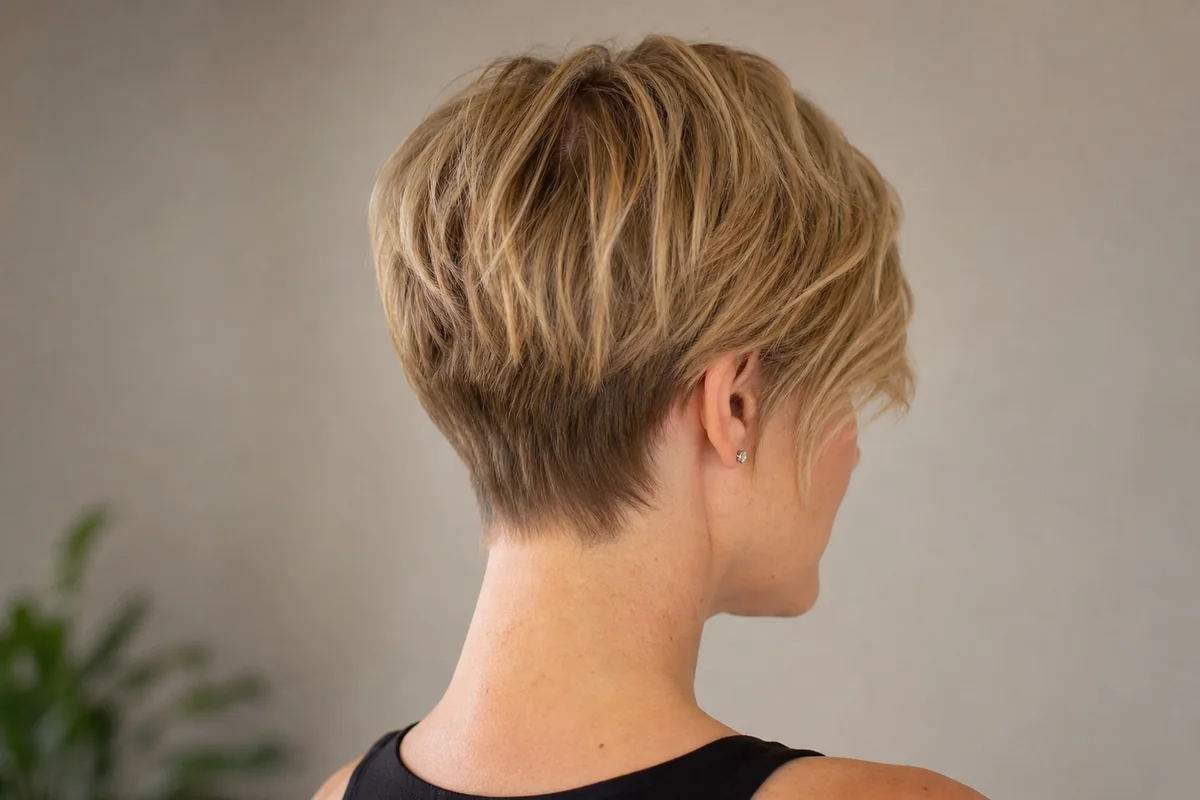
- Length
- 4-5 in on top, nape tapered short
- Texture
- Straight
- Density
- Fine
- Face shapes
- Oval, long, heart
- Daily effort
- 3-5 minutes
- Trim every
- 6-8 weeks
Think of this as a bob that has not finished growing. It needs little styling and, when the appointment slips, simply moves toward an ear-length bob. At about half an inch a month the move takes several months, a long, gentle gap compared with a pixie.
Ask for: "A bixie with the nape scissor-tapered, not clippered, so it can grow into a bob without a step."
15. Rounded Curly Shag That Grows in Step

- Length
- Chin at the longest, layers all over
- Texture
- Curly, 3B-3C
- Density
- Medium to thick
- Face shapes
- Oval, heart, long
- Daily effort
- 5 minutes
- Trim every
- 8-12 weeks
On curls, shrinkage hides growth, so a layered shape can go 8-12 weeks before it needs attention, the longest interval for any short cut here. Each curl lifts the one above it, which keeps the silhouette round as it lengthens. Heavy one-length curls are the opposite: they add width at the hem.
Ask for: "Layers throughout cut to my curl pattern, dry, with the longest layer at the chin, so it grows in step."
16. Even-Weight Jaw Bob for Fine Hair, Cut to Soften as It Grows

- Length
- Jaw, soft rounded edge
- Texture
- Straight
- Density
- Fine, low
- Face shapes
- Oval, heart, long
- Daily effort
- 5 minutes
- Trim every
- 8-10 weeks
On fine hair a rounded, softly finished edge keeps the weight at the hem instead of removing it, so as the cut lengthens the hair still looks full. The trade-off is that a bob this simple depends on the hem, and a blunt edge would show growth sooner. Layers go on top only, if at all.
Ask for: "Jaw length with a softly rounded edge, weight left at the hem, any layers only on top, and a side part."
What Low Maintenance Means by Texture and Density
The same cut costs different effort on different hair, so texture and density decide the choice more than the cut's name does. The table gives what lowers daily effort, what raises salon effort and which cut to start with, for straight, wavy, curly and coily hair.
| Hair | What lowers daily effort | What raises salon effort | Start with | Trim weeks |
|---|---|---|---|---|
| Straight, fine | A short, solid edge; root lift only | Blunt hems and tapered napes show growth | Crop, jaw bob with a soft edge | 4-6 pixie; 8-10 bob |
| Straight, thick | Interior weight removal; a gentle graduation | Earlobe-to-jaw lengths; undercuts | Jaw bob with interior layers, lob | 6-8 bob; 8-10 lob |
| Wavy | Enough length to form (3-4 in on top, or chin and up) | A hem that flips; short layers that frizz | Bixie, shag bob, layered lob | 5-7 bixie; 6-10 shag |
| Curly | Cut to the pattern, dry; one gel or cream routine | Hem width on a bob; crop outlines | Rounded crop, layered curly shag | 5-6 crop; 8-12 bob |
| Coily | Shape set by shrinkage; moisture, not heat | Taper and line-up on a crop | Rounded natural shape, tapered crop | 3-4 taper; 6-8 rounded |
Salon note: For wavy and curly hair, the cutting method matters more than the length. Ask the stylist how they cut curls and whether they check dry, because a cut that fights the pattern needs product and heat to behave, and that is the opposite of low maintenance.
What to Ask For: The Low-Maintenance Brief
Tell your stylist both numbers up front: how many minutes a day you will actually spend, and how many weeks you are willing to go between visits. A stylist can then pick the nape, the layering and the hem accordingly, instead of cutting a shape that needs more than you will give.
- "I have 5 minutes in the morning and can come back every 8 weeks." The two numbers set the cut.
- "I air-dry" or "I use a diffuser." Say which, and whether you use heat at all.
- "Scissor-taper the nape, no clipper" if you want to avoid cleanups.
- "Cut it dry" for waves, curls and coils, so the shape is judged where it will actually sit.
- Point to the cowlick or whorl and ask where the part and the fringe should go.
Salon note: Bring a photo only as a starting point and describe the cut by landmarks (chin, earlobe, cheekbone) and inches. A photo hides the parts that decide upkeep: how the nape is finished and how the layers are cut.
When a Low-Maintenance Short Cut Is Not the Right Choice
- You cannot book every 4-6 weeks. A crop or pixie drifts quickly. Choose a bixie, shag bob or lob, which go 6-10 weeks, or a curly shape that tolerates 8-12.
- Your hair needs heat to behave. If a cut only works blow-dried or flat-ironed, it is not low maintenance for you, whatever its length. Pick a shape that follows your texture, or accept the daily work.
- You have a strong cowlick or whorl. A cut that fights it, such as a short fringe over a front cowlick, needs daily correction. Work with it by moving the part or leaving the area longer; the curtain bangs guide shows how.
- Your hair is thick and straight and you want the earlobe-to-jaw length. That band tends to puff outward, and keeping it neat means frequent texture work. Go shorter or longer, or remove interior weight.
- You expect to change the cut often. Very short layers are slow to undo, so a low-maintenance cut chosen on impulse can become a long grow-out.
Hair loss or sudden shedding is not a styling question. A widening part or new thinning is worth showing to a board-certified dermatologist before any cut is chosen to manage it.
Low maintenance short haircuts for women come down to the trade you prefer: pick a crop or pixie for the shortest mornings and the most appointments, or a chin bob, shag bob or lob for a longer gap between trims. Before booking, decide your minutes a day and your weeks between visits, and bring both numbers to the consultation.