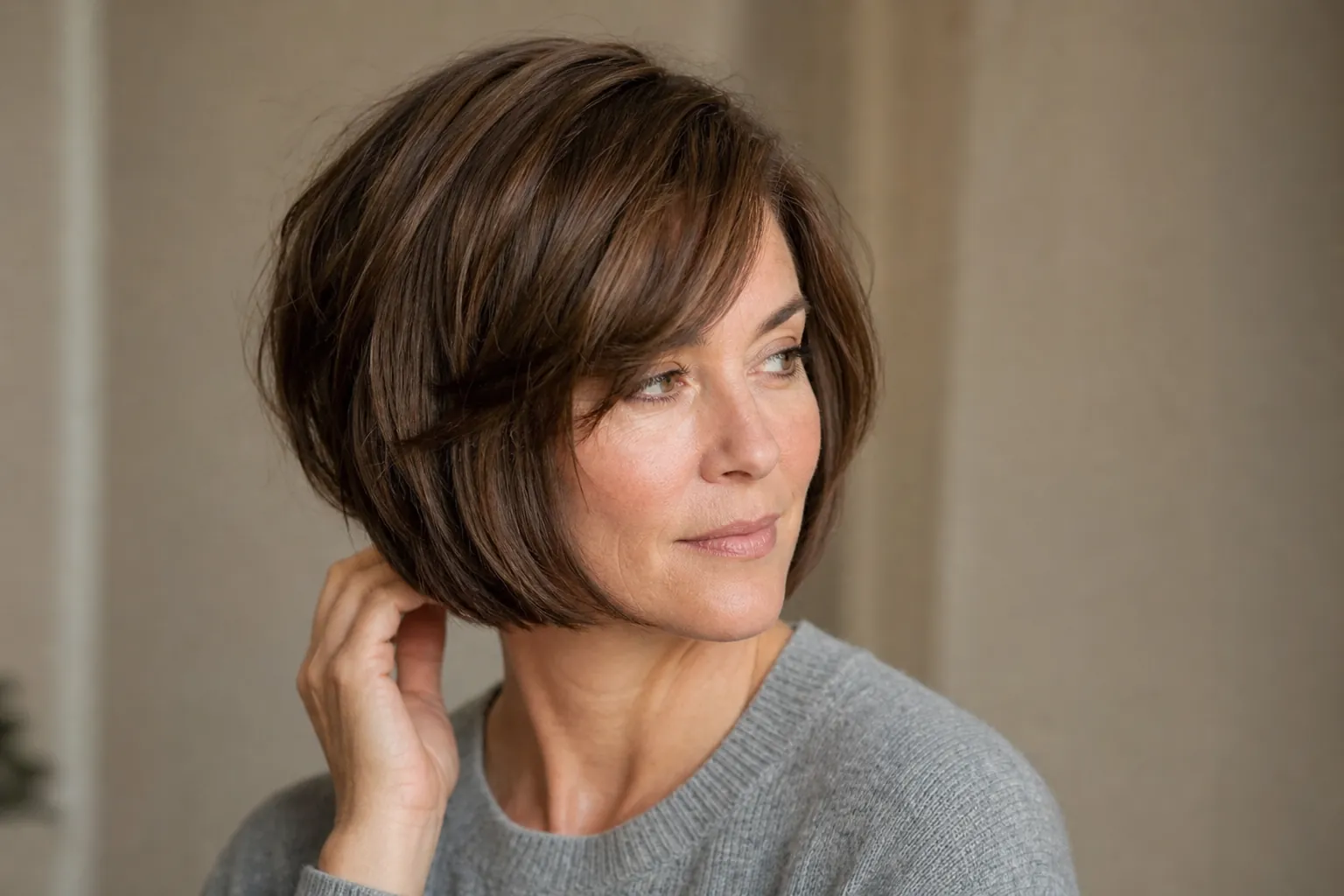

Short version: A wolf cut on short hair has short, lifted crown layers (about 2-4 inches), sides blended into face-framing pieces and a back left longer than the layers above it, at pixie, bob or collarbone length. It sits between a shag and a mullet, and it suits wavy and thick hair most easily, with adjusted versions for fine, curly and coily hair. Plan on a trim every 6-8 weeks and 5-10 minutes of styling most mornings.
What Makes a Short Wolf Cut Different from a Shag or a Mullet
A short wolf cut is defined by three measurements: how short the crown layers are, how long the back is left, and the visible step between the two. A short shag blends its layers so no step shows, and a mullet makes the step large and the sides close. The wolf cut keeps the step but softens it, with the sides cut into face-framing layers that bridge the crown and the back.
Stylists draw these lines in slightly different places, so the table gives working ranges. Treat them as a starting point for a consultation, not a rule.
| Cut | Where the weight sits | Step from crown to longest length | Back and nape | Sides |
|---|---|---|---|---|
| Short shag | Spread through connected layers | None visible | Follows the layers | Layered into the top |
| Short wolf cut | Crown | Visible: about 1.5-3 in at pixie length, more at longer lengths | Longer than the crown, wispy or softly layered | Blended face-framing layers |
| Mullet | Back | Large and abrupt | The longest part of the cut, often blunt | Short and close, often over the ears |
| Mixie | Top | Small, at the nape only | Pixie with the nape left longest | Short and tapered |
| Shaggy bob | Layers inside a bob outline | None; the outline stays level | Same length as the sides | Layered, hem even |
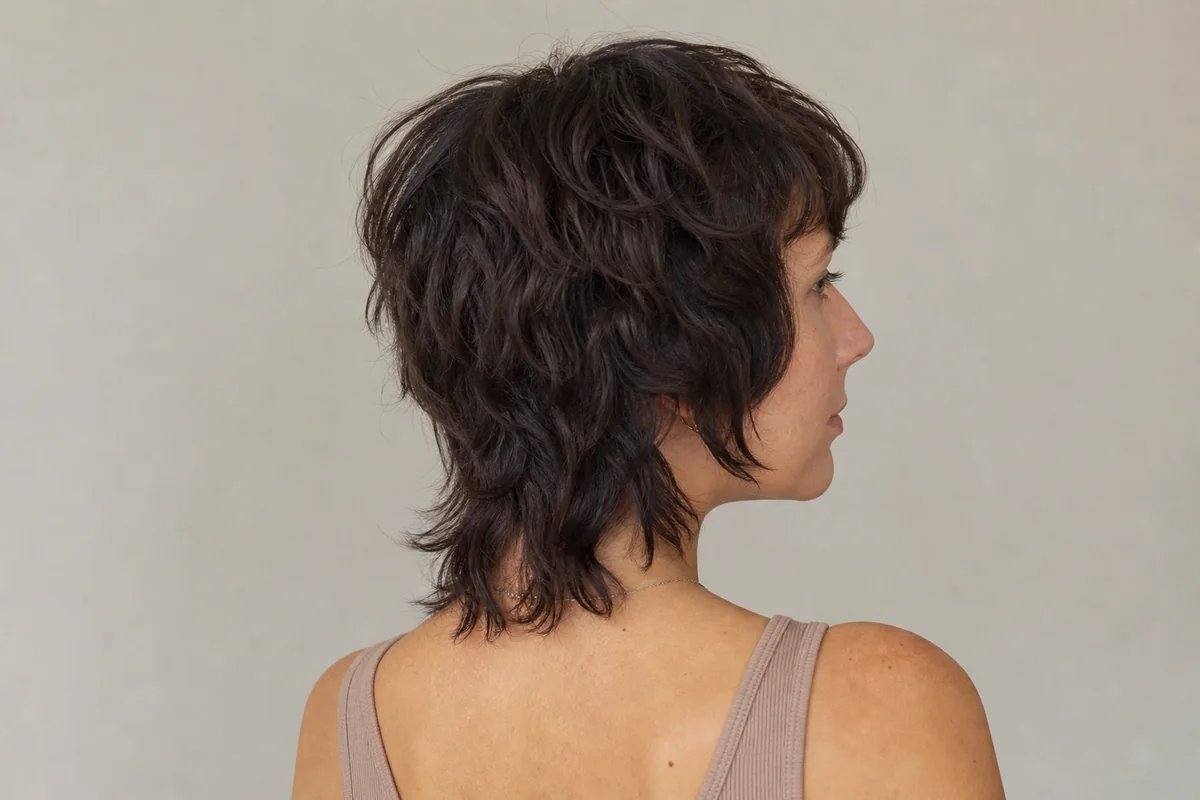
Salon note: The step is the part to discuss. A step of an inch or two reads as texture; past about three inches at pixie length it reads as a mullet. Ask the stylist to show on the hair where the shortest crown layer ends, where the back begins and whether the sides will connect the two.
Short Wolf Cut Lengths: Pixie, Bob and Collarbone
The wolf cut changes character with length, because the same crown-over-back shape needs different amounts of hair to work. At pixie length the crown and the back are only inches apart, so the cut leans on texture. At chin and collarbone length there is room for a longer back and visible face-framing layers.
| Length band | Crown layers | Back left | Sides | Trim every | Best on |
|---|---|---|---|---|---|
| Pixie-length wolf | 2-3 in | 2.5-4 in, to the neck or collar line | Tapered, ears partly out | 5-6 weeks | Wavy, thick; fine with a small step |
| Ear to chin wolf | 3-4 in | A few inches longer than a bob back would be | Earlobe to chin, layered | 6-8 weeks | Wavy, curly, thick straight |
| Collarbone wolf | 4-5 in | Collarbone | Face-framing from the cheekbone down | 8-10 weeks | Wavy, curly, thick; fine only with crown-only layers |
Wolf Pixies with a Tall Crown and a Short Tail
A wolf pixie keeps the top and sides short and lets only the back run longer, so it is the most compact version of the cut. It needs a stylist who will cut the crown with scissors in small steps. The nape finish matters more here than at any other wolf length, because the back is the part that reads first. For the choppy tops these pixies share with other cuts, the shaggy pixie guide covers the layering.
1. Tall-Crown Wolf Pixie with a Short Tail on 2B Wavy Hair

- Length
- 2.5 in crown, 3 in tail, sides tapered
- Texture
- Wavy 2B-2C
- Density
- Medium
- Face shapes
- Oval, heart, square
- Daily effort
- 5-8 minutes
- Trim every
- 5-6 weeks
Waves stack when the crown is cut short, which gives this cut its height without any teasing. The tail only needs to reach the top of a collar, and the sides are tapered so the step shows against a clean outline.
Ask for: "Crown layers about 2.5 inches, point cut, sides tapered over the ears, and the back left about 3 inches with a visible step."
2. Soft Wolf Pixie with a Blunt Tail on Fine Straight Hair

- Length
- 2 in crown, 2.5 in tail, blunt back edge
- Texture
- Straight
- Density
- Fine strands, medium to low density
- Face shapes
- Round, oval, heart
- Daily effort
- 5 minutes
- Trim every
- 5 weeks
On fine straight hair the step is kept to half an inch, because a large step leaves the tail sparse. The solid edge at the back does the work that layers would do on thicker hair, and the crown height comes from root lift rather than shorter layers.
Ask for: "A wolf pixie with a small step, layers on the surface only, a blunt edge at the back and no thinning shears."
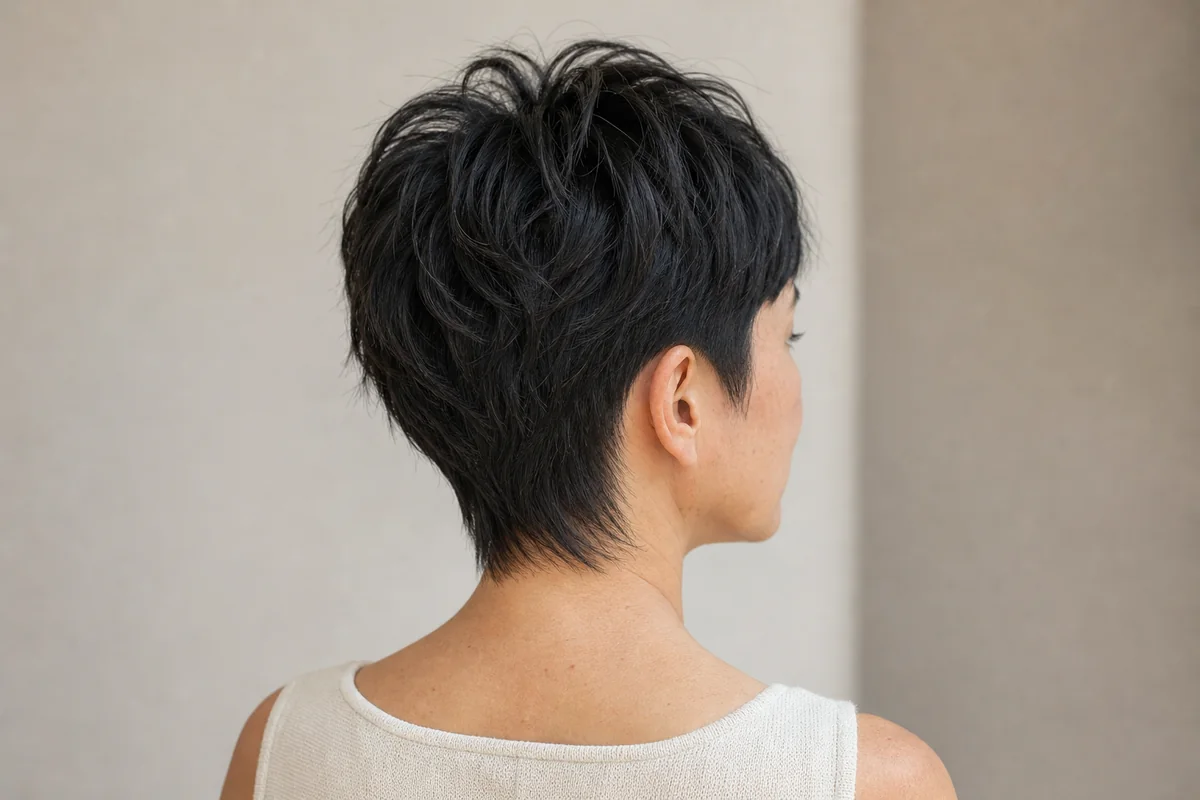
3. Wolf Pixie with Interior Weight Removed on Thick Straight Hair
- Length
- 3 in crown, 3.5 in tail, sides tapered close
- Texture
- Straight
- Density
- Thick
- Face shapes
- Oval, long, square
- Daily effort
- 5-7 minutes
- Trim every
- 5 weeks
Thick straight hair is where short wolf cuts most often puff at the sides and stick out at the tail. Weight is taken from the inside by slide cutting, so the outer layers lie close to the head and the tail sits flat.
Ask for: "Remove weight from the inside with slide cutting, keep the sides tapered close and leave the tail 3.5 inches so it lies flat."
4. Curly Wolf Pixie with a Rounded Crown on 3B Curls

- Length
- About 3 in crown dry (4-5 in stretched), 2.5 in tail
- Texture
- Curly 3B-3C
- Density
- Medium to thick
- Face shapes
- Oval, long, heart
- Daily effort
- 5 minutes, wash-and-go
- Trim every
- 6 weeks
The curls do the layering, so the stylist shapes the outline curl by curl on dry hair and leaves the crown longer than the target to allow for shrinkage. The tail is simply the curls at the back left alone.
Ask for: "Cut it dry, curl by curl. A rounded crown that dries around 3 inches, tight sides and the back left to the top of my collar."
Ear-Length and Chin-Length Wolf Cuts
Between the ear and the chin, the wolf cut has enough hair for visible face-framing layers while keeping the crown short. It is the length at which most people first try the cut, and the one where the step is easiest to adjust at later trims. The shortest layers stay in the crown, and the perimeter is not stacked the way a classic graduated bob is.
5. Pixie-to-Wolf Grow-Out Cut at Ear Length on 2B Hair

- Length
- 3.5 in crown, sides at the earlobe, 4 in back
- Texture
- Straight to wavy
- Density
- Medium
- Face shapes
- Oval, heart, diamond
- Daily effort
- 5-8 minutes
- Trim every
- 6-8 weeks
Growing a pixie out often passes through this shape, and the wolf cut turns the awkward stage into a plan. The stylist keeps the crown short, lets the sides and back grow and trims only to keep the step clean. The route is close to the one a bixie takes before it becomes a bob.
Ask for: "Keep the crown short and let the sides and back grow. Trim to shape the step and remove bulk behind the ears, not length."
6. Chin-Length Wolf Cut with Choppy Crown Layers on Wavy Hair

- Length
- 3.5 in crown, sides at the chin, back a little longer
- Texture
- Wavy 2B-2C
- Density
- Medium to thick
- Face shapes
- Heart, oval, square
- Daily effort
- 5-8 minutes
- Trim every
- 6-8 weeks
Sides that end at the chin add width at the jaw, which balances a narrow chin on a heart-shaped face. A square jaw reads softer when the face-framing layers cross it at an angle instead of ending level with it.
Ask for: "Choppy crown layers around 3.5 inches, sides layered to end at my chin and the back a little longer than the sides."
7. Razored Jaw-Length Wolf Cut on Thick Straight Hair

- Length
- 3 in crown, jaw-length sides, back 1 in longer
- Texture
- Straight
- Density
- Thick
- Face shapes
- Oval, long, heart
- Daily effort
- 5-10 minutes
- Trim every
- 6 weeks
A razor tapers each strand to a point, which lightens thick straight hair and gives the feathered edge that scissors leave blunter. It works on damp hair with a new blade, because a dull one drags and frays the ends.
Ask for: "Razor the ends on damp hair with a fresh blade, crown layers about 3 inches, jaw-length sides and the back an inch longer."
8. Chin-Length Wolf Cut with Long Wispy Bangs on Medium Straight Hair

- Length
- Bangs to the cheekbone, 3.5 in crown, sides at the chin
- Texture
- Straight
- Density
- Medium
- Face shapes
- Oval, heart, long
- Daily effort
- 6-8 minutes
- Trim every
- Bangs 3-5 weeks, cut 6-8
The fringe is cut as the first layer of the cut, so it blends into the crown instead of sitting on top of it. Wispy bangs on straight hair need a trim long before the rest of the cut does, and a cowlick at the front hairline will lift them.
Ask for: "Long wispy bangs ending at my cheekbone, blended into the crown layers, with the sides layered to the chin."
9. Silver Wolf Bob with Point-Cut Texture on Coarse Gray Hair

- Length
- 3.5 in crown, chin-length sides
- Texture
- Straight to wavy, coarse
- Density
- Medium
- Face shapes
- Oval, square, round
- Daily effort
- 5-8 minutes
- Trim every
- 6-8 weeks
Gray hair can feel wirier and look drier, and a coarse strand holds a layered edge well when it is point cut instead of razored. A little cream on the ends keeps the texture from reading as frizz, and a violet toning shampoo keeps silver from yellowing.
Ask for: "Point cut the layers, no razor on dry hair, crown about 3.5 inches and the back a little longer than the sides."
10. Curly Wolf Bob with Stepped Crown Layers on 3A-3B Curls

- Length
- 4 in crown dry, chin-length sides dry
- Texture
- Curly 3A-3B
- Density
- Medium to thick
- Face shapes
- Oval, long, square
- Daily effort
- 5-8 minutes with a diffuser
- Trim every
- 8 weeks
Curly hair keeps a wolf cut's shape when the layers are stepped rather than razored, because each curl lifts the one above it. Width is the thing to watch: the hem should stay narrow enough that the crown does not turn the cut into a triangle.
Ask for: "Cut dry, stepped crown layers that finish around 4 inches, chin-length sides and no thinning shears."
11. Coily Wolf Shape with a Rounded Crown and Longer Back on 4B-4C Hair

- Length
- 3 in crown, sides tapered, back 2 in longer
- Texture
- Coily 4B-4C
- Density
- Medium to thick
- Face shapes
- Oval, round, heart
- Daily effort
- 3-5 minutes
- Trim every
- 6-8 weeks
On 4B-4C hair the wolf cut is a shaping decision, not a layering one: the crown is carved into a rounded dome, the sides are tapered and the back is left longer. A stylist who cuts coily hair dry will show the step before it is final.
Ask for: "Shape it dry. A rounded crown about 3 inches, tapered sides and the back left 2 inches longer, with no razor."
Collarbone Wolf Cuts
At the collarbone the wolf cut is a lob with a short crown, so the layers need to be placed with care. There is enough length for a visible back, and the crown layers start about 4-5 inches from the root. The usual landmark rules for a collarbone lob apply: the ends will sit on the shoulders at the sides. The short layered haircuts guide has the full layer-type vocabulary.
12. Collarbone Wolf Cut with Short Crown Layers on Wavy Hair

- Length
- 4 in crown layers, collarbone lengths
- Texture
- Wavy 2B-2C
- Density
- Medium
- Face shapes
- Oval, heart, square
- Daily effort
- 5-8 minutes
- Trim every
- 8-10 weeks
The top of the cut stays short enough to show off the waves, and the face-framing layers from the cheekbone add movement near the face. It is the easiest wolf cut to style, since the waves fill the space between crown and ends.
Ask for: "Crown layers about 4 inches, layers framing the face from the cheekbone, and the longest lengths to the collarbone."
13. Soft Collarbone Wolf with Crown-Only Layers on Fine Hair

- Length
- Layers in the top 4 in, blunt ends at the collarbone
- Texture
- Straight to slightly wavy
- Density
- Fine strands, medium density
- Face shapes
- Oval, round, heart
- Daily effort
- 8-10 minutes
- Trim every
- 8 weeks
Fine hair keeps volume at the crown and density at the ends, so the layers stop at the top and the hem stays blunt. If the ends still look thin at the collarbone, the better fix is a shorter length, not more layers.
Ask for: "Layers only through the crown, about 4 inches, with blunt ends and no thinning at the bottom."
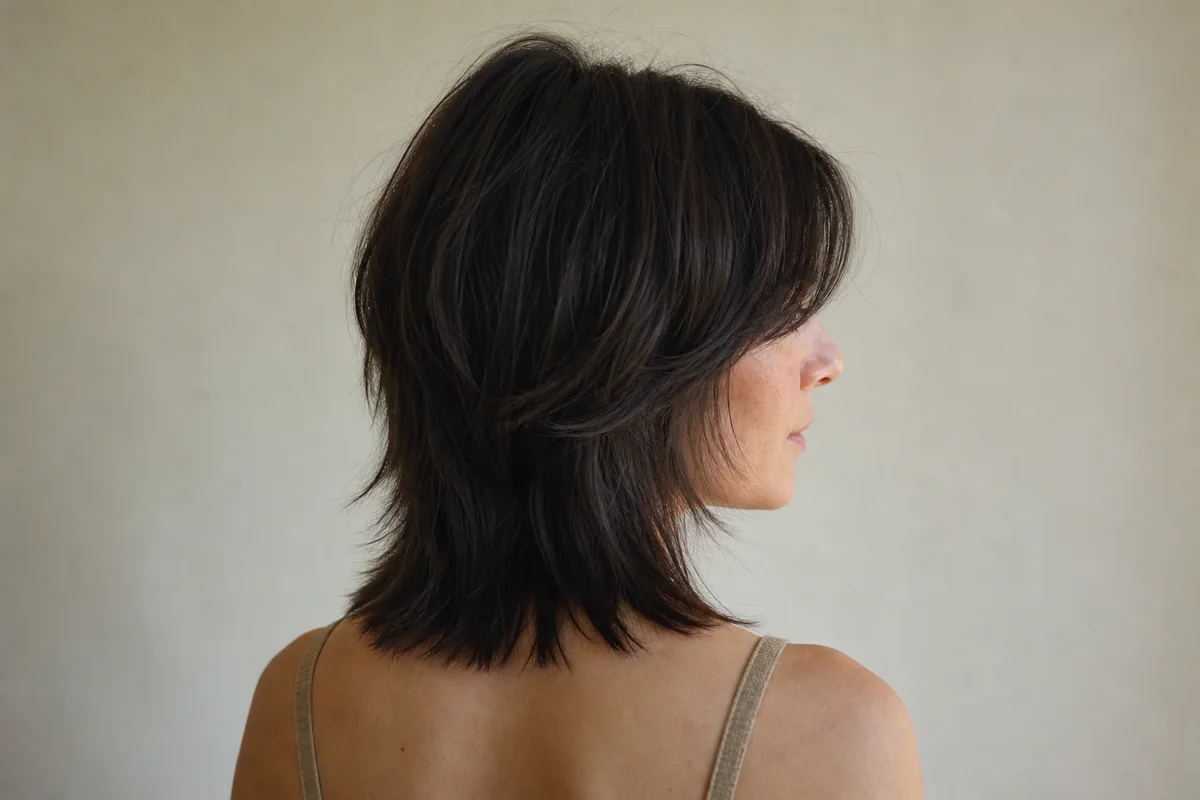
14. Two-Tier Collarbone Wolf on Thick Straight Hair
- Length
- 4.5 in upper tier, collarbone lower tier
- Texture
- Straight
- Density
- Thick
- Face shapes
- Long, oval, square
- Daily effort
- 8-10 minutes
- Trim every
- 8 weeks
Thick hair at this length can carry two tiers: a short upper tier at the crown and a lighter lower tier, with weight removed from the inside of both. The result moves where a one-length cut would hang flat.
Ask for: "Two tiers: crown layers about 4.5 inches and lengths to the collarbone, with weight removed from the inside of both."
15. Diffused Collarbone Wolf Cut on 3C Curls

- Length
- 5 in crown dry, curls near the collarbone dry
- Texture
- Curly 3B-3C
- Density
- Thick
- Face shapes
- Oval, long, heart
- Daily effort
- 10 minutes with a diffuser
- Trim every
- 8-10 weeks
Curls shrink as they dry, so the cut is planned for how they sit dry, not how long they hang wet. Defined curls need soaking-wet styling and a diffuser, and the crown layers stay rounded.
Ask for: "Cut dry, curl by curl, with rounded crown layers and the lengths to the collarbone after they dry."
How Each Texture and Density Wears a Short Wolf Cut
Texture decides the cutting method and density decides how short the crown can go. Wavy hair is the easiest match, since waves fill the step. Straight hair shows the step, so it needs a small one or interior weight removal, and curls need the layers cut dry. The short curly hair styling routine applies to every curly version here.
| Texture | Fine or low density | Thick | Cutting method | Crown height |
|---|---|---|---|---|
| Straight | Small step, surface layers, blunt edge | Interior weight removal; razor or slide cutting | Scissors, razor on damp hair | 2-3 in |
| Wavy (2A-2C) | Soft layers, no thinning shears | Choppy layers with weight removed | Point cutting | 2.5-4 in |
| Curly (3A-3C) | Longer crown, little layering | Stepped layers, narrow hem | Dry, curl by curl | 3-5 in dry |
| Coily (4A-4C) | Shaped dome, tapered sides | Shaped dome, longer back | Dry, shaped, no razor | About 3 in |
Tip: For fine or low-density hair, the question is how much the crown can afford to lose. A crown cut short with nothing underneath shows the scalp, so ask for the crown layers to be left longer. The short hairstyles for thin hair guide covers the options.
Razor Cut or Scissor Cut: Choosing a Technique
A razor makes a wolf cut wispier and scissors make it more controlled, and neither is right for every head. The choice depends mostly on texture and on how much fray the hair will forgive.
| Method | What it does | Best on | Avoid on |
|---|---|---|---|
| Point cutting | Cuts small notches into the ends for a soft, broken edge | Fine, wavy, curly, gray | Rarely a problem |
| Razor | Tapers ends to a feathered point | Thick straight, medium wavy hair cut damp | Fine hair, curls, coils, dry hair |
| Slide cutting | Removes weight from the inside by sliding the blades | Thick straight and wavy | Fine hair |
| Thinning shears | Removes a share of strands at each cut | Thick straight | Wavy, curly, coily, fine |
Salon note: A razor works on damp hair with a new blade. On dry hair, or with a dull blade, it drags and frays the ends, and on waves and curls the frayed ends read as frizz. If the stylist reaches for a razor, ask whether the hair is damp and the blade is new.
What to Ask for When You Book a Short Wolf Cut
The photo shows the look, but the words that decide it are the crown length, the back length and the step. Bring two photos if you can, and say what you do not want, since a wolf cut can drift toward a mullet. Bangs are optional; the short hair with bangs guide covers the types.
- The length band (pixie, ear to chin or collarbone) and where the sides end.
- The crown layers in inches, and whether they are cut with scissors, a razor or slide cutting.
- How long the back is left, and how big the visible step should be.
- Whether the sides connect crown and back, so the cut does not split into two.
- Your cowlick or crown whorl, and where the part falls.
- Your drying routine: air-dry, diffuser or blow-dry.
Salon note: A whorl at the crown decides where short layers stand up or split. Stylists usually check it dry before cutting and leave the crown longer over it, then shorten at the next trim if it lies flat.
Styling a Short Wolf Cut in 5-10 Minutes
A short wolf cut is styled to look roughed up, not smoothed down, and the product goes in while the hair is damp. The cut holds the shape; the products add grit and keep the crown from falling flat. Keep heat low on fine or gray hair, around 300-350°F.
- Prep damp hair. Towel dry gently, then work a dime-sized amount of cream or a golf-ball amount of mousse through, more on curls. Fine hair takes mousse and thick hair takes cream.
- Dry for lift. Blow-dry the crown upward with your fingers, or diffuse curls with the head tilted. Air-dry waves after scrunching.
- Separate the tail. Twist the back and ends with a pea-sized amount of paste.
- Finish the crown. Add 4-8 spritzes of texture spray at the roots and crumple.
- Refresh on day two. Dry shampoo at the crown, and a mist of water on curls.
Wolf Cut Face Shapes
A wolf cut keeps volume high and the ends narrow, which lengthens the face unless the layers are placed to balance it. Crown height and the face-framing layers are the two controls. The guide to short haircuts for women has the full face-shape rules.
| Face shape | Crown | Face-framing layers | Avoid |
|---|---|---|---|
| Round | Tall, adds length | Start at the chin or below | Layers ending at the cheekbone |
| Oval | Any height | Any | Nothing specific |
| Heart | Medium | Chin-length, adds width at the jaw | A very tall crown over a narrow back |
| Square | Medium to tall | Soft, crossing the jaw at an angle | Blunt layers ending at the jaw |
| Long | Low to medium | Fringe or layers at the cheekbone | A very tall crown |
Trims and Grow-Out for a Short Wolf Cut
A short wolf cut needs a trim every 6-8 weeks, because the crown layers lose their shape first. Hair grows about half an inch a month on average, and a study of 2,249 young adults found growth rates that differed by scalp area, sex and geographic origin, so the crown and the back will not grow in step. Bangs need a trim first, at 3-5 weeks.
| Time since the cut | What it looks like | What to do |
|---|---|---|
| 0-6 weeks | Step crisp, crown lifted | Style as usual |
| 6-10 weeks | Crown layers soften, back touches the collar | Trim to reshape the step |
| 3-4 months | Crown loses lift, step blurs | Ask for the layers to be connected |
| 5-6 months | Reads as a longer shag | Recut the step, or move on to a layered lob |
Three-inch crown layers need about six months at half an inch a month to catch up with the layers below. Growing a wolf cut out is easier than growing a pixie out, because trims only have to blend the layers.
When a Short Wolf Cut Is Not the Right Choice
- Fine, sparse hair with short crown layers. Short layers leave the back looking see-through. Choose a blunt bob, or ask for crown-only layers as in the shag section.
- A strong crown cowlick. Short crown layers split along the whorl. Leave the crown longer, or choose a longer cut.
- A thinning crown. Short layers show the scalp. See a board-certified dermatologist about new thinning, and ask for a cut with more length on top.
- No styling time. The shape falls flat without product and fingers. A one-length bob or a pixie holds up better with no routine.
- A preference for sleek hair. A wolf cut is meant to look undone. A blunt bob or a French bob is the sleeker option.
- Hair that frizzes when razored. Ask for point cutting, or choose a cut without a feathered edge.
A wolf cut for short hair works best when the crown, the back and the step are agreed in inches before the first cut. Book a consultation with two reference photos, pick one of the three lengths, and ask for the crown to be left a little longer the first time, since short layers cannot be put back.